A find in a colleague's collection
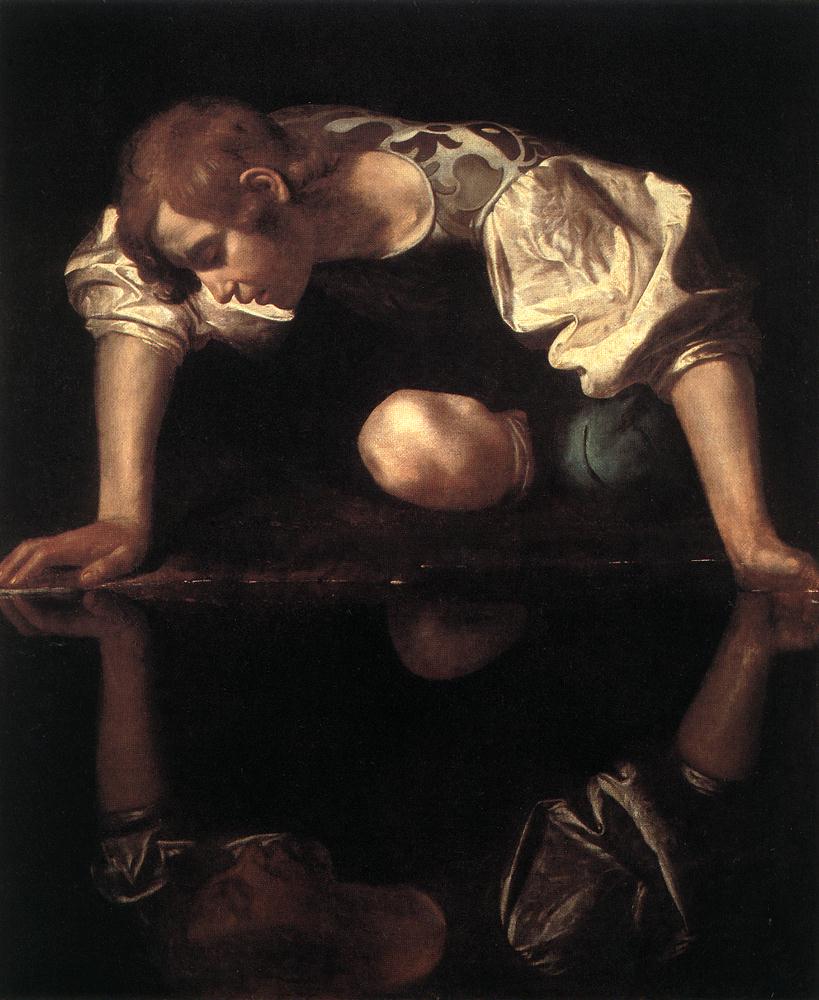
Roberto Longhi, the historian most responsible for pulling Caravaggio's reputation out of three centuries of neglect, first saw this painting in 1913, in Milan, in the private collection of a fellow scholar, Paolo D'Ancona. D'Ancona had inherited it from a Florentine banker great-uncle, Laudadio della Ripa, who is recorded as having bought a group of paintings from the Giordani, a noble family from Pesaro, sometime in the first half of the 19th century. Nothing in that chain of ownership mentions Caravaggio by name. Three years after seeing the canvas, in 1916, Longhi published an article titled Gentileschi padre e figlia and named it an autograph work by Michelangelo Merisi da Caravaggio anyway, later calling it one of the painter's most personal inventions.
The attribution held up reasonably well for most of the 20th century. Scholars including Baroni, Bernard Berenson, Bottari, Mia Cinotti, and, until 1989, Mina Gregori signed onto Longhi's reading at various points, alongside Maurizio Marini and Rossella Vodret, who went on to do the deepest archival digging in its defense. Basile Khwoschinski bought the painting soon after Longhi's discovery and, in 1916, the same year Longhi's article appeared, donated it to what is now the Galleria Nazionale d'Arte Antica at Palazzo Barberini in Rome, where it still hangs. That is a fast route from a private Milanese apartment to a national collection, and it happened almost entirely on the strength of one historian's eye. No contract, inventory entry, or contemporary letter naming a Caravaggio Narcissus survives from the 1590s, the decade most Caravaggio partisans place the painting in. Whatever case exists for his authorship has to be built after the fact, out of physical and circumstantial evidence, not paperwork from the artist's own lifetime.
An export license that almost, but doesn't quite, settle it
The best documentary lead anyone has produced dates from decades after the painting was supposedly made. Working in the 1970s through a 19th-century article by the historian Antonino Bertolotti, Marini found a reference to a 1645 license authorizing the export of several paintings from Rome to Savona, one of them described as a Narcissus by Caravaggio and matching the Barberini canvas in size. In 1989, Vodret went back to the State Archives in Rome and published the license in full. It names the shipper as Jo.Bap.Ta Valtabel, a name Marini later connected to Giovanni Battista Valdibella, from a Genoese merchant family.
It is a real document describing a real painting. What it is not is proof that the painting it names is the one hanging in Rome today. Nobody has closed that gap beyond matching size and subject, and both were common enough in a period when Narcissus was a popular theme and Caravaggio's name was already being attached, correctly or not, to a great deal of Roman painting. Vodret tried a second angle in the mid-1990s, proposing a possible ownership path running from Cardinal Francesco Maria del Monte, Caravaggio's early patron, through two brothers from the Giordani family of Pesaro who are documented as having ties to del Monte, and down eventually to della Ripa and D'Ancona. She called the theory suggestive, stopping short of calling it proven, and no will, inventory, or letter has surfaced in the thirty-plus years since to move it any further.
The case for a different painter
Giovanni Antonio Galli, nicknamed lo Spadarino, worked in Rome from around 1585 to sometime after 1651 and left almost no paper trail of his own. For decades the only painting anyone could document as securely his was Saints Valeria and Martial, still in the Chapter House of St. Peter's Basilica. Longhi himself rebuilt most of what is now Spadarino's catalog, in a 1943 essay that worked outward from that one documented canvas, in the process reclaiming two paintings he had previously assigned to Caravaggio directly and one he had given to Artemisia Gentileschi. None of that touched the Narcissus. At that point Longhi still believed it was Merisi's.
The Spadarino theory came later, from a different scholar. In 1973-74, Cesare Brandi, lecturing at the University of Rome, first proposed Galli as the Narcissus's real author. The idea sat mostly undeveloped until 1986, when Gianni Papi picked it up in an article on Spadarino's biography and catalog and then kept building the case for years afterward. Papi's strongest piece of evidence isn't a document at all. It's a side-by-side comparison to a painting called the Baptism of Constantine, in the civic museum of Colle Val d'Elsa, which Papi had already returned to Galli's catalog on the strength of an inventory of the painter's possessions taken at his death. Papi pointed out that a cleric watching Constantine kneel to receive the sacrament shares Narcissus's exact profile, with the two noses nearly interchangeable, matching skin tone, and the same soft rendering of auburn hair.
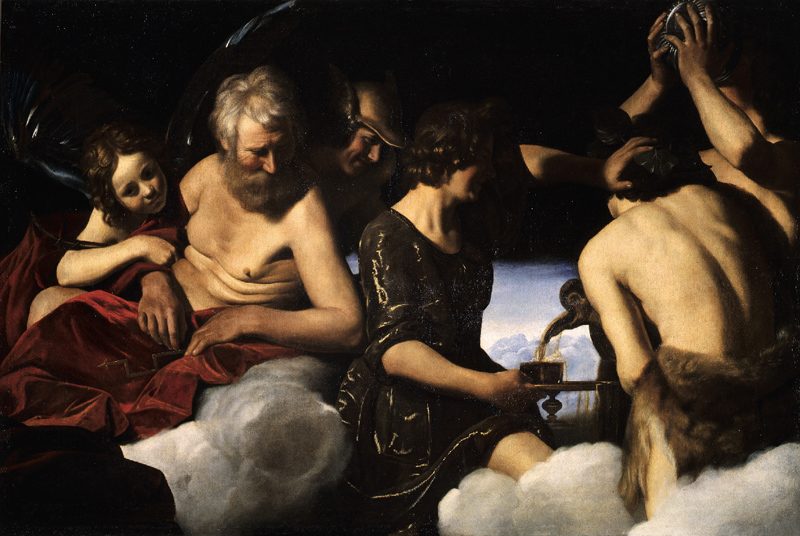
The comparison has a timing problem the theory has to work around. The Colle Val d'Elsa painting is generally dated to a little past the middle of the 17th century, decades after the roughly 1597-1599 window most Caravaggio partisans put on the Narcissus. To make the two line up, Papi proposed pushing the Narcissus forward to around 1645, the same year as Marini's export license, and reading that license differently: not as evidence the painting already existed, but as the moment Spadarino, cashing in on demand for anything carrying Caravaggio's name, finished a new canvas and passed it off as an old Merisi to the shipper Valdibella. Papi found a second comparison in an earlier Spadarino work, the Banquet of the Gods at the Uffizi, where the cupbearer Ganymede, flipped and rotated, lines up with Narcissus's head, shoulder, and arm almost exactly. Presenting the Barberini painting on a television program about Caravaggio, the art historian Tomaso Montanari called that particular comparison decisive.
What the 1995 X-rays actually found
Physical evidence has cut both ways, which is part of why the argument has run this long. The canvas had been damaged by an overly aggressive 19th-century cleaning and trimmed along all four edges, and a 1995 restoration ran X-rays across it looking for answers. It found no preliminary drawing under the paint, consistent with what technical analysis has repeatedly shown in Caravaggio's other pictures, that he worked directly in paint without sketching first. The scan also confirmed something noted before that restoration: a single line, incised into the wet ground with a brush handle or an awl, running along the outline of a sleeve in the reflected image, the kind of scored guideline Caravaggio is documented using in multiple other paintings to position figures before applying color. Radiography from the same session turned up pentimenti, changes the painter made mid-process, in the knee and the profile, both nudged upward from an earlier position, and in the hand reaching for the reflection, originally painted fully submerged before being pulled back above the waterline.
None of that persuaded everyone. Presenting his own analysis of the same paint layering in the catalog for a 1991-1992 Rome exhibition built on Longhi Foundation laboratory research into Caravaggio's technique, where the painting was displayed labeled as Spadarino's, the conservator Thomas Schneider concluded that achieving this particular construction would have needed Caravaggio's hand to show itself, in the technical sheet's own words, "with more vehemence and, despite his characteristic shifts and changes, with more clarity." Vodret pushed back directly, arguing that the Narcissus lacks the "compact and solid" consistency she associates with Spadarino's work and shows instead a "much different luminous and vibrant aspect," pointing to comparable drapery handling in Caravaggio's early Lombard-influenced pictures. Papi, for his part, has said the restoration and Vodret's reading of it don't change the terms of the attribution question either way. Federico Zeri added a further wrinkle, noting a close resemblance between Narcissus and a figure in Niccolo Tornioli's Astronomers, a wholly different painting dated to 1643-45, one more name added to the roster of possible authors, though this suggestion never gained the traction Papi's did. Bruegel's Icarus is another doubted attribution.
A painting with two open files
No consensus has formed on either side. Reproductions and general references still mostly list the painting as Caravaggio's, while a substantial roster of specialists, including Papi, Giovanni Previtali, Ferdinando Bologna, and, more recently, Tomaso Montanari, argue for Spadarino, and Gregori herself moved from the Caravaggio camp to the Spadarino camp at some point after 1989. What rarely comes up in either camp's argument is how much of Ovid's myth the composition itself strips away, no Echo, no nymphs, no landscape, just an adolescent in an elegant brocade doublet kneeling over the water, the whole tragedy compressed into one silent, symmetrical image arranged almost like a face-up and face-down playing card. Whoever built that composition made a real and specific choice about how much of the story to leave out, a choice this article has stuck to the painting itself to describe rather than the older myth behind it.
This site has run into a comparable identity problem inside a different Caravaggio picture before, over which figure at the table is actually meant to be Matthew in Caravaggio's Calling of Saint Matthew, a scholarly dispute about reading the composition, not about who painted it. Technology has settled more than argument here, too, elsewhere in this site's coverage: a 2022 Rijksmuseum scan using Macro-XRF and reflectance imaging found that Vermeer had painted over a wooden jug holder and a woven fire basket beneath the surface of The Milkmaid, the same kind of non-invasive, paint-layer-reading approach the 1995 Narcissus restoration used, just aimed at a different question. And the broader conservation-science toolkit behind both cases, X-ray methods that read what a painter did without removing a single paint sample, is the same one a 2010 fluorescence study used to measure the individual glaze layers inside Leonardo's sfumato, a reminder that a lot of what modern viewers know about how these paintings were physically made has come from instruments invented centuries after the paint dried.