One myth, two paintings that barely agree on what to show
In the story Ovid tells in the Metamorphoses, Icarus flies too close to the sun on wings his father Daedalus built from feathers and wax, and drowns when the wax melts. That single sentence is as much of the myth as this article needs. The two paintings that answer most "Icarus painting" searches focus less on the myth itself than on two artists, roughly 340 years apart, making almost opposite decisions about which second of the story deserves the canvas.
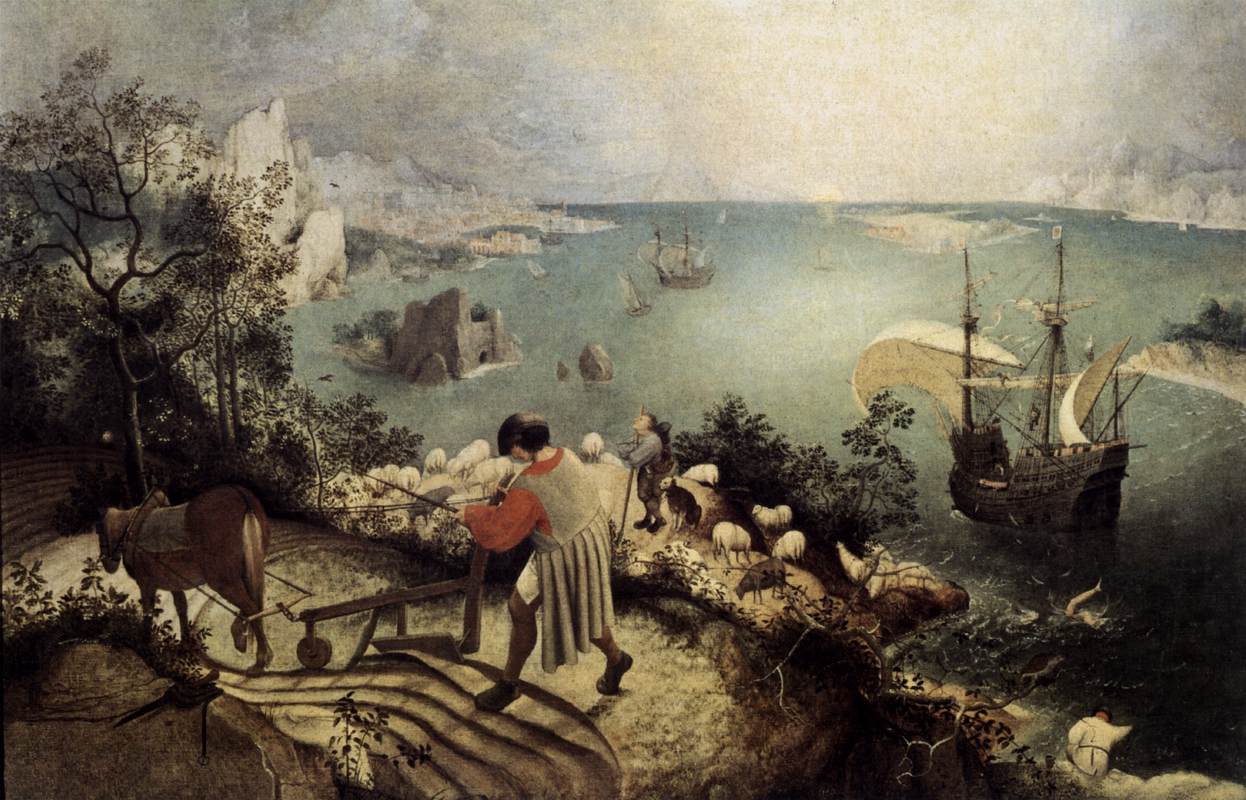
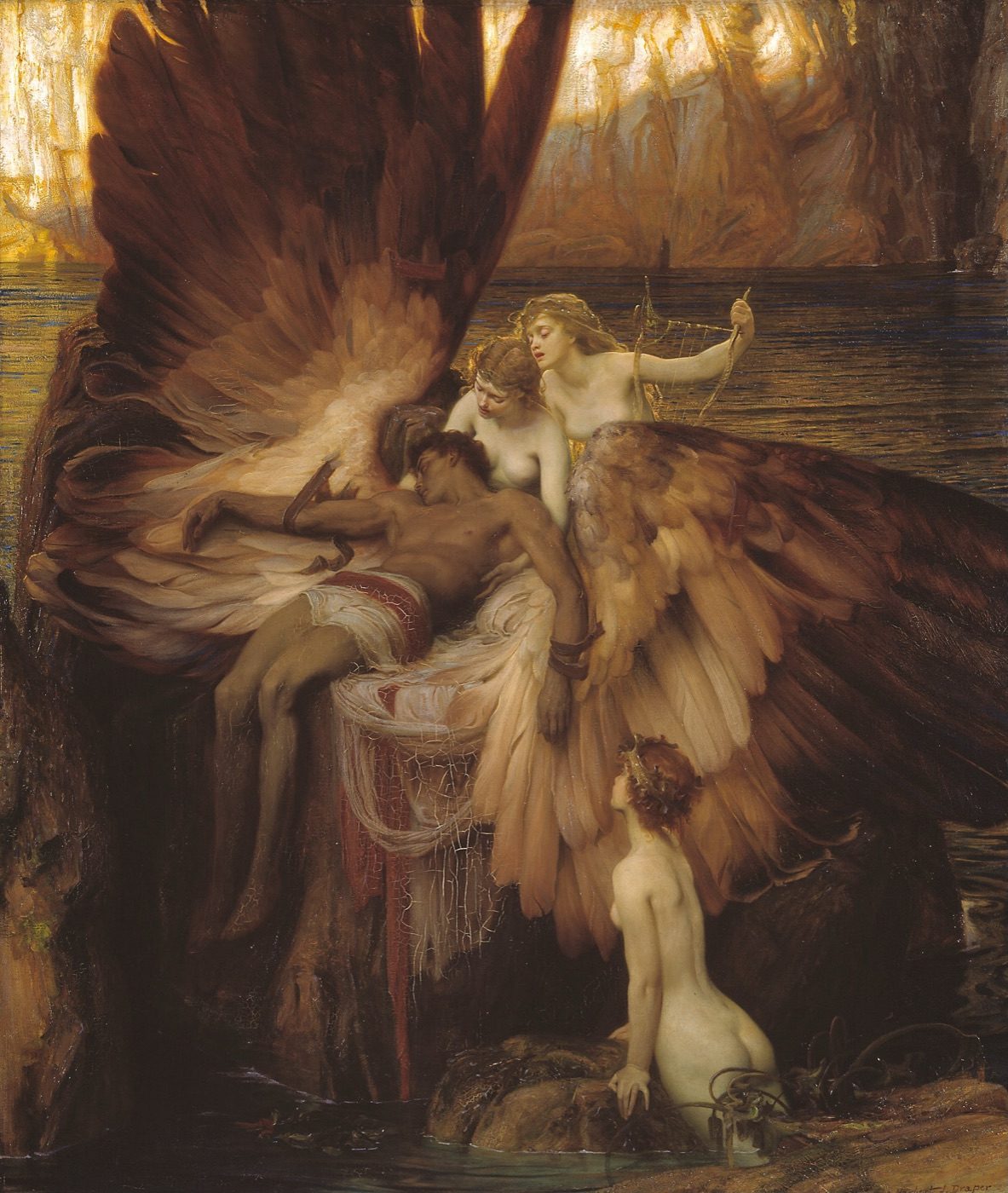
One painting hides Icarus almost entirely: a pair of legs kicking above the water in a corner of an otherwise ordinary countryside scene, easy to miss on a first look. The other painting shows nothing else: Icarus's dead body, life-size, cradled by mourning nymphs, filling the entire frame. There's no historically "accurate" version to prefer between them. Both are choices, made independently, and both turned out to matter far more than either painter could have predicted.
A Bruegel that might not be a Bruegel
Landscape with the Fall of Icarus is an oil-on-canvas painting, 73.5 by 112 centimetres, that entered the collection of the Royal Museums of Fine Arts of Belgium (RMFAB) in Brussels in 1912, bought on the art market. For decades it was catalogued as the work of Pieter Bruegel the Elder. It no longer is, at least not without a heavy qualifier.
A technical examination of the painting in 1996 cast serious doubt on that attribution. Since then, the museum's own position is that it is "doubtful the execution is by Bruegel the Elder, but the composition can be said with certainty to be his." In plain terms, the design is Bruegel's, most likely copied from a lost original he painted around 1558, while the physical object in Brussels is now generally treated as a good early copy by an unknown hand, made perhaps in the 1560s. In 2006, the chemist J. Reisse re-examined an earlier paint sample and argued the case for authenticity wasn't as closed as the 1996 consensus suggested, reopening a debate that technical analysis alone hasn't settled.
That debate is still active as of this writing. RMFAB published a notice on 9 April 2026 announcing new, non-invasive technical research on the painting, carried out with Belgium's Royal Institute for Cultural Heritage. The museum's own wording captures how unresolved the file still is: "Doubts have been expressed about its attribution, dating, painting technique and the extent of its restoration." The results are scheduled to be unveiled at a Pieter Bruegel the Elder exhibition the museum plans for autumn 2028, and the painting itself, out of its usual gallery for the study, is expected back at the museum around October 2026.
How a 1938 poem taught the world to read it
Most of what people now assume this painting is "about" comes less from the canvas itself than from a poem written more than 350 years after it was made. In December 1938, W. H. Auden was staying in Brussels with Christopher Isherwood and visited the RMFAB. The visit produced "Musée des Beaux Arts," which opens: "About suffering they were never wrong, / The Old Masters: how well they understood / Its human position." The poem's second half turns to the Icarus painting directly, describing how the ploughman, the ship, and the sun keep going about their business while, in the corner, "something amazing, a boy falling out of the sky," goes almost unnoticed.
Auden's reading, that the painting is fundamentally about how ordinary life continues indifferent to someone else's catastrophe, became so influential that it now shapes how most viewers approach the image before they've had a chance to look at it themselves. William Carlos Williams pushed the same idea further in his own poem, also titled "Landscape with the Fall of Icarus," first published in the Hudson Review in 1960 and later collected in Pictures from Brueghel and Other Poems (1962), the book for which Williams won a posthumous Pulitzer Prize. Williams's version is even more literal about the world's unconcern: spring is "awake," a farmer is ploughing, and Icarus drowns "unsignificantly" off the coast, the poem's last word. A popular explanation for a painting's most famous detail can turn out to be a later, discredited story rather than documented fact elsewhere too: the veiled faces in Magritte's The Lovers are usually traced to a riverbank scene from his childhood that biographers have since walked back as unreliable.
None of this is a criticism of either poet. What's actually documented and what's since been layered on top are two separate things. Whoever painted the Brussels canvas, Bruegel or the copyist working from his design, left no writing explaining what the scene meant to them. The "human indifference to suffering" interpretation is a twentieth-century literary lens, arriving nearly four centuries after the fact, not a caption the original composition came with.
Draper's answer: skip the irony, paint the corpse
Herbert James Draper made the opposite bet. The Lament for Icarus, oil on canvas, 183 by 156 centimetres, was exhibited at the Royal Academy in 1898 and shows the dead Icarus draped across the arms of sea-nymphs who mourn over him, his wings still attached to his shoulders. Where the Brussels painting buries its subject in the margins of an unrelated landscape, Draper's canvas has almost no landscape at all. Icarus and the nymphs are the entire composition, lit in the warm colours of a setting sun.
Draper wasn't the first English painter to take on Icarus. Frederic Leighton had painted Daedalus and Icarus around 1869, choosing an earlier moment in the story: Daedalus strapping the wings onto his son before the flight, not after it. Draper, working nearly three decades later, adopted Leighton's method: build the composition from separate posed figures instead of one grouped sitting. He named four professional models for the picture: Ethel Gurden, Ethel Warwick, Florence Bird, and Luigi di Luca. Millais famously painted Ophelia's landscape first, with no model at all, and only added Elizabeth Siddal to the canvas months later, a different version of the same underlying habit in Victorian studio painting: build the picture's pieces separately, then assemble them, instead of staging one live scene from start to finish.
The painting did well by any measure available to a Victorian artist. The Chantrey Bequest, a public fund set up by the sculptor Francis Leggatt Chantrey to buy modern British art, purchased it directly from the 1898 Royal Academy exhibition. Two years later, it was awarded the gold medal at the Exposition Universelle of 1900 in Paris. It now hangs at Tate.
One detail in the painting doesn't match the myth it illustrates. Icarus's wings are shown fully intact, still spread across his back, even though the entire point of the story is that the wax holding them together melted and the wings came apart in the air. Draper had a plausible reason to make that choice: a "winged creature" reads as more symbolic and elegant on canvas than a young man who fell to his death without any wings left at all. Draper chose the more legible image over the more literal one.
Two philosophies of tragedy, on the same wall of art history
Set side by side, the two paintings amount to two different arguments about how to paint a death. The Brussels canvas, whoever painted it, argues that catastrophe is small next to the ordinary world, so small that a farmer doesn't even look up. Draper's argues the opposite: that the moment deserves the whole canvas, framed like a Pietà, with nothing else competing for the viewer's eye. Both approaches found an afterlife their painters couldn't have arranged for themselves. One shaped two of the twentieth century's most anthologised poems and is now the subject of fresh laboratory work aimed at settling who actually painted it. The other won an international gold medal within two years and has hung in a major national collection ever since. For a third way of painting a fall, there is Cabanel's Fallen Angel.
The same pattern shows up across other paintings assembled from religious and literary texts, not from direct observation: artists working from a shared text or myth routinely make incompatible choices about which moment to freeze, and those choices, not just technical skill, are often what later audiences end up arguing about.