One sister, at least four documented artworks
Cristina Kahlo y Calderón was born on 7 June 1908 in Coyoacán, Mexico City, eleven months after her sister Frida, to the photographer Guillermo Kahlo and his wife Matilde Calderón. Most of what gets written about her stops at biography: the close bond with Frida, the failed marriage, the affair with Diego Rivera that nearly ended the sisters' relationship. What tends to get skipped is a shorter, more checkable list, the actual artworks in which Cristina appears, made by two of the twentieth century's most examined Mexican artists over roughly a decade.
By the time Frida and Rivera had returned to Mexico as established painters in the early 1930s, Cristina was sitting for both of them regularly. That work survives in at least two Frida paintings, one Frida self-portrait that uses her only as a symbol, and two separate Rivera murals in two different Mexico City buildings. Each one records a different stage of the sisters' relationship, and each has a documented location, date range, or provenance that a museum catalogue or a mural's own site history can confirm.
A 1928 portrait painted before Frida found her own style
Frida's Portrait of Cristina, My Sister dates to 1928, near the start of her career as a painter and roughly a year before she married Rivera. The painting's style leans closer to Rivera's own than to the sharper, more personal manner her later work is known for, a debt the twenty-one-year-old had not yet shaken; it was after this portrait, working through her own sister's face, that she began settling into that later style. The picture is one of the clearer data points for how Frida's style actually developed, closer to a documented before-and-after than the origin-story shorthand that usually stands in for it. Frida's fuller catalogue, and the fakes that keep testing how well-documented it really is, gets its own accounting elsewhere.
Cristina shows up in Frida's work again, if less directly, in My Wet-Nurse and I (Mi Nodriza y Yo), a 1937 painting, oil on metal, roughly 30 by 37 centimeters and now in the Dolores Olmedo collection in Mexico City, that does not depict Cristina at all but exists because of her. Frida's mother, Matilde, became pregnant with Cristina within a couple of months of Frida's own birth, the two sisters born eleven months apart, and had to hand her older daughter off to an indigenous wet-nurse rather than continue nursing her. The painting stages that substitution as a self-portrait with an infant's body and an adult's face, held to a wet-nurse whose own face is covered entirely by a pre-Columbian funerary mask, hiding whether she is tender toward the child or indifferent to her. Cristina is the reason the scene exists, present in the painting's premise while absent from its frame.
The affair, and the 1937 self-portrait that answered it
Cristina married a man named Antonio Pineda and had two children, Isolda and Antonio; her husband left soon after their son's birth. In that period, with Cristina back in the Kahlo household and modeling for both painters, she and Rivera began an affair. Frida and Cristina were estranged for a period afterward before Frida forgave her, an event her own paintings from the period do not narrate directly but do register symbolically.
The clearest of those responses is Memory, the Heart, a small 1937 self-portrait, oil on metal, measuring 40 by 28 centimeters and held today in the Michel Petitjean collection in Paris. Frida paints herself standing at a shoreline, one foot on sand and one in water, face blank and streaked with tears. A metal rod pierces an empty cavity in her chest, a small Cupid figure balanced at each end like a seesaw, while her actual heart, oversized and visibly wounded, lies on the ground beside her, bleeding into the sand and out into the sea. Two dresses hang nearby, a schoolgirl's uniform and her own Tehuana costume, each holding a single disembodied arm: one reaches toward Frida without touching her, the other holds her upright. The rod through her chest is usually read as a displaced penetration, in the phrase commonly used to describe it, a symbolic stand-in for the affair between her husband and her sister that the rest of the canvas mourns in blood and metal rather than in any literal scene of betrayal.
Frida returned to the same wound within the year, in A Few Small Nips, another 1935 painting in oil on metal, roughly 30 by 40 centimeters and held today in the Dolores Olmedo collection in Mexico City. Its surface subject is not autobiographical: it restages a newspaper account of a man who stabbed his girlfriend to death and told the court, in the line that became the painting's title, that he had only given her a few small nips. Frida painted the woman's body covered in wounds and the killer standing over her unbothered, then gouged the picture's own wooden frame and spattered it with real drops of red paint, so the violence appears to spill past the canvas into the room. The borrowed crime story works as another vehicle for the same betrayal Memory, the Heart addresses more directly, a way to paint a woman near-fatally wounded by a man close to her without naming either Rivera or her sister. Frida returned to her own body as evidence again six years later, in The Broken Column, a 1944 self-portrait usually read as a painting made in the aftermath of spinal surgery even though the documented medical record places it before the operation, not after.
Two Rivera murals, two different treatments of the same model
Rivera painted Cristina too, and called her one of his favorite subjects. She appears in his sprawling mural cycle The History of Mexico, painted across the stairwell of Mexico City's National Palace between 1929 and 1935. On the south wall's panel, completed in 1934-35 and known as Mexico Today and Tomorrow, Rivera shows Frida teaching a group of schoolchildren, part of the mural's tribute to the rural-education campaigns that followed the Mexican Revolution; Cristina appears in the same crowded panel, alongside imagery of Karl Marx, part of the same vision of a socialist future for the country. The south wall was finished the year after Nelson Rockefeller had a different Rivera mural chiseled off a wall in New York, a very different building and a very different outcome for the same muralist, still working through the same question of who gets to shape a country's future, with Cristina placed inside this one.
The other Rivera depiction is more direct and more contested. Rivera worked on the murals of Mexico City's Ministry of Health building on and off for more than two decades, from 1929 to 1953, and one panel from that long-running cycle, known as Figure of Knowledge, shows Cristina nude, holding a stylized flower shaped as a yonic symbol of femininity. Neither this nor a second nude depiction of Cristina in the same building was intended as erotic; both were commissioned as allegories of health and purity, the register the Ministry of Health project called for throughout. Whatever the intent, the choice to paint his mistress nude, in a government building, while married to her sister, is the kind of detail that turns up in nearly every account of the affair, whether the writer is discussing the mural or the marriage.
A camera runs in the family, one generation at a time
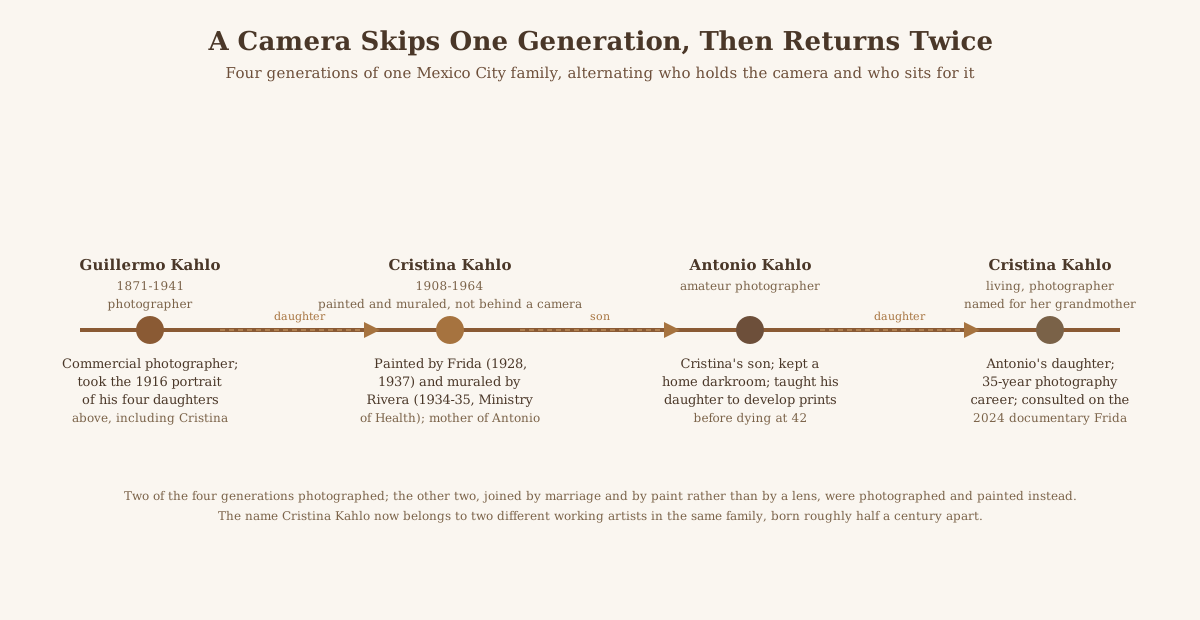
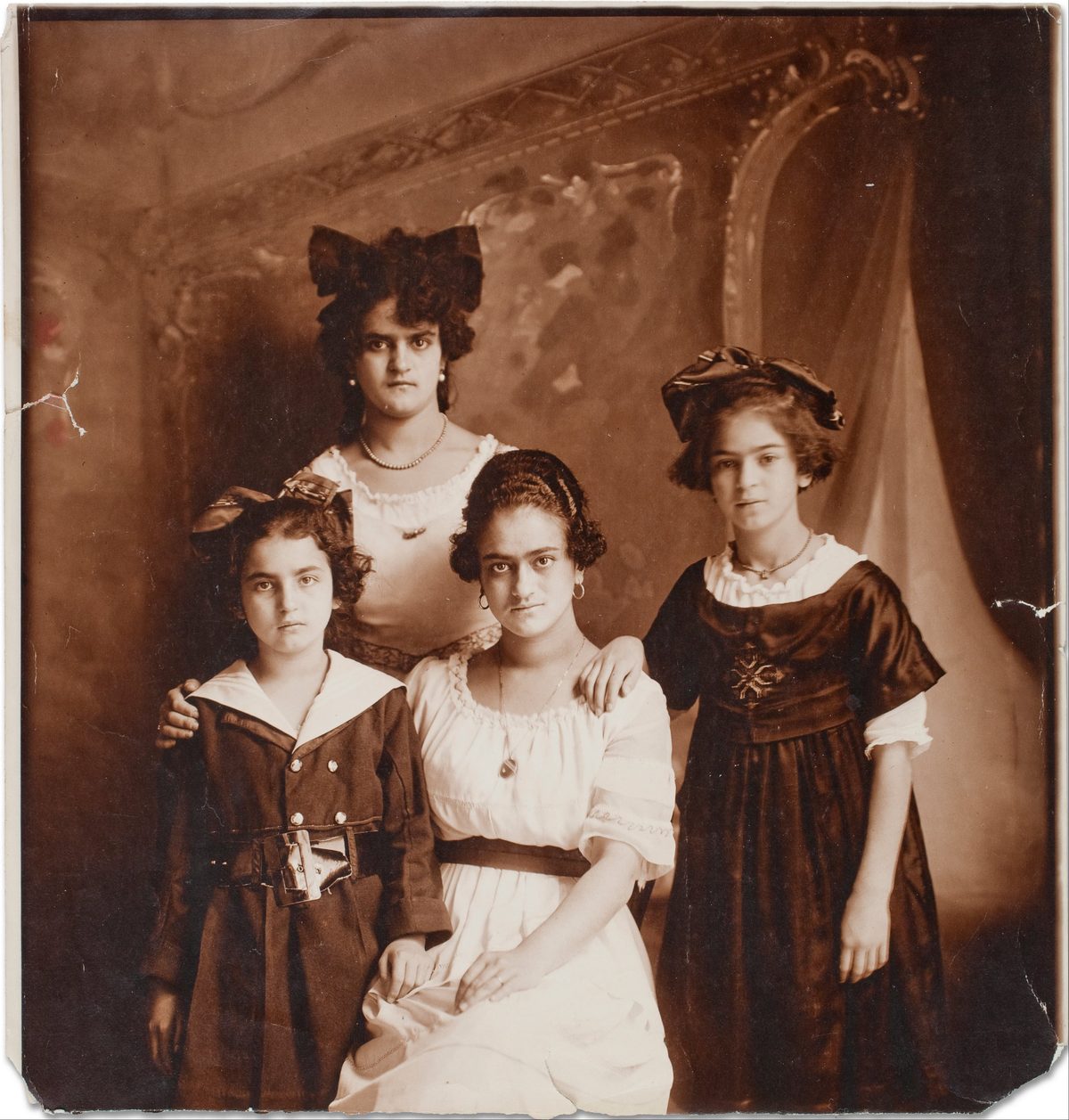
Frida's paintbrush was not the only image-making tool in this family. Guillermo Kahlo, Frida and Cristina's father, was not Mexican by birth: born Carl Wilhelm Kahlo in Pforzheim, in what is now Germany, he emigrated to Mexico in 1891 and took Mexican citizenship in 1894, then built a career as a commercial photographer, commissioned by the government to document the country's architecture and churches, work published under Mexico's Ministry of Education in 1923. By his era, photography had moved well past the daguerreotype's silver-plated-copper origins and into the studio-portrait and archival-documentation work that made up his living. The 1916 group portrait of his four daughters at the top of this article, Cristina among them as a child, is his.
Cristina herself never picked up the camera professionally, spending her documented life as a painter's and a muralist's subject rather than an image-maker in her own right. She was also, of the four Kahlo sisters Guillermo and Matilde raised, the only one who went on to have children, which is the specific reason the family's photographic line runs through her descendants rather than Frida's or either of their other two sisters'. Her son, Antonio Kahlo, took photography up as an amateur, with a darkroom at home; when his own daughter was about ten years old, he let her help him develop a print of a family picnic, and watching the image surface in the chemical bath is what she has said made her fall in love with the medium. Antonio died at 42, when that daughter, also named Cristina Kahlo after her grandmother, was 13. She built a 35-year career as a working photographer anyway, documenting Mexican cultural institutions and communities, and much of what she knows about her great-aunt Frida, she has said, came from research she did later in life rather than family stories. In 2024, she served as a consultant on Frida, a documentary directed by Carla Gutiérrez that premiered at Sundance on 18 January that year, produced by TIME Studios and Imagine Documentaries and distributed by Amazon MGM Studios; rather than an outside narrator, the film uses Frida's own writing, voiced by the actress Fernanda Echevarría, and went on to a place on the 2025 Oscars documentary shortlist. The name Cristina Kahlo now belongs to two different working artists in one family, born roughly half a century apart, on either side of the paintings and murals in between.