A painting mistaken for an aftermath
Search for The Broken Column and nearly every summary places it on the same side of a single event: Kahlo painted it, sites and gallery labels say, "shortly after spinal surgery." The claim is repeated widely enough that it functions as background fact rather than something anyone checks. It also runs in the wrong direction. Kahlo's documented medical history in 1944 involves no operation at all. According to her orthopedic history as reconstructed in the medical literature, her surgeon that year, Alejandro Zimbrón, responded to worsening back pain with a conservative plan: extended bed rest and a steel corset in place of the plaster ones she had worn before, not surgery. She would not go under the knife for her spine until 1946, when New York surgeon Philip Wilson performed a posterior fusion of four lumbar vertebrae, grafting bone from her pelvis and inserting a metal support rod, an operation later widely believed, including by people close to her, to have fused the wrong vertebrae.
That puts two full years between the painting and the surgery it is routinely said to follow. The Broken Column isn't a record of a failed fix; it's a portrait made in the middle of the wait, while a corset was standing in for a procedure that hadn't happened yet.
What the corset was actually for
The corset in the painting wasn't invented for the composition. Kahlo wore twenty-eight of them over her lifetime by her own later count: one steel, three leather, the rest plaster, worn against a body already compromised twice over. She contracted poliomyelitis at age six, which left one leg shorter and thinner than the other and produced a functional curve in her spine to compensate; a bus crash at eighteen, in 1925, added direct trauma to vertebrae already working under that imbalance. By 1944 the pain from that combination had become severe enough that Zimbrón's steel-corset order was, in her account, close to non-negotiable.
She wrote to Julien Levy, her New York dealer, that spring: "have to wear a damn corset (iron) and it has been hell for me, it is so hard to work." It's a rare instance of Kahlo describing the physical mechanics of pain in something other than paint, and it dates from the same window in which The Broken Column was made. The corset she's shown wearing in the finished painting was the exact device she had just complained about to Levy, not an invented prop.
An Ionic column instead of a spine
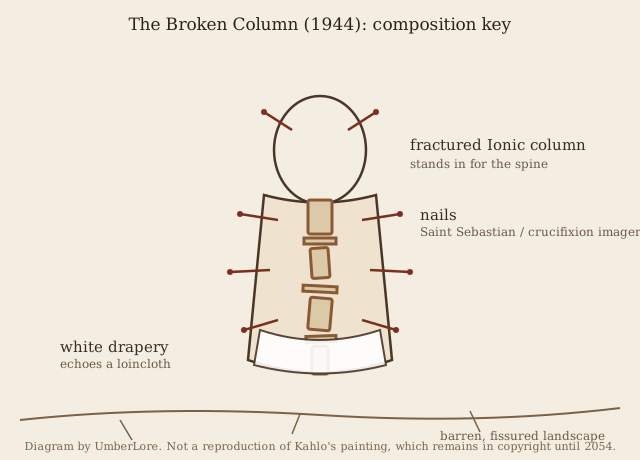
The painting's central substitution is architectural. Where a spine would run, Kahlo painted a cracked Ionic column, the fluted, classically load-bearing form borrowed from Greek and Roman temple architecture, shown split into unaligned segments and barely holding the torso upright. Using a form built to signal structural permanence to represent the opposite, a body that cannot support its own weight, is the painting's single most-cited formal choice, and it works precisely because viewers already know what a column is supposed to do.
The rest of the imagery reads as religious rather than architectural. Nails driven into her face, neck, arms, torso, and legs, along with a white cloth draped at her hips, echo two familiar Christian references at once: the martyrdom of Saint Sebastian, traditionally shown pierced by arrows, and the crucifixion, evoked by the loincloth-like drapery. Unlike either source image, Kahlo's version stages no rescue and no external figure administering the suffering; she is both the pierced body and, meeting the viewer's eyes directly, the only witness to it. The setting reinforces the isolation: a barren, fissured landscape with no horizon feature to anchor it, a backdrop she used in other self-portraits from the same period.
The bookend portrait, seven years later
The corset-and-column composition wasn't Kahlo's only attempt to paint her way through a failed medical fix. By 1950, Wilson's 1946 fusion had not resolved her pain, and a different surgeon, Juan Farill, operated on her spine seven times that year at Mexico City's English Hospital; she spent nine months recovering. The painting that followed, Self-Portrait with the Portrait of Doctor Farill (1951), her last signed self-portrait, shows her seated in a wheelchair, facing the viewer, holding a heart-shaped palette with veins painted across its surface, brushes gripped in one hand, an easel beside her carrying an unfinished portrait of Farill himself.
Set next to The Broken Column, the later painting reads less like a change of subject than a change of posture. The 1944 canvas depicts a body propped upright by an external brace and pierced by external force; the 1951 one depicts a body that has stopped standing altogether, seated permanently, its suffering now folded into an act of gratitude toward the doctor rather than staged as isolated endurance. Both paintings share the label "self-portrait with a corrective apparatus," but the seven years and seven operations between them changed what that apparatus was doing in the composition, propping her up in one case, wheeling her through the rest of her life in the other.
Not a Surrealist painting, despite the resemblance
André Breton, who encountered Kahlo's work in Mexico in 1938 and championed it in Paris and New York afterward, called her a natural Surrealist without her asking for the label. Kahlo rejected it in blunt terms: "They thought I was a Surrealist, but I wasn't. I never painted dreams. I painted my own reality." The distinction matters for a painting like this one specifically, because The Broken Column has the formal vocabulary Surrealism trained audiences to recognize, dislocated anatomy, an empty dream-like landscape, symbolic substitution, without the movement's underlying premise. Breton's 1924 manifesto described Surrealism as fusing dream and waking life into a single "surreality." Kahlo's column wasn't standing in for her spine in a dream; medically, by 1944, it was closer to a literal description of what an unsupported spine could no longer do. Diego Rivera, her husband, ran into a comparable gap between what an image looked like and what its maker meant by it, though over political rather than clinical content, when a mural he insisted was accurately titled got chiseled off a wall in New York anyway. Rivera also painted Kahlo's sister Cristina.
How a pain-medicine journal reads the same canvas
Most writing on The Broken Column comes from art historians working through iconography and biography. A 2017 paper in Physical Therapy, the journal of the American Physical Therapy Association, approaches it from the other direction. Physical therapists Carol Courtney, Michael O'Hearn, and Carla Franck analyzed Kahlo's medical history and self-portraits, this painting among them, against the modern clinical understanding of chronic neuropathic pain and central sensitization, the process by which a nervous system that has processed pain signals for long enough starts amplifying and misreading them independent of new injury. Their argument turns on the specific way she depicted pain, spread across the whole body rather than localized to the spine, and constant rather than tied to a single wound, a pattern that matches what clinicians now associate with a sensitized nervous system rather than straightforward tissue damage.
That reading doesn't overturn the standard art-historical account so much as sit alongside it as an independent form of evidence. A journal built for physical therapists has no stake in Kahlo's place in art history and cites her paintings only insofar as they document a clinical picture, which is a different kind of scrutiny than the painting usually receives.
Where it lives now
The original, oil on masonite and small at 39.8 by 30.6 centimeters, is held by the Museo Dolores Olmedo in Xochimilco, on Mexico City's southern edge, one of 25 Kahlo paintings in a collection built primarily around the 145 works by Diego Rivera that its founder, collector Dolores Olmedo, spent decades acquiring. Olmedo's route to owning so much Kahlo is itself a documented irony: biographers describe her relationship with Kahlo while both were alive as openly conflictual, and Olmedo built her Kahlo holdings mainly after the painter's 1954 death, largely as an extension of her far closer, decades-long friendship with Rivera rather than out of any affinity for Kahlo's own work. The museum that today houses the single most reproduced image of Kahlo's private suffering was assembled, in significant part, by someone who wasn't especially moved by it while she had the chance to be. Rivera is one of the famous Mexican artists profiled on this site.