The pond was built before the paintings were
Giverny had no water garden when Monet arrived in 1883. He rented the house, bought it in 1890, and in February 1893 acquired a separate plot at the south end of the property, across a road and a set of railway tracks. A small stream ran through it, the Ru, a branch of the Epte. Monet applied to the prefect of the Eure for permission to draw water off for a pond and to build two bridges.
The application met resistance. Neighbouring farmers objected, on the grounds that his imported plants would foul water their animals drank. The Art Institute of Chicago's scholarly catalogue of its Monet holdings records his argument to the prefect: a water garden would be “agreeable and for the pleasure of the eyes”. He offered a second reason as well, that he intended to mine the setting for subject matter. The permits came through in July, and within a few months a pond of about a thousand square metres and a Japanese-style wooden bridge were finished. By May 1901 he had bought more land in order to enlarge it.
MoMA, in its own publication on the Water Lilies, puts the consequence plainly. The garden may signify nature, but “it was not a purely natural site”. Monet spent heavily on the pond for the rest of his life and eventually kept six gardeners on it.
The order of events matters for reading the series. Monet did not find this motif and return to it. He commissioned it, then painted the thing he had commissioned. The first canvases of the bridge date from 1895, two years after the water went in, and the Art Institute counts at least eight treatments of the water lily itself in 1897 and 1898.
Two kinds of picture, and the point where they diverge
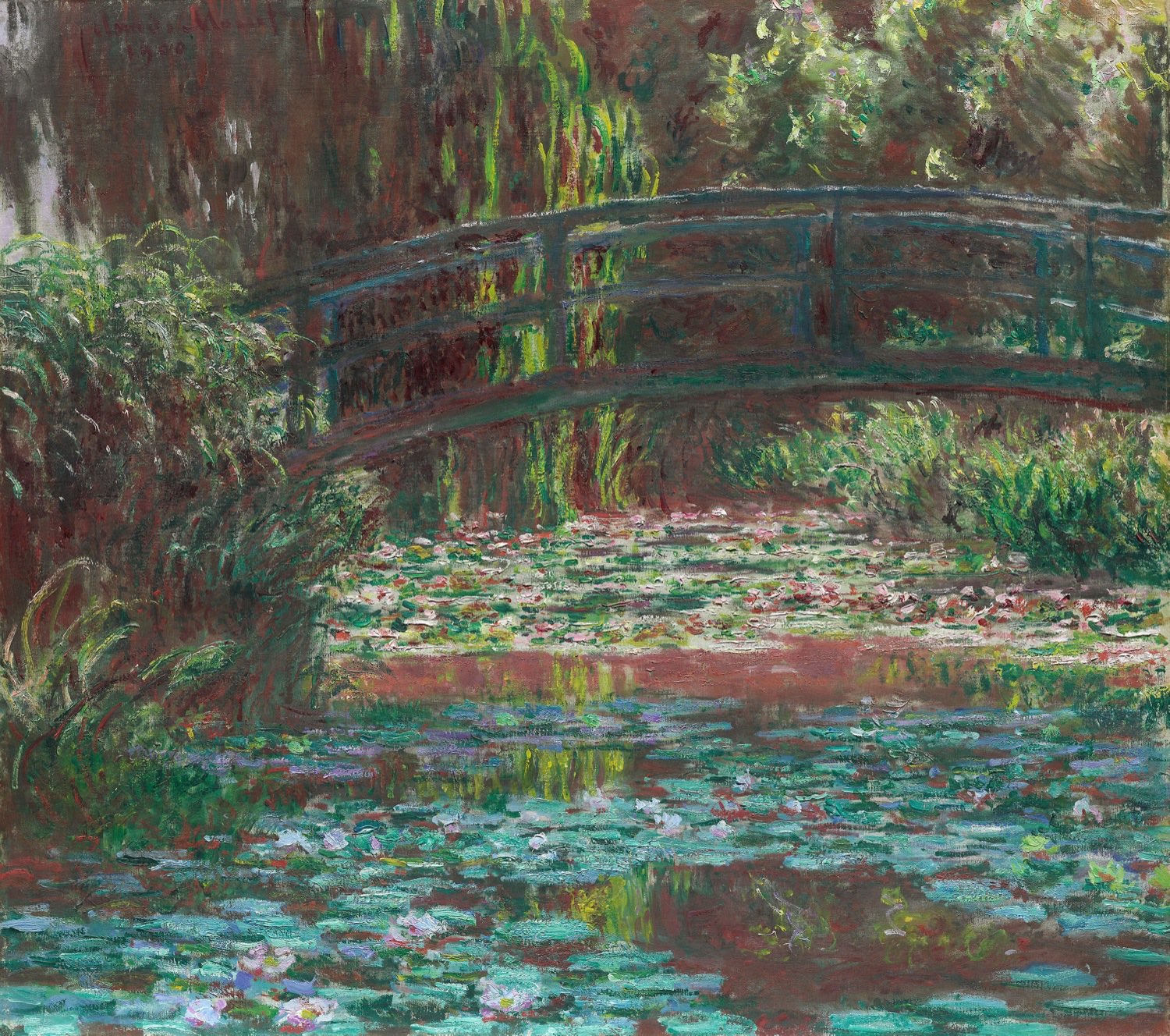
The Orangerie describes two composition types that Monet fixed early in the cycle. The first takes in the bank of the pond with the dense planting around it, which covers the Bassins aux nymphéas of 1899 to 1900 and the Japanese bridge canvases. The second drops the bank and keeps only the sheet of water, its flowers and its reflections, which covers the Paysages d'eau of 1903 to 1908.
The numbers behind the first type are unusually firm. Across the summers of 1899 and 1900 Monet produced eighteen paintings of the bridge and pond, twelve in the first year and six in the second. When Durand-Ruel showed his recent work in late 1900, twelve of the twenty-six pictures on the walls were water lilies. Reviewers were divided; some praised the light, others complained that the vantage point barely changed from canvas to canvas.
From 1903 Monet began stripping out the conventional furniture of landscape painting, the horizon line, the sky and the ground, and worked directly on the water's surface. In May 1909 Durand-Ruel hung forty-eight of the resulting canvases under the title Les Nymphéas, série de paysages d'eau. The show sold well, and it marks the point where a set of pictures turns into a plan for a building.
That plan predates the exhibition by a decade. In 1898 the journalist Maurice Guillemot reported that Monet had in mind a circular room whose walls, above the baseboard, would be covered with paintings of water “dotted with these plants to the very horizon.” In 1909 he told the critic Gustave Geffroy that he wanted the theme “carried along the walls.”
Nobody can tell you exactly how many there are
Search for a figure and you will be given one, usually 250, usually without qualification. The institutions that hold the paintings do not actually agree.
The Musée de l'Orangerie, which holds the culminating panels, says the pond inspired “a colossal work composed of almost 300 paintings, over 40 of which were large format.” Its own teaching dossier repeats the figure in French. The Art Institute of Chicago, writing about its Water Lilies of 1906, gives a different one: “These paintings, numbering around 250”. Both are careful institutions writing about work they own.
The gap has two causes. The first is that the boundary of the series was never defined. It is unsettled whether the Japanese bridge canvases of 1899 and 1900 belong to Water Lilies, or the bridge and rose garden pictures of 1918 to 1924, or the Agapanthus panels. Move that line and the total shifts by dozens.
The second is that an unknown quantity no longer exists. The Orangerie's account of the gift to France says Monet was “prey to doubt” and “continually reworked his panels and even destroyed some.” MoMA says the same of the large canvases: “The paintings were sufficiently radical that Monet often doubted their worth, and he destroyed some canvases along the way.” He destroyed more after his cataract operation, once he could see what he had done. A range is the only defensible answer: somewhere between 250 and 300 paintings, of which more than forty are large studio panels, with no exact figure recoverable.
The late panels were manufactured to a specification
In 1914, aged seventy-four and having just lost his son Jean, Monet committed himself to what he called his grande décoration. Work at that scale needed a building, so he had a third studio put up at Giverny with a concrete floor and a glass roof. The Orangerie dates the construction to 1914 through 1916 and MoMA dates it to 1915. Monet grumbled that he had added an eyesore to his own garden.
The studio reorganised his year. MoMA's account describes the pattern: in summer he painted outdoors on smaller canvases, and in winter he retreated indoors to work on paintings roughly six and a half feet tall and up to twenty feet wide, moving between several panels at a time. Six and a half feet is about two metres, and that measurement is the whole specification. It is why separate canvases could later be butted together into continuous compositions, and why the two big MoMA canvases that never went to Paris share the same height as the Paris panels. MoMA's triptych of 1914 to 1926 measures 200 by 424.8 cm per panel and 200 by 1,276 cm overall; its single panel is 199.5 by 599 cm.
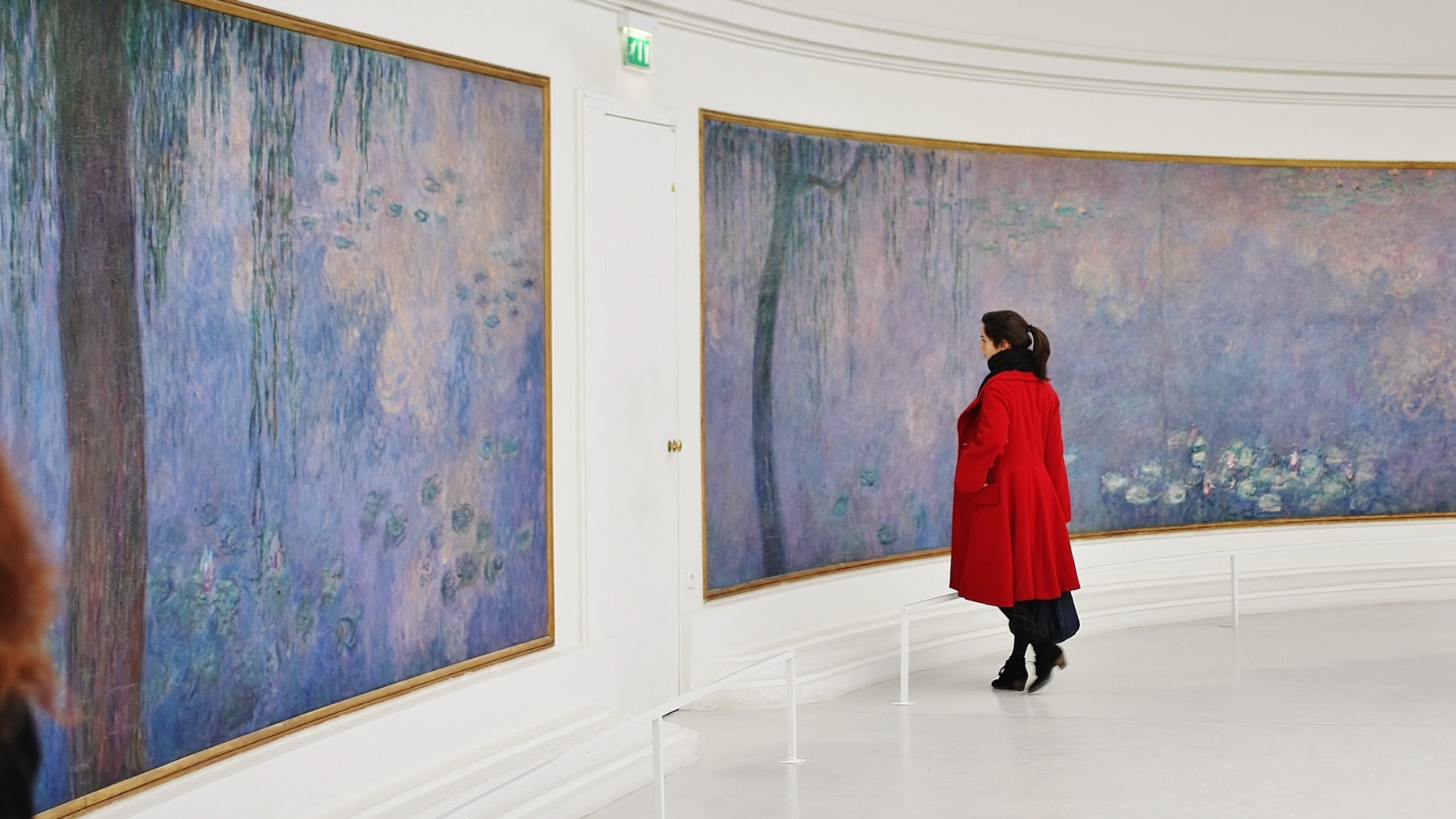
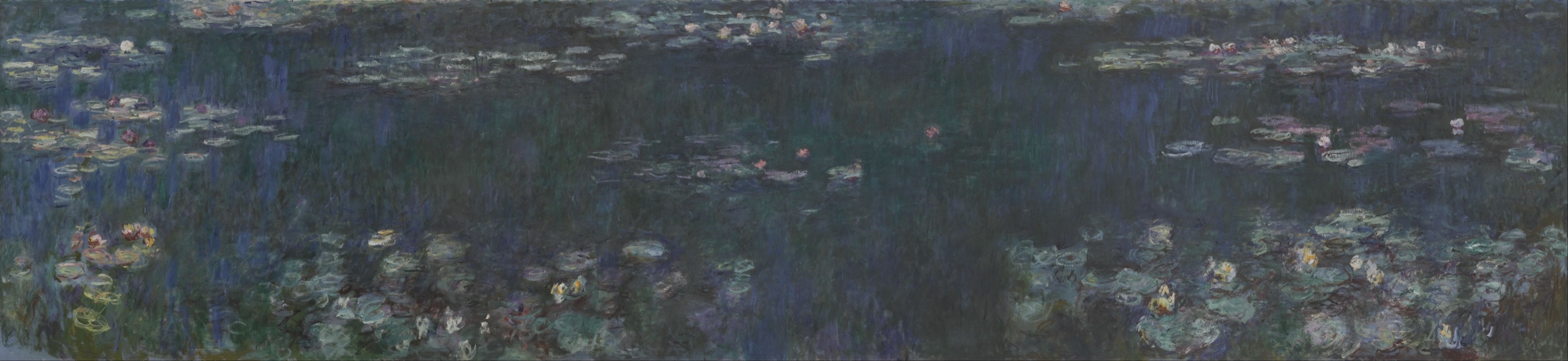
Monet made more than forty of these large paintings. Twenty-one of them ended up in Paris, joined into eight compositions. The Orangerie's catalogue records describe each composition as panels joined edge to edge on canvas that was then marouflaged, glued directly onto the wall. Room one holds Les Nuages and Matin (three panels each, 200 by 1,275 cm), Reflets verts (two panels, 200 by 850 cm) and Soleil couchant (a single panel, 200 by 600 cm). Room two holds Les Deux Saules (four panels, 200 by 1,700 cm), Le Matin aux saules and Le Matin clair aux saules (three panels each, 200 by 1,275 cm) and Reflets d'arbres (two panels, 200 by 850 cm).
Add the widths from those eight records and the ensemble comes to 91 metres of painting, 40 metres in the first room and 51 in the second, about 182 square metres of painted canvas. The museum rounds this in its public texts to nearly 100 linear metres and about 200 square metres, which counts the wall the panels sit in rather than the canvas alone.
One inconsistency is worth naming, because the figure travels everywhere unchecked. MoMA's publication and the Orangerie's teaching dossier both state that the French state received twenty-two panels. The Orangerie's own eight catalogue records add up to twenty-one. Every panel but one is 425 cm wide; Soleil couchant is a single 600 cm canvas. The likeliest reading is that one canvas gets counted as two half-widths in the traditional tally, but the museum publishes both numbers and does not reconcile them.
The room is part of the work
On 12 November 1918, the day after the Armistice, Monet wrote to Georges Clemenceau. In the Orangerie's translation of the letter, he says: “I am on the verge of finishing two decorative panels which I want to sign on Victory Day, and am writing to ask you if they could be offered to the State with you acting as intermediary.” Clemenceau talked him up from two panels to the entire decorative cycle.
Delivering it took another eight years. In September 1920 Monet reached an agreement with Paul Léon, director of the Beaux-Arts, covering twelve panels, with the state obliged to install them according to the painter's instructions in a building set aside for the purpose. The deed of gift was signed on 12 April 1922, for nineteen panels, and approved by decree that June. Monet kept reworking. Clemenceau wrote to him the same year that “you are well aware that you have reached the limit of what can be achieved with power of the brush and of the mind.” It changed nothing. On 19 March 1925 Monet wrote to the director of the Beaux-Arts floating a way out: he would destroy the panels and compensate France with part of his own collection of Cézannes and other pictures. That letter is itself in the Orangerie's collection. He kept the paintings until he died on 5 December 1926.
What he had already fixed, in detail, was the room. Working with the architect Camille Lefèvre, Monet set the shape of the two oval galleries, the placement and rhythm of the panels and the gaps between them, the several openings that let a visitor wander rather than follow a route, and the overhead daylight that floods the space in sun and goes quiet under cloud. Sunrise colours face east and sunset colours west, so walking the rooms runs with the sun rather than against it. Seen in plan the two ellipses draw the mathematical sign for infinity.
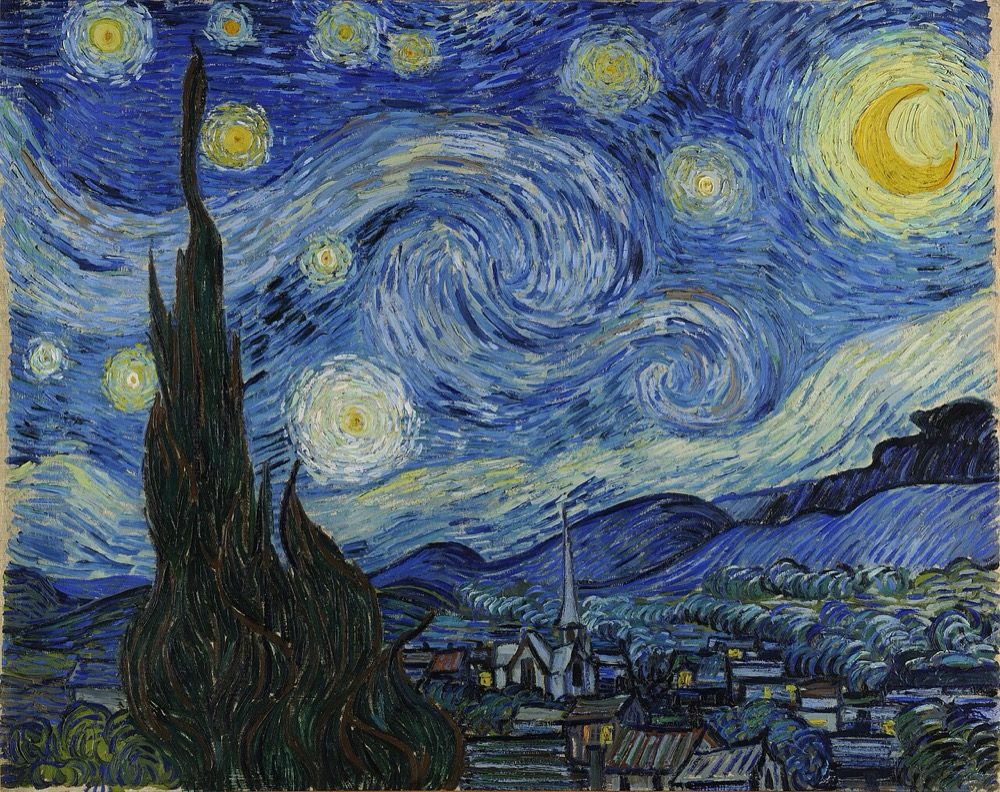
The result is a set of paintings that cannot be lent, cannot be rehung and cannot be seen anywhere else. Clemenceau presided over the opening in 1927. The public stayed away for decades. It took the arrival of postwar American abstraction, and André Masson's 1952 description of the rooms as the Sistine Chapel of Impressionism, before the ensemble was widely taken seriously. For a painter who worked at the opposite end of the scale, compressing an entire career into roughly a decade of ready-bought canvases, see Van Gogh's paintings.
The cataracts, without the myth
Monet's eyesight is the part of this story most often told badly. The version in the medical literature is stranger and better documented than the one about a nearly blind old man daubing at a pond.
The Orangerie's chronology places his first cataract symptoms in 1908; MoMA dates the diagnosis to 1912. In 1913 Monet travelled to London to consult the German ophthalmologist Richard Liebreich, who prescribed glasses and recommended surgery on the right eye. Monet refused. An account published in the British Journal of General Practice collects what he wrote as it worsened around 1914 and 1915: that “reds had begun to look muddy” and that “my painting was getting more and more darkened.” He started labelling his paint tubes and keeping a strict order on the palette so he would not reach for the wrong colour.
He avoided the operation for years, having watched Honoré Daumier and Mary Cassatt come out of theirs badly. He argued: “I prefer to make the most of my poor sight, and even give up painting if necessary, but at least be able to see a little of these things that I love.” In 1922 the ophthalmologist Charles Coutela measured light perception only in the right eye and 6/60 in the left. Surgery on the right eye went ahead in early 1923, in two stages. Monet was a terrible patient and said so: “It is to my great chagrin that I regret having had this fatal operation.” His new aphakic spectacles left everything tinted blue. Only in 1925, after Jacques Mawas fitted him with tinted Zeiss lenses and his operated eye read 6/9, did he resume serious work.
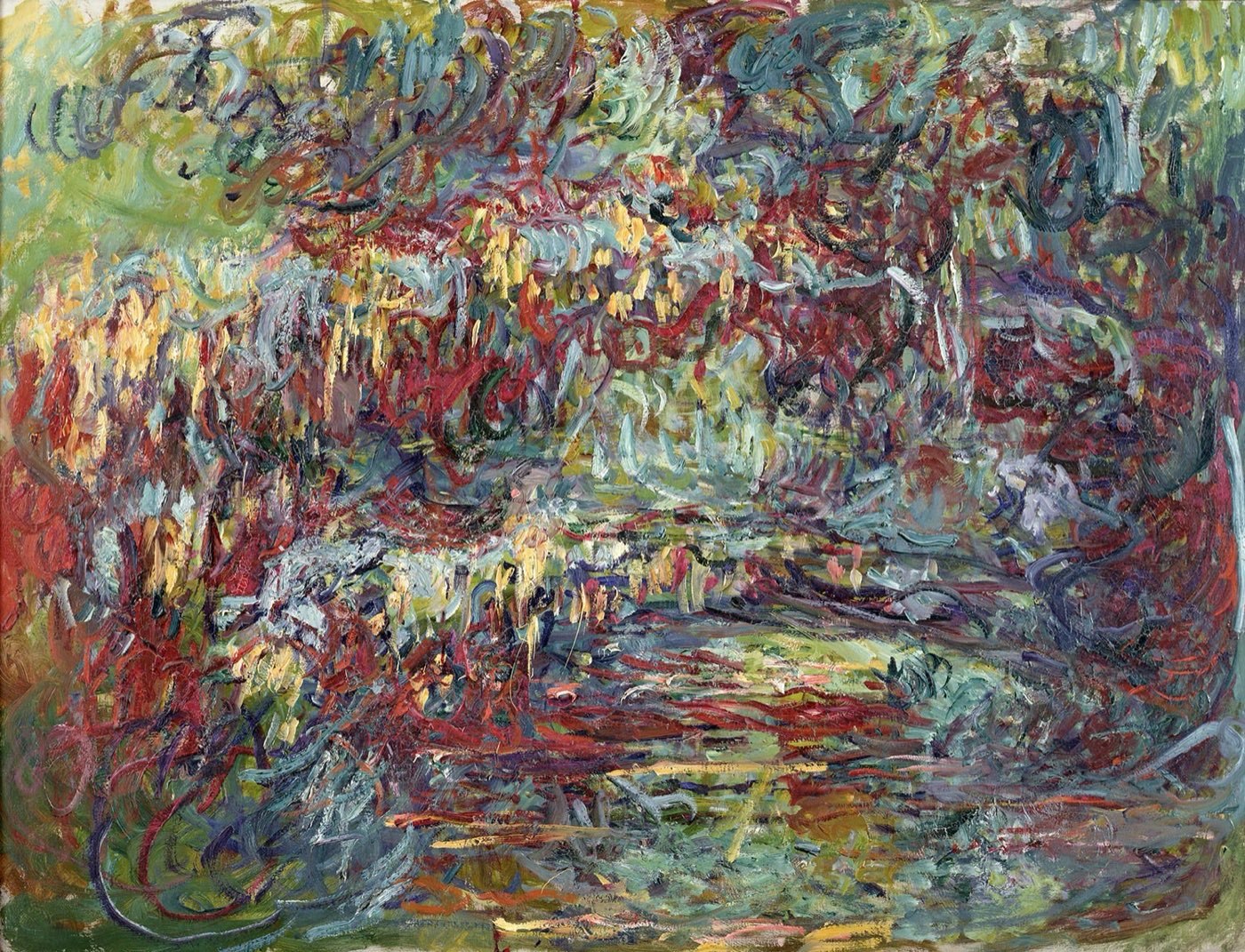
Two consequences run against the popular account. Once his colour vision was corrected he destroyed canvases painted before the operation and retouched others, which is part of why the series total is unrecoverable. And the Grandes Décorations were finished in that last corrected stretch, from 1925 until his death, rather than under the cataract. The most violently coloured of the late pictures, the red and green Japanese bridges now held mainly by the Musée Marmottan Monet, are precisely the canvases he did not send to Paris.
The series was scattered before anyone could see it whole
Nobody has ever seen the Water Lilies series assembled, and nobody will. The eight Orangerie compositions are glued to their walls. Everything else left Giverny by other routes and at wildly different moments.
Monet sold steadily while he worked. The Art Institute's Water Lily Pond of 1900 went to the dealer Léonce Rosenberg around the time of the 1900 Durand-Ruel show, which is part of why the museum treats it as a finished picture rather than a study. The Metropolitan Museum's Bridge over a Pond of Water Lilies of 1899 came in through the Havemeyer bequest in 1929.
The large studio panels moved much later, and in a hurry. MoMA's history of its own holdings records that in 1955 it became the first American museum to buy one, paying Michel Monet four million francs, then about $11,500. It added a smaller panel in 1956. On 15 April 1958 a fire broke out on the museum's second floor, where contractors were working on the air conditioning. An electrician was killed, around 550 paintings were exposed to smoke or water, and both Water Lilies panels were destroyed.
When the curator Dorothy Miller telephoned Giverny looking for a replacement, Michel Monet's wife told her the studio was empty and everything had gone to the Paris dealer Katia Granoff. Miller found four large canvases in storage in another painter's studio. MoMA bought the triptych for the equivalent of $150,000 and a single panel for $83,000, more than seven times per painting what it had paid three years earlier for the canvas that burned.
The rest of the family's pictures reached the Musée Marmottan Monet in 1966, when Michel Monet left the museum as his universal legatee. Over a hundred canvases arrived, among them the monumental water lily and garden paintings which, in the museum's own words, were never shown during the artist's lifetime and went on public view for the first time when they entered the collection. Forty years after the painter's death, most of the series was still coming out of storage.