The one detail that checks out: a morning star from his asylum window
In May 1889, Van Gogh admitted himself to the Saint-Paul-de-Mausole asylum outside Saint-Rémy-de-Provence, where he was given a bedroom with a barred window facing east over a wheat field. In a letter to his brother Theo, written between about 31 May and 6 June 1889, he described what he had seen from that window before dawn: "This morning I saw the countryside from my window a long time before sunrise, with nothing but the morning star, which looked very big." He was not being poetic about the star's size. The Van Gogh Museum's own letters project notes, in its annotation to this passage, that the star was the planet Venus, which had emerged from obscurity in the morning twilight during mid-May 1889 and grew more prominent through June, citing astronomer Charles A. Whitney's study "The Skies of Vincent van Gogh," published in the journal Art History.
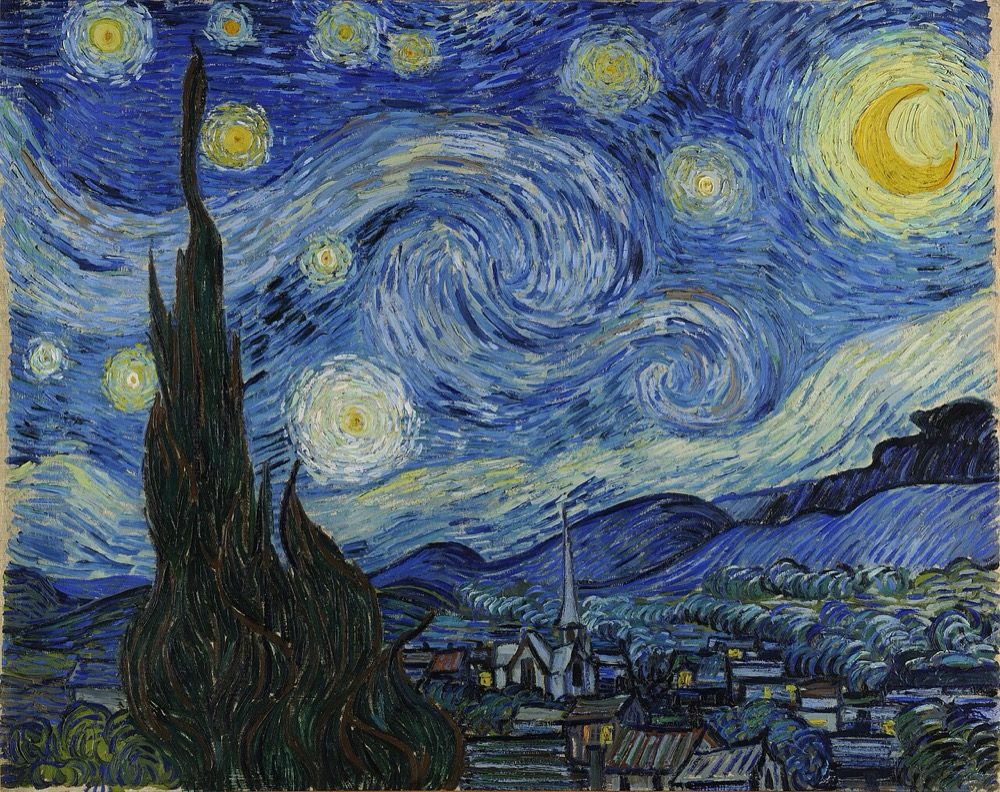
About two weeks later, on or about 18 June, Van Gogh wrote to Theo again, mentioning that he had just finished "a new study of a starry sky." That study is catalogued today as F 612 / JH 1731, the painting now known as The Starry Night. Between those two letters is essentially everything that can be independently verified about what Van Gogh actually observed before he painted it: a bright morning star, seen from an asylum window, in the last days of May or first weeks of June 1889.
The village below is not Provence. It's Holland, remembered
Everything under the sky is a different matter. The Museum of Modern Art, which has owned the painting since 1941, describes the huddled town at the bottom of the canvas plainly in its own collection record: the scene shows the view from Van Gogh's window "with the addition of an imaginary village." No village of that kind stood outside his room; what he could actually see, by his own account in other letters from the asylum, was a walled field of wheat.
The invented church at the village's center has drawn particular attention from art historians, because its steep, pointed steeple resembles the Dutch Reformed churches of Nuenen and Zundert, the towns where Van Gogh grew up, far more than it resembles the low, rounded Romanesque bell towers common around Provence. The cypress looming in the left foreground is oversized to the same degree, dwarfing the village it stands beside. The painting, in other words, sets one real astronomical detail, a planet he watched from his window, inside a landscape built from homesick memory rather than observation.
Astronomers have dated two other Van Gogh night skies to the hour. Not this one
Donald Olson and Russell Doescher, astronomers at Texas State University, have made a specialty of reconstructing the exact moment behind Van Gogh's night paintings by calculating where the moon and planets stood in the sky on candidate dates. Working from the position of a bright "star" beside a house in White House at Night, a painting that resurfaced in 1995 after being presumed lost since the Second World War, they identified the object as Venus and fixed the scene to around 8 p.m. on a specific evening in June 1890. They carried out comparable work dating Van Gogh's Moonrise, publishing their findings through Sky & Telescope.
The Starry Night has never received the same treatment. No astronomer has pinned it to one specific night the way Olson and Doescher pinned White House at Night, and the likely reason is the painting itself: it mixes one observed detail, Venus, with an invented village and an exaggerated cypress that don't correspond to any single real view. Van Gogh seems to have agreed with that assessment. In a letter to Theo written on or about 20 September 1889, he grouped what he called the "Night effect," identified by the Van Gogh Museum's own letter annotations as this same canvas, together with Moonrise, and dismissed both: "These are exaggerations from the point of view of the arrangement, their lines are contorted like those of the ancient woodcuts." The canvas didn't leave for Paris with that batch; a follow-up letter on 28 September lists the "Night effect" and Moonrise among a further group of paintings finally heading out that day, over a week after he first wrote them off. A painting built that loosely from a real sky doesn't hold still long enough for astronomical dating to work on it.
Physicists have argued about the swirls for almost twenty years
In 2006, the Mexican physicist José Luis Aragón and colleagues tested something more abstract than the sky's contents: whether the pattern of brightness across the painting's surface obeys the same statistics as real turbulent fluid flow, as described mathematically by Andrei Kolmogorov in 1941. They measured the probability distribution of luminance fluctuations in The Starry Night and several other paintings from Van Gogh's late, "impassioned" period, and found the distributions tracked Kolmogorov's predictions closely.
The result was not automatic for any swirling picture. Aragón told Nature's news team the same year that his group had tested other artists' turbulent-looking work and come up empty: "We have examined other apparently turbulent paintings of several artists and find no evidence of Kolmogorov scaling." He named Edvard Munch's The Scream specifically, a painting made by a similarly tumultuous artist and full of superficially similar swirls, as one example whose luminance pattern simply does not fit Kolmogorov's law.
A cropped sky said one thing. The whole sky said another
The question did not stay settled. In 2019, astrophysicist James Beattie and colleagues took a different statistical approach, calculating the power spectrum, rather than the brightness distribution, of a square patch of sky roughly in the painting's center. They found a power-law slope of about −2.1, a value closer to the turbulence found in real interstellar molecular clouds, the supersonic, star-forming turbulence of outer space, than to the −5/3 exponent that defines classic incompressible Kolmogorov turbulence.
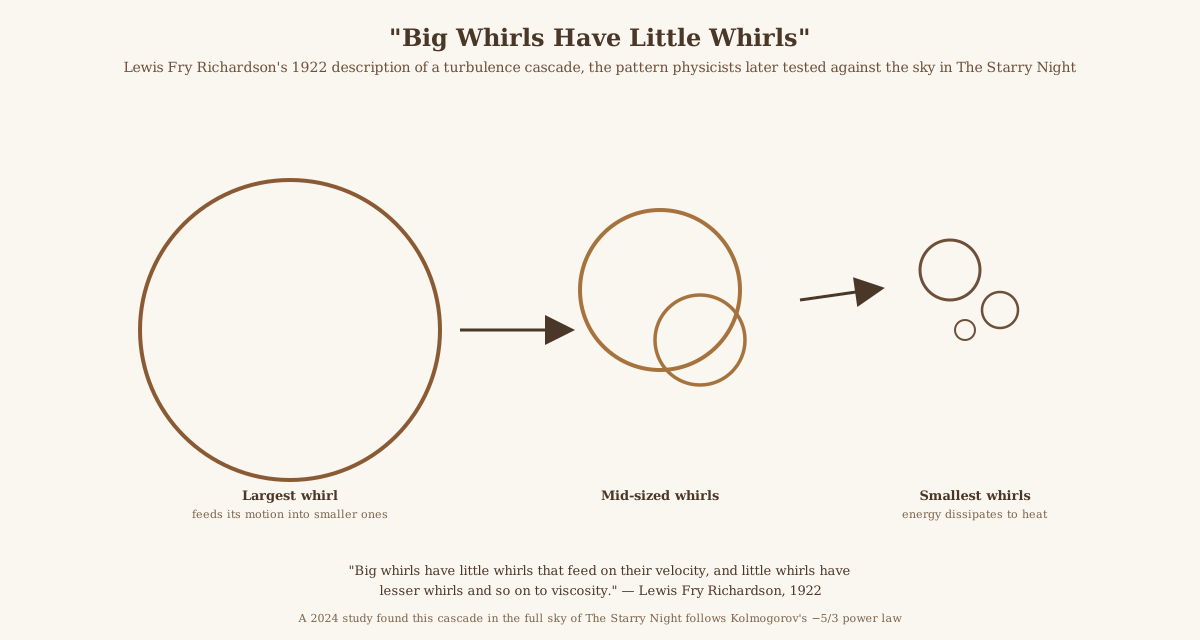
In 2024, a team of researchers led by Yinxiang Ma and Yongxiang Huang published a rebuttal of sorts in the journal Physics of Fluids. Their argument was methodological: earlier studies, including Beattie's, had analyzed only part of the sky. The team processed every whirl in the entire sky region instead, and found that its luminance's power spectrum did resolve into a clean −5/3 Kolmogorov-like law after all, alongside a second, steeper pattern at the smallest scales consistent with a related turbulence effect called Batchelor scaling. Their conclusion was that Van Gogh's brushwork had captured the size, spacing, and intensity of real turbulent eddies with a precision the fragmentary, cropped analyses had missed. Physicist Lewis Fry Richardson had described the underlying idea in 1922, two decades before Kolmogorov's mathematics formalized it, in a couplet that still opens most textbook discussions of the cascade: "Big whirls have little whirls that feed on their velocity, and little whirls have lesser whirls and so on to viscosity."
Two 2025 papers say the method itself is broken
The 2024 result didn't stand unchallenged for long. In March 2025, James J. Riley of the University of Washington and Mohamed Gad-el-Hak of Virginia Commonwealth University published a direct rebuttal in the Journal of Turbulence, arguing the whole approach rests on a category error. The 2024 paper had extended Kolmogorov's velocity-turbulence theory to a scalar quantity, in this case pixel luminance, using an extension developed independently by Alexander Obukhov and Stanley Corrsin for real fluids. Riley told Virginia Commonwealth University's newsroom that the objection was foundational: "there is no identifiable, measurable scalar fluid property in the painting that can be used to apply the theory of Obukhov and Corrsin," and that "the atmospheric flow field assumed does not even closely satisfy the assumptions required of the theory."
A second team went further. In August 2025, Daniel Bourgault and Cédric Chavanne of the Université du Québec à Rimouski's Institut des sciences de la mer, writing in the Bulletin of the American Meteorological Society, ran the 2024 paper's identical power-spectrum method on an unrelated painting, Edgar Degas's A Woman Seated beside a Vase of Flowers, an indoor scene with nothing to do with skies or fluid motion. It produced a power-law slope near −5/3 too. Bourgault's point was that the slope alone proves nothing: "the fact that fully developed turbulent flows exhibit a −5/3 power spectrum does not imply that any field with a −5/3 spectrum is turbulent. All roses are flowers, but not all flowers are roses." His team also noted that Van Gogh's own letters name the bright shape beside the cypress as Venus, not an eddy, and that both Venus and the moon are painted at an exaggerated scale that would distort any energy-spectrum measurement taken off the canvas. In December 2025, authors from both rebuttal teams published a joint comment in Physics of Fluids, the same journal that had run the original 2024 paper, concluding that "the analysis in the paper by Ma et al. is flawed, and their conclusions unfounded."
From a painting he almost didn't send, to MoMA's most recognized canvas
Van Gogh's own low opinion of the painting did not keep it from circulating after his death, or from changing hands repeatedly. Theo died in January 1891, six months after Vincent, and his widow, Jo van Gogh-Bonger, became caretaker of the estate; in 1900 she sold the painting to the poet Julien Leclercq, who sold it on to the painter Émile Schuffenecker the following year. Jo bought it back from Schuffenecker and, in 1906, sold it again, this time to the Oldenzeel Gallery in Rotterdam, where a local collector, Georgette van Stolk, acquired it; van Stolk kept it for over thirty years, reportedly hanging a curtain in front of the canvas on hot summer days to protect it from the sun. She eventually sold it to the Paris dealer Paul Rosenberg, who fled to the United States in 1940 as Germany occupied France. MoMA did not buy the painting from Rosenberg in 1941; it swapped for it, trading him three works bequeathed to the museum by its late co-founder Lillie P. Bliss, two Cézannes and a Toulouse-Lautrec, and recording the arrival under accession number 472.1941, the kind of specific catalogue detail that tends to get lost once a painting turns into a reproduced image rather than a physical object with an inventory record. The museum first displayed it to the public that September, in an exhibition simply titled "New Acquisition: Vincent van Gogh, The Starry Night," and it has remained one of the most visited works in the collection ever since.
What survives of the actual night behind the painting is thin: a bright planet, watched from a barred window sometime around late May or June 1889, and a canvas finished by 18 June. Everything else, the village, the spire, the scale of the cypress, and even whether its swirls truly obey the physics of real turbulence, has had to be argued over by astronomers and physicists rather than simply read off the canvas, and in the case of the physics, the argument is still less than a year old.