More than half of the list is private
Ask where Monet's paintings are and the usual answer is a list of museums. The Musée Marmottan Monet describes itself on its homepage as holding the world's biggest collection of his work. The Musée de l'Orangerie has the great Water Lilies panels. Boston, Chicago and Washington cover the American stops. All of that is true, and it leaves out the largest single holder, which is not a museum at all.
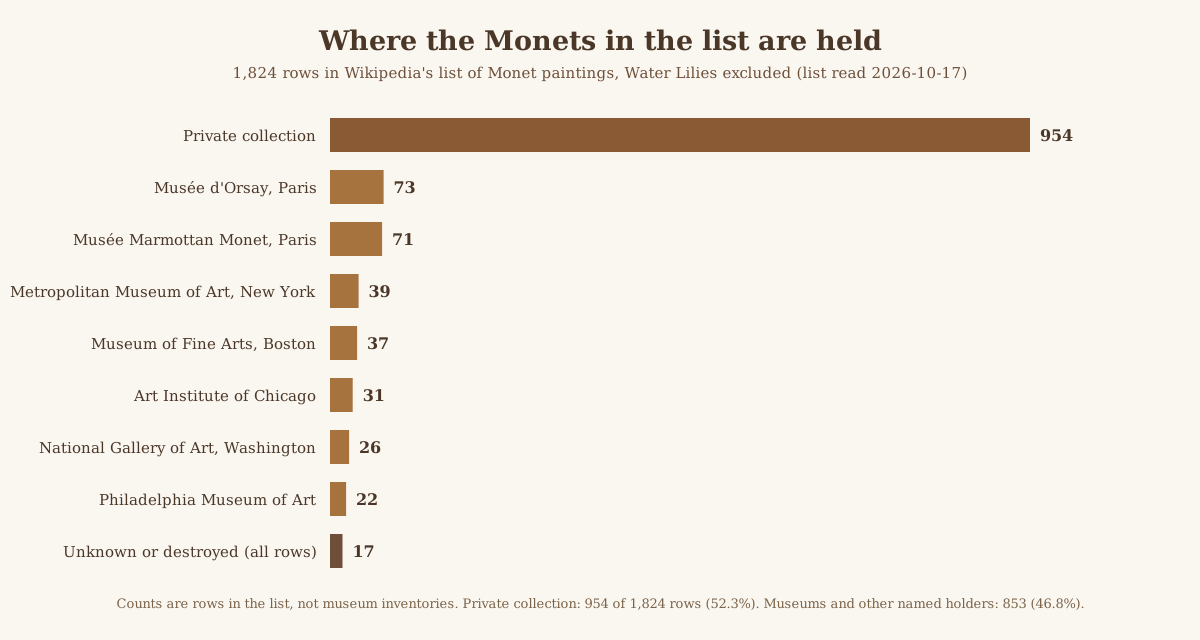
To put a number on it, this page counts the rows of Wikipedia's list of paintings by Claude Monet (checked 2026-10-17). The list says it covers the extant finished paintings apart from the Water Lilies, which have a separate table, and it gives each painting a Wildenstein catalogue number and a current location. It has 1,824 rows. Some rows share a base catalogue number and differ by a letter suffix, so about 1,750 distinct base numbers sit behind them.
| Holder | Rows | Share of 1,824 |
|---|---|---|
| Private collection | 954 | 52.3% |
| Museums and other named holders | 853 | 46.8% |
| Unknown or destroyed | 17 | 0.9% |
That makes 954 rows, 52.3 percent, private collection. A further 853 sit with museums or a few other named holders such as the Nahmad and Pérez Simón collections, and 17 are either unknown or recorded as destroyed. The label is a statement about ownership, and the five rows that spell it with a capital letter are counted with the rest. It does not say whether the painting hangs in a house, sits in a vault or is on loan to a museum, and it does not say who owns it.
Two limits apply. The list is volunteer-edited, so a painting can stay marked private after a museum buys it, or the reverse. And a row is not an object in a museum inventory, as the cross-check below shows. Read the counts as a ranking with a margin of a few paintings per holder, not as audited totals.
Which museums hold the other 853
Two Paris museums lead by a wide margin. The Musée d'Orsay has 73 rows and the Musée Marmottan Monet 71, together 144 of the 853 named-holder rows, about 17 percent. Grouped by city, Paris institutions hold 153 rows, New York 50, Washington 38 and Boston 37.
| Rank | Holder | City | Rows |
|---|---|---|---|
| 1 | Musée d'Orsay | Paris | 73 |
| 2 | Musée Marmottan Monet | Paris | 71 |
| 3 | Metropolitan Museum of Art | New York | 39 |
| 4 | Museum of Fine Arts | Boston | 37 |
| 5 | Art Institute of Chicago | Chicago | 31 |
| 6 | National Gallery of Art | Washington, D.C. | 26 |
| 7 | Philadelphia Museum of Art | Philadelphia | 22 |
| 8 (tie) | National Museum of Western Art | Tokyo | 14 |
| 8 (tie) | Hermitage Museum | St Petersburg | 14 |
| 10 | Pola Museum of Art | Hakone | 12 |
The Marmottan's claim to the biggest collection survives the count once the Water Lilies are added. Its homepage says some hundred masterpieces were bequeathed by the painter's family and close friends. Across the two lists it has 71 plus 18 rows, 89 in all, against 73 plus 3, or 76, for the Orsay. On the main list alone, the Orsay leads the Marmottan by two rows. The museum's round figure of a hundred is above the 89 rows, so the list may undercount it.
The Louvre, which many visitors assume is the place for Monet, has two rows. ArtAtlas's itinerary page calls it not a primary Monet destination. Outside France and the United States the biggest blocks are in Tokyo, St Petersburg and Hakone, at 14, 14 and 12 rows.
Checking the list against the Met's database
To see how far the list can be trusted, the Metropolitan Museum's open-access database was queried for Claude Monet in its European Paintings department on 2026-10-17. It returns 39 objects, all classified as paintings, and two of them carry the title Water Lilies. A search without the department filter returns two more objects that could not be inspected. The list gives the Met 39 rows in the main table and 4 in the Water Lilies table, 43 in all, so the museum lists fewer.
Some of that gap may be loans or former holdings, and some may be the list running ahead of or behind the museum. The two sources cannot be reconciled from outside. A difference of about ten percent for one museum is enough to swap neighbors in the ranking below the top two, which is why this page treats every count as approximate.
The Water Lilies have their own list, and a smaller private share
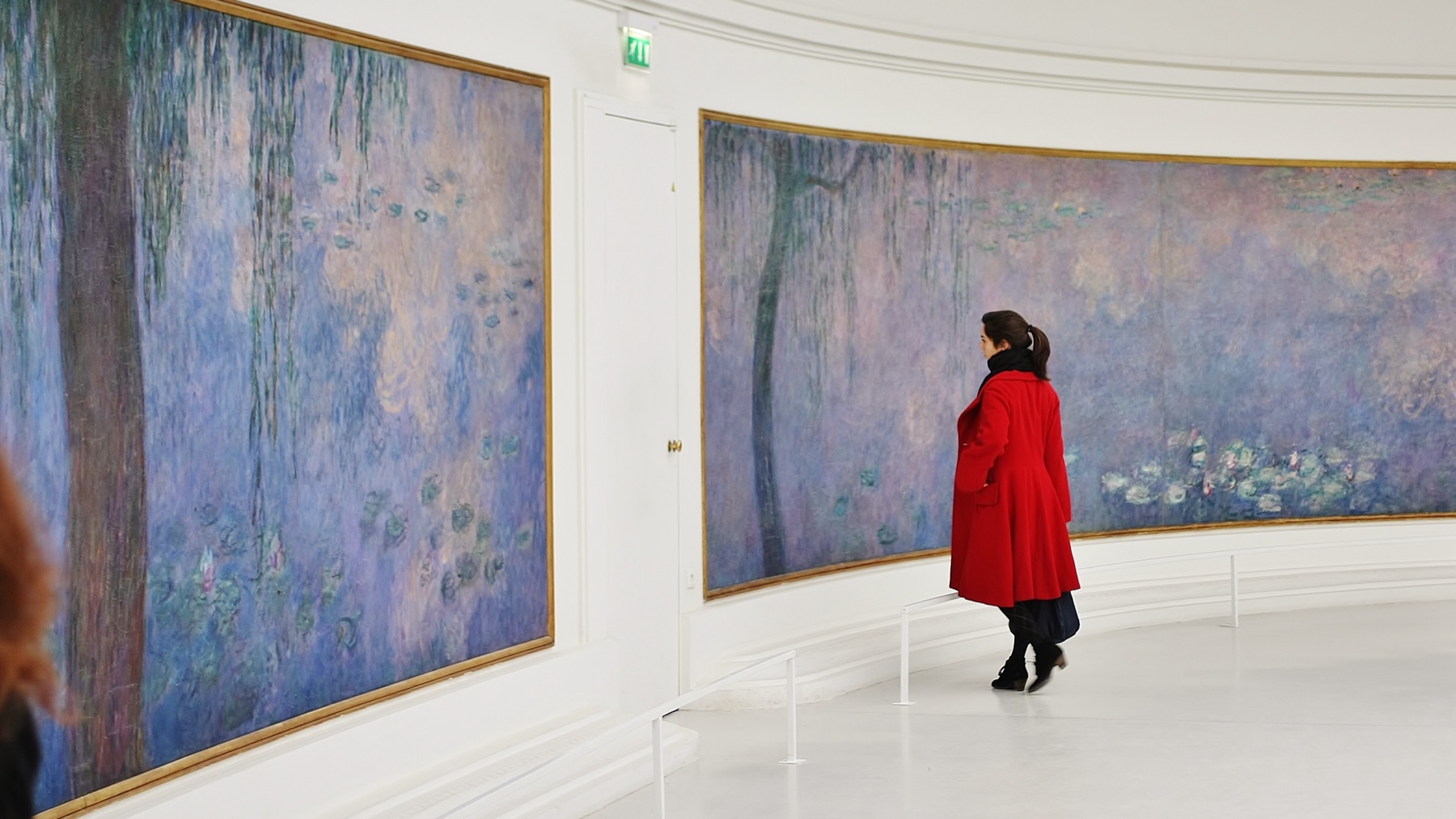
Wikipedia's separate table of Water Lilies (checked 2026-10-17) has 214 rows. Of those, 83 are private collection, about 39 percent, a smaller share than in the main list. The Marmottan has 18, the Orangerie 8, the Chichu Art Museum on Naoshima 6, the Museum of Modern Art 6 (two of them marked lost in fire) and the Met 4. The Orangerie's eight rows match the eight compositions the museum itself describes. Monet offered two large panels to the French State on 12 November 1918, and the eight compositions were installed at the Orangerie in 1927, a few months after his death.
Private owners do sell. In June 2014 a Water Lilies painting sold at Sotheby's in London for $54 million to an anonymous buyer, and the same canvas was then shown in the exhibition Painting the Modern Garden at the Cleveland Museum of Art and the Royal Academy of Arts from 2015, according to Wikipedia's article on the series (checked 2026-10-17). How the cycle was built and why it was scattered is covered in the page on Monet's Water Lilies series.
The table is not complete either. The same Wikipedia article (checked 2026-10-17) describes the series as approximately 250 oil paintings, MLive's reporting uses about the same figure, and the table lists 214 rows.
The series were broken up too
Monet's series went the same way as the single canvases. The Museum Barberini's catalogue note counts twenty-five Grainstacks painted in 1890 and 1891. ArtAtlas's itinerary page places six of them at the Art Institute of Chicago, with others at the Met, the Orsay and in private collections, and it says the Rouen Cathedral series divides between the Orsay, which has four, and the Musée des Beaux-Arts de Rouen, which has one.
A visitor chasing one series therefore needs several cities and, for some canvases, an exhibition loan. That is also why the museum ranking above says little about any single motif. The Orsay's 73 rows are dated from 1861 to 1920, and 46 of them come from the 1860s and 1870s, so its strength is the early Impressionist years more than the late series.
What a private collection can hide
The label can also cover a painting that is on public view. The list marks the 1890 Grainstacks (W.1273) as private collection. The Museum Barberini in Potsdam catalogues the same canvas under inventory number MB-Mon-26 and gives its Wildenstein number as 1273. Its provenance record shows the picture was consigned for Sotheby's New York on 14 May 2019 as lot 8, and it has been on show at the museum in the exhibition Impressionism: The Hasso Plattner Collection since 5 September 2020. Wikipedia's article on the Haystacks series says that sale fetched $110.7 million, a record for Monet, and names Hasso Plattner as the buyer (checked 2026-10-17). The list is not wrong, since a collector owns the painting, but a reader who takes private to mean invisible would miss one of the more visitable pictures among the 954.
Seventeen rows in the main list have no holder at all. Eleven are listed as unknown and six as destroyed. By the list's notes, two were destroyed in the Second World War, one in a fire around 1950, one in a fire in 2022, one is recorded only as lost in a fire, and a 1917 self-portrait was destroyed by the artist. Apart from the 2022 fire, those notes come from the list alone and were not checked here against a second source.
The 2022 fire is the best documented. MLive reported on 26 September 2023, from documents filed in an insurance lawsuit, that three Monet paintings were apparently destroyed in a house fire in Pentwater Township, Michigan: Prairie, ciel nuageux (1890), La Route de Vétheuil (1880) and Falaise à Varengeville (1882). Together they were valued at more than $45 million. The first had been sold at Sotheby's in 2019 to a telephone bidder for just under $6 million. The fire chief told MLive the cause was still undetermined, and the owners' claim against their insurer was in litigation at the time of the report.
The list marks one 1890 meadow painting, Meadow, Cloudy Sky (W.1246), as destroyed in a fire in 2022 and cites the MLive article for it. The other two paintings the article names are not among the list's 17 destroyed or unknown rows. If the court filings are right, the private count above may be too high by up to two, because a private owner's loss reaches a volunteer-edited list late or not at all.
Where the sources disagree
Three of the numbers a reader would want do not agree between sources, and none of them can be settled from the pages read for this article.
| Question | One source says | Another source says |
|---|---|---|
| How many paintings did Monet complete? | Art historian Paul Tucker, quoted by MLive: more than 2,100 | The two Wikipedia lists together (checked 2026-10-17): about 2,040 rows (1,824 plus 214) |
| How many Water Lilies are there? | Wikipedia's article (checked 2026-10-17) and MLive: roughly 250 | Wikipedia's table (checked 2026-10-17): about 215 rows |
| What did the MoMA fire destroy? | MoMA's history page: a fire on April 15, 1958 destroyed one Water Lilies panel, and the damaged other went to a university conservation clinic | MoMA's Monet course booklet lists both Water Lilies panels it held among the works not saved; Wikipedia's Water Lilies table (checked 2026-10-17) marks two MoMA entries (W.1813 and W.1982) as lost in fire; MLive dates the fire to 1957 |
The first two rows fit a list that is incomplete: about 60 paintings short of the total Tucker gives, and about 35 short on the Water Lilies. The third is a disagreement between two MoMA pages, with a newspaper year that matches neither. The museum's history page counts one destroyed panel and one damaged; its course booklet counts two losses, which is also what the Wikipedia table (checked 2026-10-17) shows. The sources read here do not settle which count is right.
What the numbers mean for seeing them
For anyone trying to see as many Monets as possible in a day, the arithmetic points to Paris: the Orsay, the Marmottan and the Orangerie's eight Water Lilies compositions sit in one city and account for about 170 rows between them. In the United States the Met, Boston and Chicago are within a few rows of each other, and which one has more depends on the loans and rehangs of any given year.
Most of the 954 private paintings can be seen only when owners lend them to an exhibition or when a work comes to auction, as the 2014 and 2019 sales show. A few, like the Potsdam Grainstacks, are shown by their owners. For the wider picture of where the best-known pictures by many artists hang, see the guide to famous paintings, and for Monet's landscapes in context, the survey of famous landscape paintings.