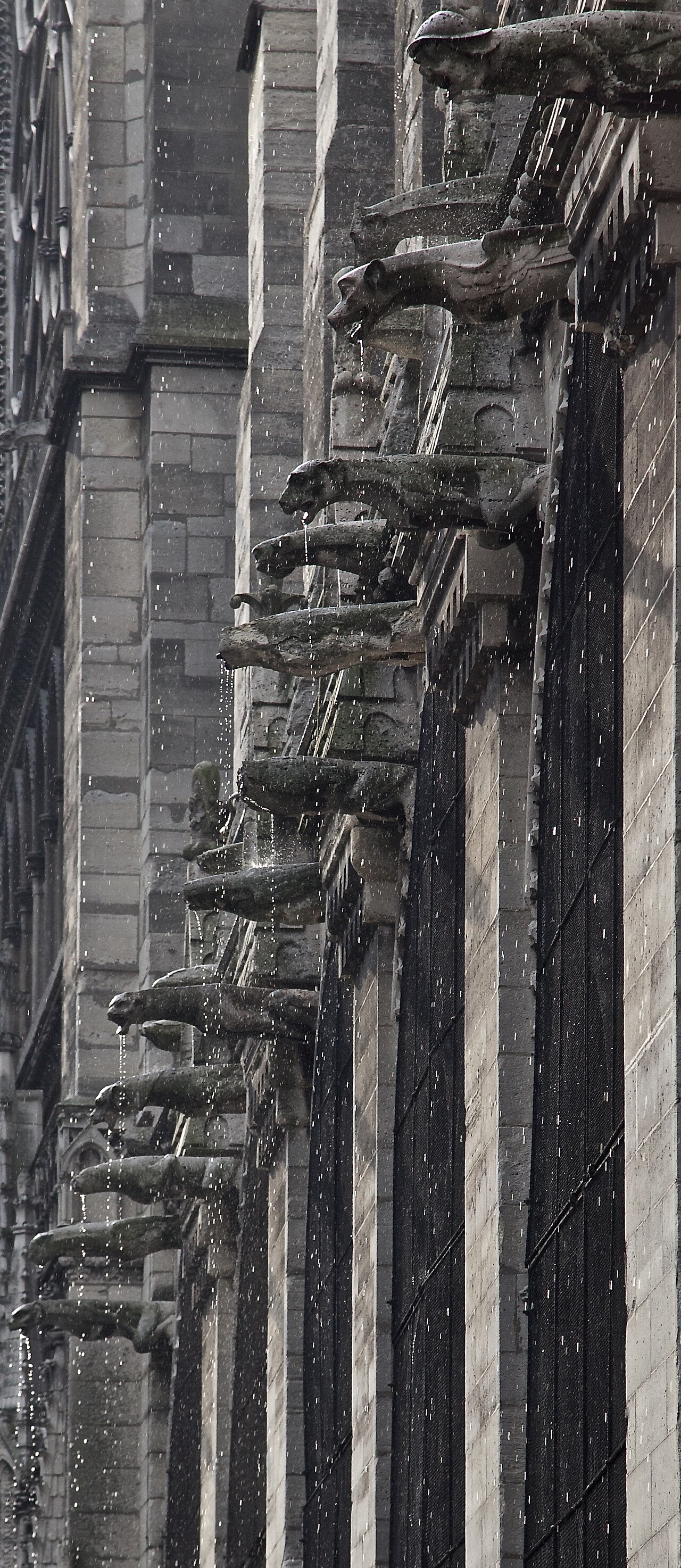
The test is whether water comes out of it
Ask most people to picture a gargoyle and you get a hunched stone demon squatting on a cathedral parapet. Ask a mason and you get something much less atmospheric. A gargoyle is a length of stone with a gutter cut along it, projecting from the top of a wall, with a hole at the far end for water to leave. Whatever has been carved around that channel is secondary.
Washington National Cathedral, which was still commissioning new ones in the 1980s, states the rule plainly in its visitor guide: "They function as drain spouts that direct rain and melted snow away from the building." The same guide gives the other category its name: the whimsical carvings on the exterior that have no drain spout are called grotesques.
The proportions in that guide are worth holding onto. It counts 112 gargoyles on the building against roughly 1,200 stone grotesques. On a cathedral designed from scratch in the twentieth century by people who cared about the distinction, the great majority of carved figures still fail the test. Another church of the same century, the Sagrada Família, reached a 2026 finish engineered a century earlier.
Friends of Notre-Dame de Paris describes the French case in the same mechanical terms: "Gargoyles are decorative elements with a practical purpose. Their function is to protect the walls from rainwater runoff which erodes the stone. They designate the end of the gutters to drain away water from the roof."
So the definition is not a matter of style, period, or how frightening the face is. Water in at the parapet, water out at the mouth. No channel, no gargoyle.
The word began as plumbing
French gargouille did not start out meaning a monster. The Trésor de la langue française records the first attestation in 1294, in the building accounts of Saint-Lazare at Autun, in the form gargoule, glossed "conduit pour l'écoulement des eaux", a conduit for water to run off through. The spelling gargouille appears at the end of 1313.
The word is built from an onomatopoeic root garg- and Old French goule, the modern gueule, meaning throat or maw. The same root sits under gargariser, to gargle, and under English gurgle. It is the noise of liquid going down a gullet, applied to a fitting that makes exactly that noise in heavy rain.
That sequence matters, because the story usually told about the word runs the other way. In the Rouen legend, Archbishop Romanus subdues a river dragon called La Gargouille and fixes its head to his church, where it becomes the first waterspout. As an origin for the word, this is backwards. The dragon is absent from the early accounts of Romanus, who died around 640, and the earliest surviving text carrying the story dates from 1394. By then Burgundian clerks had been writing gargoule in their fabric accounts for a century, for a plain piece of drainage. The legend explains the monster. It does not explain the word.
What the stone is actually doing up there
A masonry wall does not fail all at once. It fails where water sits. Rain running down a face of ashlar finds the joints, soaks the mortar, and in a hard winter freezes inside the pores of the stone and spalls the surface off in flakes. Run that cycle for a few centuries and the bedding joints open, the wall carries water into its core, and any iron cramps buried inside it rust and force the stones apart.
A large medieval roof shed an enormous volume of water and had nowhere sensible to put it. Behind the parapet ran a lead-lined gutter. The problem was getting the contents of that gutter past the wall without letting any of it touch the wall on the way down, and a pipe strapped down the face of a flying buttress was neither practical nor wanted. The answer was to build the pipe out of the masonry itself and throw the water into open air.
That is why gargoyles are long. The projection is not display. It is the distance needed to clear the string courses, the buttress offsets, the plinth, and the heads of anyone standing below. Seen side-on, the sculpture reads as what it is: a stone beam cantilevered out of the wall head, held down by the masonry that traps its inner end, with a trough running the length of its back.
The drain is cut first, the animal second
Look at a good one closely and the order of decisions becomes legible. The block arrives as a rough rectangular baulk, long enough to reach from deep inside the wall to well beyond it. The channel is worked along the top or the back as a straight open trough, sometimes finished with a lead lining or a lead pipe seated in the groove so that water never sits against a joint. Only after that does the figure appear, and the figure has to accommodate the trough rather than the other way round.
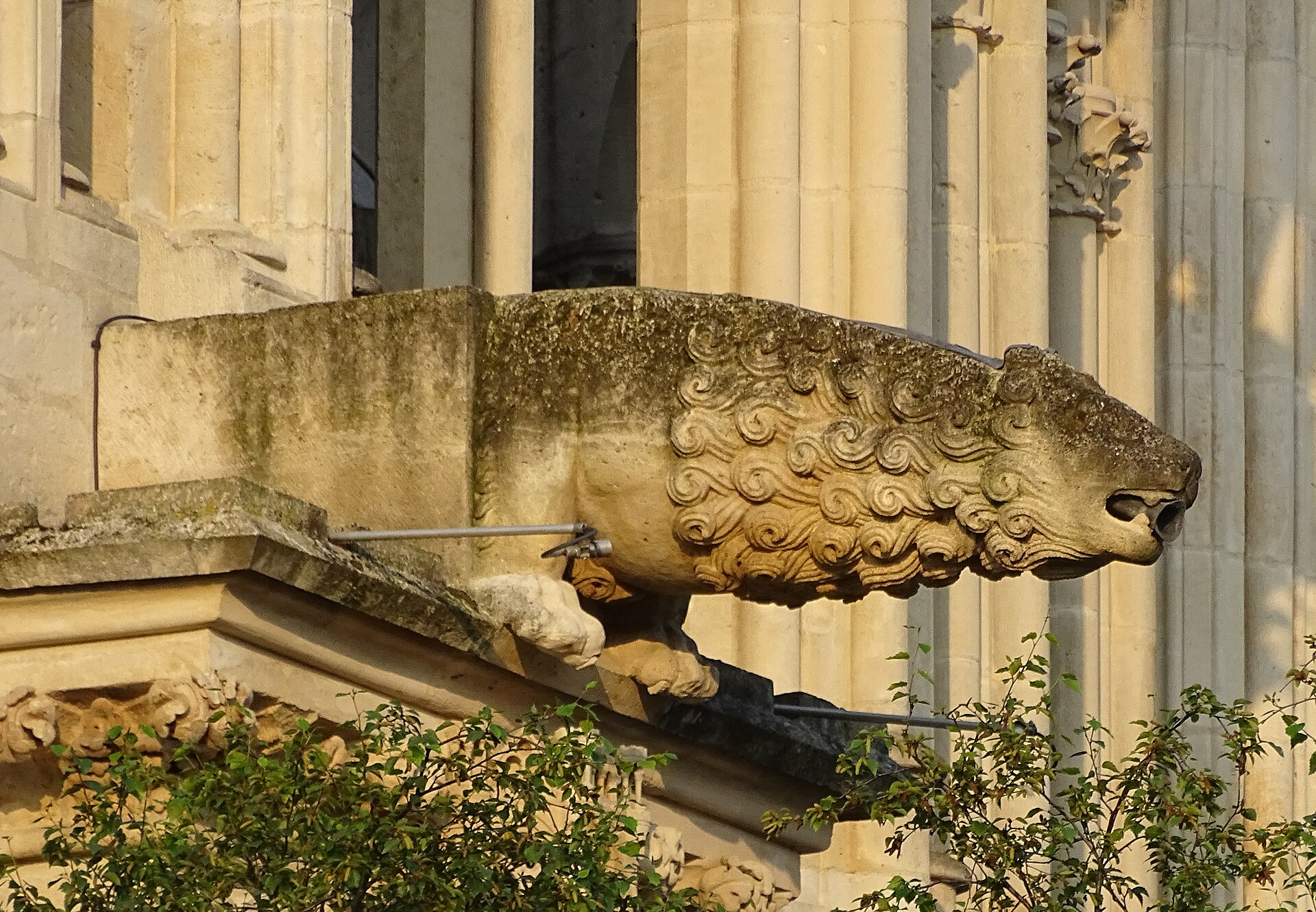
This is why so many gargoyles share a posture no free-standing sculpture would choose. The animal lies flat, forelegs braced on the cornice, neck extended, head down, mouth open at the end of a body far too long for it. The lion at Reims is stretched into something closer to a plank than a cat. Beasts get elongated spines. Human figures get thrust forward onto their elbows. The mouth ends up at the one point where the channel has to discharge, and everything else is arranged to make that look deliberate.
Most of this work happened at ground level, in the lodge, on the banker, before the finished piece was hoisted up and bedded in. The mason was therefore cutting a drain to measurements taken off a wall he could not see while carving a face that would only ever be read from a hundred feet below and at a steep angle. The coarseness of the features on many surviving gargoyles is a response to viewing distance rather than a lapse of skill.
The Greeks got there sixteen centuries earlier
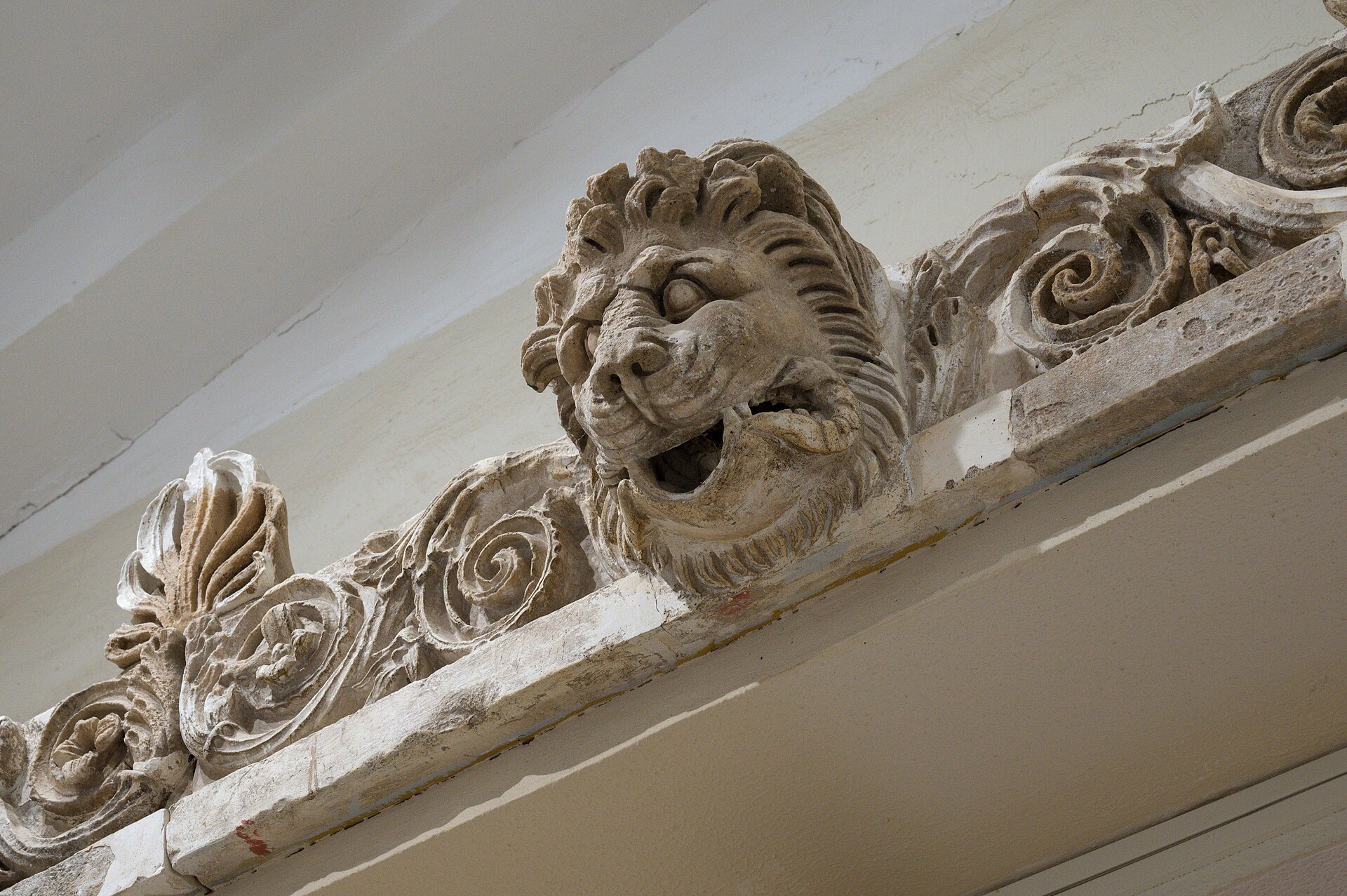
None of this was a Gothic invention. Greek temple roofs ended in a sima, the upturned lip along the eaves, and the sima was pierced at intervals by spouts shaped as lion heads. The Museum of Classical Archaeology in Cambridge describes its cast of one from Bassae in terms a thirteenth-century French mason would have recognised at once: "This lion’s head was a waterspout for throwing rainwater from the roof clear of the temple’s walls and columns." The same entry places it, with many others, "at the end of the sloping sima, high above the sculptured frieze of the temple."
The J. Paul Getty Museum holds a South Italian example from Metapontum, made between 425 and 400 BC in terracotta with polychromy (accession 71.AD.449). Its catalogue records that "In the center of this sima (a projecting molding from the edge of a roof) is a waterspout fashioned in the shape of a lion’s head. The lion’s mouth is open, revealing its teeth, and its tongue projects." An open mouth with a projecting tongue is not only a snarl. It breaks the stream and stops water tracking back along the underside of the stone.
Greek and Gothic builders reached the same solution with different animals. Cut an opening at the low point of the roof edge, run the water through it, and shape the opening into a head so that a hole in an expensive building reads as intentional. What changed in medieval Europe was the size of the bestiary and the length of the throw.
The most photographed gargoyles in the world are not gargoyles
The figures that made the word famous are the ones that fail the test.
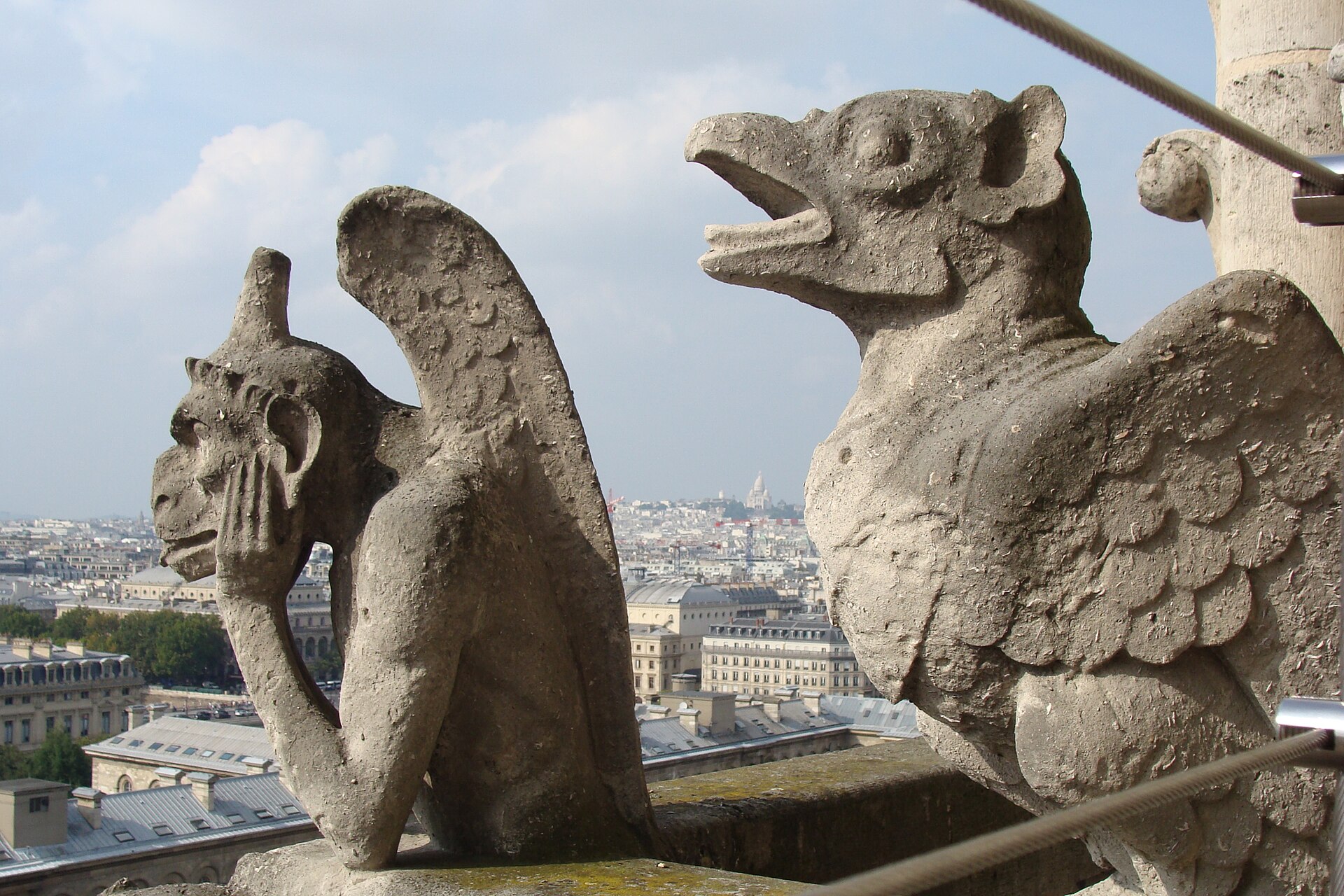
Between 1843 and 1864, Eugène Viollet-le-Duc and Jean-Baptiste-Antoine Lassus rebuilt much of Notre-Dame de Paris; Lassus died in 1857 and Viollet-le-Duc carried the campaign on alone. Among the additions was a row of hybrid creatures set along the balustrade linking the two west towers, the Galerie des Chimères. The brooding horned figure resting its chin on its hands, the one that appears on every second postcard of Paris, belongs to this group. It has no channel. It drains nothing. It is a chimera, and it is younger than the Arc de Triomphe.
The University of Chicago Press summarises Michael Camille’s study of them without hedging: most visitors "probably do not realize that the legendary gargoyles adorning this medieval masterpiece were not constructed until the nineteenth century." Camille traces the campaign "from 1843 to 1864, when the gargoyles were designed, sculpted by the little-known Victor Pyanet, and installed."
The point extends past the chimeras. Friends of Notre-Dame de Paris records that during that restoration "many of the original gargoyles were replaced with new sculptures." The twelfth- and thirteenth-century waterspouts had been weathering in Paris air for six hundred years and many were past saving. A visitor photographing the parapet today is generally looking at nineteenth-century stone whichever kind of figure is in the frame. The working gargoyles, mostly on the flying buttresses of the choir, are replacements. The celebrities on the tower gallery are inventions.
This is not a gotcha about Viollet-le-Duc, who put the gargoyles back partly because removing them in earlier centuries had left the walls wet. It is a caution about what the camera selects. The chimeras sit at eye level on a public walkway. The gargoyles hang over a void where nobody stands. The gap between the photographed image and the documented record is a recurring problem in art history; the same gap runs through how the Mona Lisa became famous.
What happens when a gargoyle stops working
A blocked gargoyle is worse than no gargoyle. Once the throat silts up with leaf litter, pigeon nest, or its own eroded grit, the parapet gutter backs up and spills over the wall head instead, laying a continuous sheet of water down precisely the surface the whole arrangement existed to keep dry. Clearing those outlets is ordinary maintenance rather than restoration, and it is the kind of job that gets deferred until the wall underneath starts to show it.
The channels have also carried things other than rain. On 19 September 1914 the roof of Reims Cathedral caught fire while the city was under bombardment. The cathedral’s own history of the building records what followed: "The heat from the flames melted the 400 tonnes of lead sheeting covering the roof. The molten metal flowed through the gargoyles." The drainage system worked exactly as designed, with the wrong fluid. When Henri Deneux rebuilt the roof structure, completed in 1938, he framed it in reinforced cement so that it could not happen a second time.
Conservation faces a duller version of the same question every few decades. A gargoyle that has lost its face is still a functioning drain. A gargoyle that has lost its channel is a lump of weathered limestone cantilevered over a public pavement. Some are consolidated where they sit. Others come down, go into store, and are replaced on the wall by a carved copy. Where the sculpture is too far gone to copy honestly, a plain lead spout sometimes goes in instead, on the reasoning that the water matters more than the animal.
Telling them apart from the pavement
You rarely need binoculars for this.
Start with reach. A gargoyle has to clear everything below it, so it projects much further from the wall than an ornamental figure needs to, and it sits at a wall head, on a buttress, or at a cornice rather than tucked into a niche or standing on a plinth.
Then the mouth. On a working spout the opening is a real hole, usually cut wider and rounder than the modelling of the face would suggest, and often noticeably coarser inside. Weathering gives it away too: below a live gargoyle the masonry frequently carries a pale washed streak or a dark stain where centuries of discharge have run down.
Then position in the roof plan. Spouts appear at the low points of gutters, which puts them at regular intervals along a parapet or lined up with the ends of buttresses. Purely decorative carving is placed wherever it looks good, which is a different and more scattered logic.
After that, wait for rain. Everything else is inference and the water is proof. The photograph at the top of this article was taken at Notre-Dame after a storm, and it settles the question for that particular row of figures in a way no amount of iconography can.