Why these read as a single, observed view
These three paintings are among the most reproduced landscapes of the 19th century, and reproduction has flattened them into something simpler than what their own records describe: a man stood in one spot, looked at one real scene, and painted what was in front of him. That impression is doing a lot of work that the paintings themselves don't support. Friedrich never stood where his composition implies. Constable's most famous "view of nature" was assembled and painted indoors, then rejected by the audience it was made for. Church's single vista is an argument about an entire continent's climate, built from separate trips years apart.
None of this comes from skeptical re-reading. It comes from the same kind of paper trail this site has used to check other canonical paintings against the museums that actually own them: the catalogue record, the preparatory material that survives alongside the object, and in Constable's case, the artist's own letters about who bought the thing and why.
Friedrich's peaks never stood together
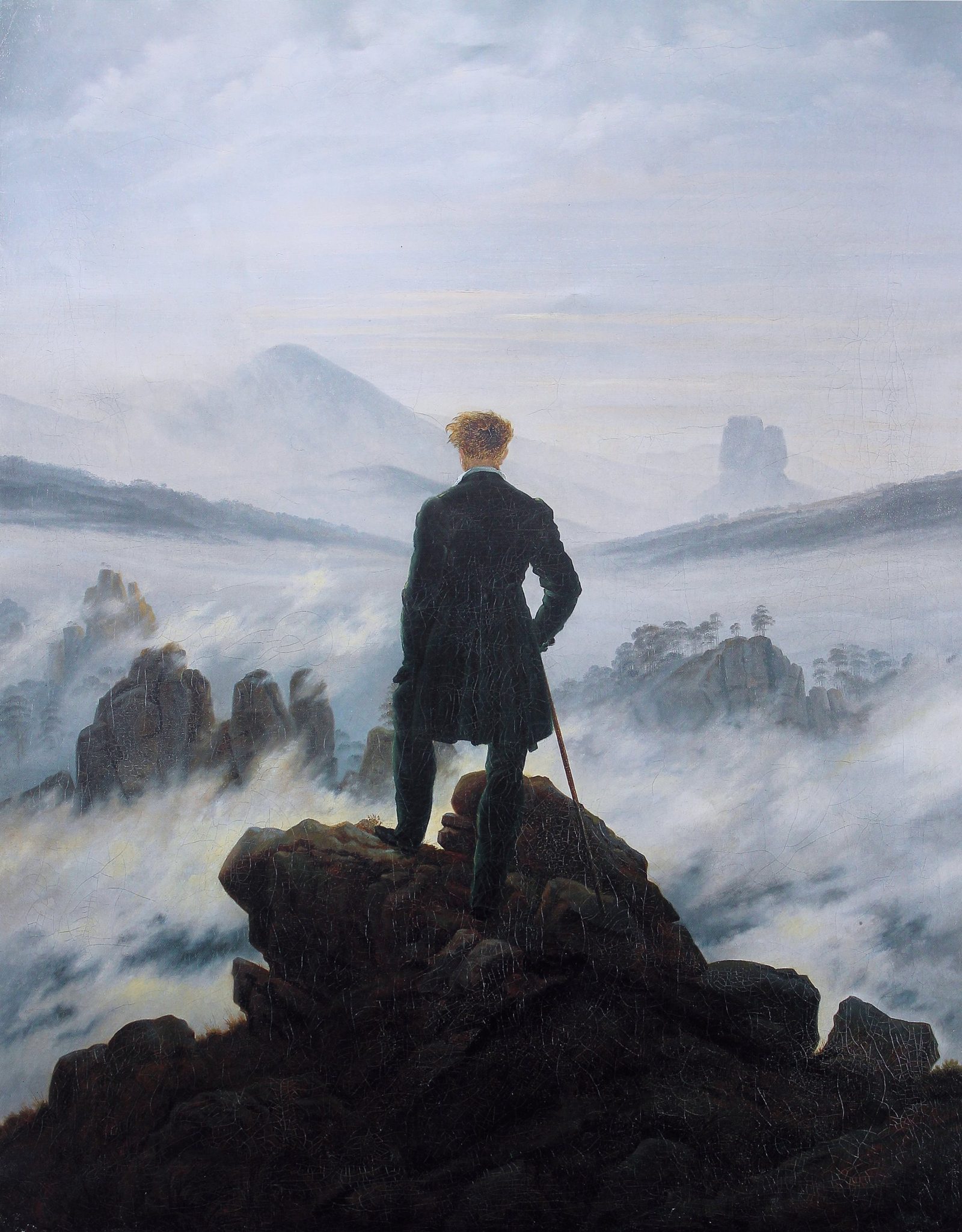
Wanderer Above the Sea of Fog (1818, Hamburger Kunsthalle) shows a man on a rocky summit looking out over a sea of cloud, with ridgelines breaking through the fog toward the horizon. Wikipedia's entry on the painting, drawing on the Kunsthalle's research, identifies the individual elements: the peak in the background to the right is the Zirkelstein; the mountain in the background to the left is either the Rosenberg or the Kaltenberg, and the sources disagree on which; the rock formation in front of that mountain is the Gamrig, near the village of Rathen; and the outcrop the wanderer himself stands on is part of the Kaiserkrone. All four are real, named features of the Elbe Sandstone Mountains on the Saxon-Bohemian border.
They do not appear together from any single vantage point in that range. Friedrich's standard working method, documented across his career, was to sketch individual rock formations and views on site and then rearrange those elements in the studio to build a composition. Wikipedia's description states this plainly: the landscape is "composed of various elements... sketched in the field but in accordance with his usual practice, rearranged by Friedrich himself in the studio." The fog itself does more than add atmosphere; it removes the middle distance that would otherwise expose how far apart these formations actually sit from one another.
The painting's own history adds a second layer of uncertainty. Its ownership before 1939 is undocumented, it did not enter the Hamburger Kunsthalle's collection until 1970, and it did not become one of the most reproduced images in Western art until the decades after that. A picture now treated as an instantly recognizable icon of German Romanticism spent roughly a century and a half as a work whose whereabouts, and even the identity of the man standing in it, were not settled questions. Later Renaissance landscapes have their own version of this gap between an object's making and the paper trail proving what happened to it, though in Friedrich's case the gap runs the other direction: the physical panel was never lost, only its ownership record.
Even the wanderer's identity is unresolved. He faces away from the viewer, a device Friedrich used often enough that art historians have a name for it, the Rückenfigur, and some writers have proposed the figure is a self-portrait. Friedrich left no statement confirming this, and the claim rests on comparing the man's dress and posture to other depictions of the artist rather than on any documented sitting. The painting is built, in other words, from a real mountain range that never lined up this way and a figure whose identity was never recorded by the one person who could have settled it.
Constable's studio production, sold under someone else's name for it
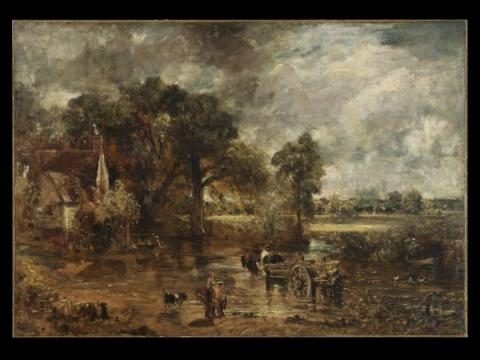
The Hay Wain depicts a real place: the millpond beside Willy Lott's cottage on the River Stour, near Flatford Mill in Suffolk, where Constable's father owned the mill. But the six-foot canvas now in London's National Gallery was painted in Constable's studio in London in 1821, not on the riverbank. Before starting the final version, Constable produced a full-size preparatory oil sketch to work out the composition and balance of color; that sketch survives and is held by the Victoria and Albert Museum under object number 987-1900, catalogued as a study for the painting exhibited at the Royal Academy that year. Constable was known for refusing to part with these full-scale studies during his lifetime, reportedly saying he had no objection to selling "the corn," meaning the finished picture, but not "the field that grew it."
The title itself is not Constable's. According to the National Gallery's catalogue entry, Constable submitted the work to the 1821 Royal Academy exhibition under the title Landscape: Noon. "The Hay Wain" was a nickname given to it afterward by his friend, the clergyman John Fisher, and the nickname is the one that stuck.
The reception is the part most at odds with the painting's later reputation as a beloved image of English rural life: it did not sell. Three years later, in 1824, Constable agreed to sell it along with two other works to the Anglo-French dealer John Arrowsmith for £250 total. Arrowsmith sent the paintings to the Paris Salon, where they caused a sensation among French critics and painters, reportedly including Delacroix. Constable was awarded a gold medal by King Charles X for his Salon exhibits, chiefly for The Hay Wain, and the medal is now held in the National Gallery's archives. Writing about the sale, Constable dryly noted he was sending "the peaceful farm houses of Suffolk" to "amuse the gay and frivolous Parisians," a comment that reads more like resignation than pride. London had passed on the picture; Paris made it famous.
Even the wagon at the center of the scene isn't quite what it claims to be. The National Gallery's catalogue notes that the cart's proportions don't match a real hay wagon of Constable's period: its sides are too low to carry a hay load and it more closely resembles a timber cart, closer in form to a chalk study Rubens made of a hay cart for his own painting Return from the Harvest, now in Berlin. Constable was not in the habit of copying other artists directly, and he built his reputation on what he called painting "founded on original observation of nature." That the vehicle nearest to the viewer's eye may borrow its shape from a 17th-century Flemish master, and not from a wagon Constable actually watched cross the Stour, sits oddly next to the claim that made the picture famous in the first place.
Church's five climates in one frame, and a staging myth that outran the record
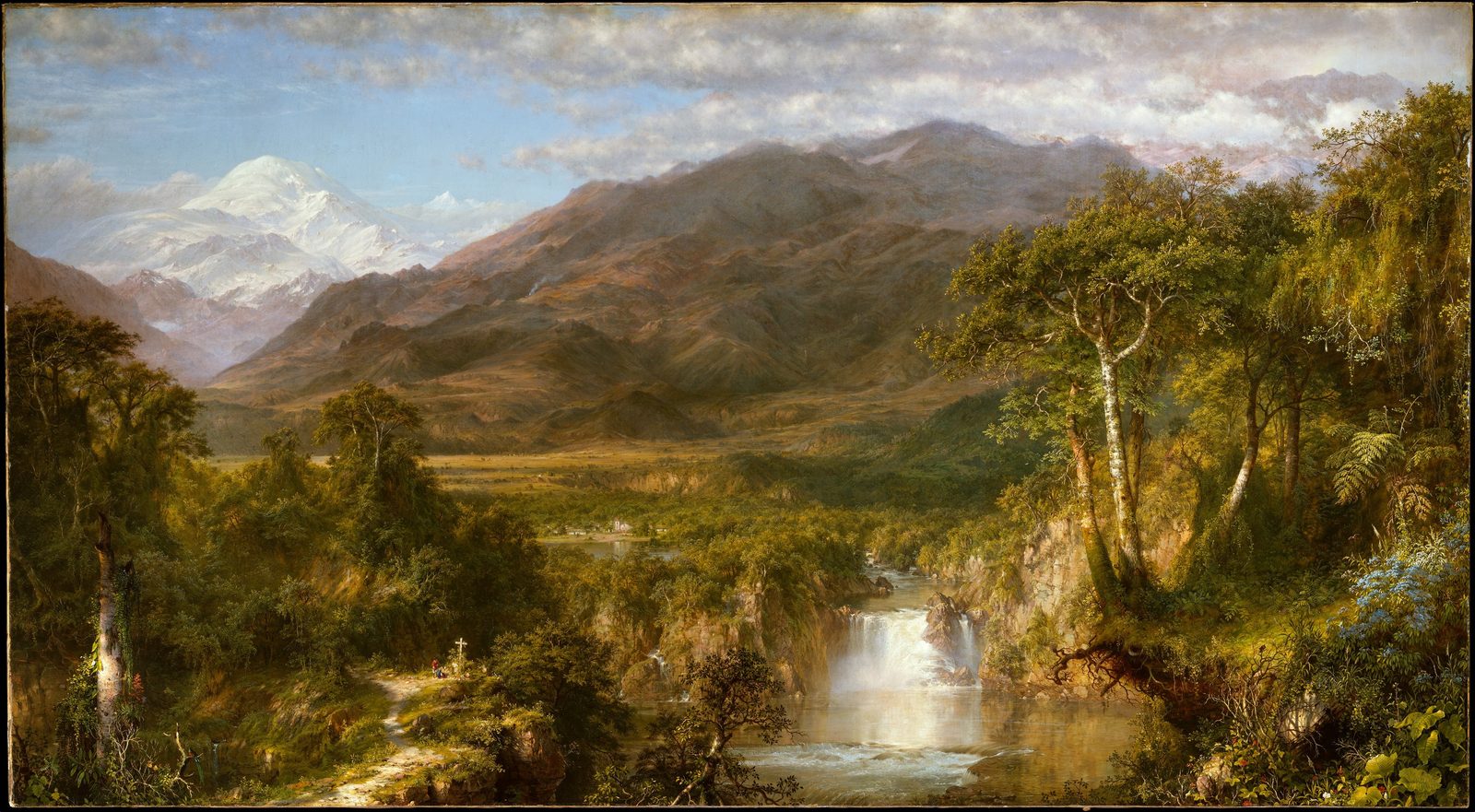
Heart of the Andes gives the convincing impression of a single view: a shimmering pool fed by a waterfall in the middle distance, a snow-capped Mount Chimborazo rising beyond it, and a tangle of jungle foliage in the foreground. Wikipedia's account, drawing on the Metropolitan Museum's history of the work, describes it instead as a synthesis of "numerous topographies of the Andes into his composition, from Mount Chimborazo to a plain and a jungle"; other sources describe the composite as spanning at least five distinct Ecuadorean bio-regions, from tropical lowland to alpine peak. Church built the picture from scores of pencil and oil sketches made during two separate expeditions to Ecuador and Colombia, in 1853 and 1857, the second trip financed by the businessman Cyrus West Field. Monet later built an entire body of work the opposite way, returning to one motif dozens of times instead of compressing many places into one canvas, but both approaches share the same premise: a finished landscape doesn't have to record a single sitting in front of the subject.
The composite wasn't an accident of convenience. Church was working directly from the influence of the Prussian naturalist Alexander von Humboldt, whose treatise Kosmos argued that a landscape painting could capture the full "physiognomy," or characteristic climatic range, of a region rather than a single spot in it. Church retraced Humboldt's own South American route and intended the finished canvas as a kind of tribute. On May 9, 1859, near the end of the painting's first New York exhibition, he wrote to the poet Bayard Taylor that he planned to ship it to Berlin so Humboldt, by then in his eighties, could see "a transcript of the scenery which delighted his eyes sixty years ago." Humboldt had already died three days earlier, on May 6, and the exhibition itself, which had opened April 29, didn't close until May 23. The trip never happened.
The 1859 exhibition itself was staged as a spectacle: a custom frame roughly fourteen feet wide and thirteen feet high, built low to the ground so the painted horizon sat at eye level, with drawn curtains and directed skylighting meant to make the canvas feel like a window rather than a picture on a wall. But one detail repeated in many popular accounts, that the room was decorated with palm fronds and lit with gaslights fitted with silver reflectors, is flagged by Wikipedia's sourcing as "widely claimed, although probably falsely"; no contemporary record of the exhibit's actual appearance survives to confirm it. What is documented is the price: Church sold the painting to the collector William Tilden Blodgett for $10,000, the highest sum then paid for a work by a living American artist, with a clause letting Church resell it if a buyer offered $20,000 or more. That record stood for six years, until the painter Albert Bierstadt sold The Rocky Mountains, Lander's Peak for $25,000 in 1865.
What is well documented, from the exhibition itself, is the crowd it drew. More than 12,000 people paid a 25-cent admission fee to see the single canvas during its first New York run, and opera glasses were provided so visitors could examine the painted detail up close, an amenity that suggests the crowding in the room made close viewing difficult without them. The writer Mark Twain saw it more than once and described in a letter to his brother returning again and again, each time noticing detail he'd missed before, until his "brain" was "gasping and straining with futile efforts to take all the wonder in." Twain's reaction, like the crowd's, was a response to a landscape built specifically to overwhelm a single, fixed vantage point with more geography than any one vantage point could actually contain.