What separates 'abstract' from merely simplified
People use "abstract" loosely, for anything from a blurred landscape to a geometric print. Tate's glossary is more exact: "Abstract art is art that does not attempt to represent an accurate depiction of a visual reality but instead uses shapes, colours, forms and gestural marks to achieve its effect." That definition draws a real line, not just a stylistic one. A Cubist portrait that fractures a face into planes is still, technically, a picture of a face. A fully abstract work has given up that anchor: there is no object left to recognise underneath the paint, only the arrangement of paint itself.
Tate credits Kazimir Malevich and Piet Mondrian as "pioneers of 'pure' abstract painting... from about 1910-20", and for most of the twentieth century Wassily Kandinsky held the same title, usually attached to a specific sheet of paper and a specific year. That single work, and the date attached to it, turns out to be the least settled fact in the whole story of how painting stopped representing anything. Malevich's Black Square, the best-known monochromatic painting, has more hiding under it than one colour.
Nothing about that line appeared overnight. Cubism and Fauvism spent the years before 1910 breaking a painted face or landscape into planes and unnatural colour without ever quite letting go of the underlying subject, which is why they count as only partial abstraction, not the full kind. Tate's account of the period treats those movements as groundwork rather than the finish line, noting that they "opened the door for more extreme approaches to abstraction" that painters then walked through. What happened next, and specifically who walked through first with no subject left at all, is the part the record does not settle cleanly.
The dispute is not folklore passed between blogs. It runs through two separate museums' catalogue records, and it is worth tracing exactly, because the answer changes depending on which record you trust and how far back you are willing to look outside the exhibited art world of the time.
The catalogue card that argues with the artist's handwriting
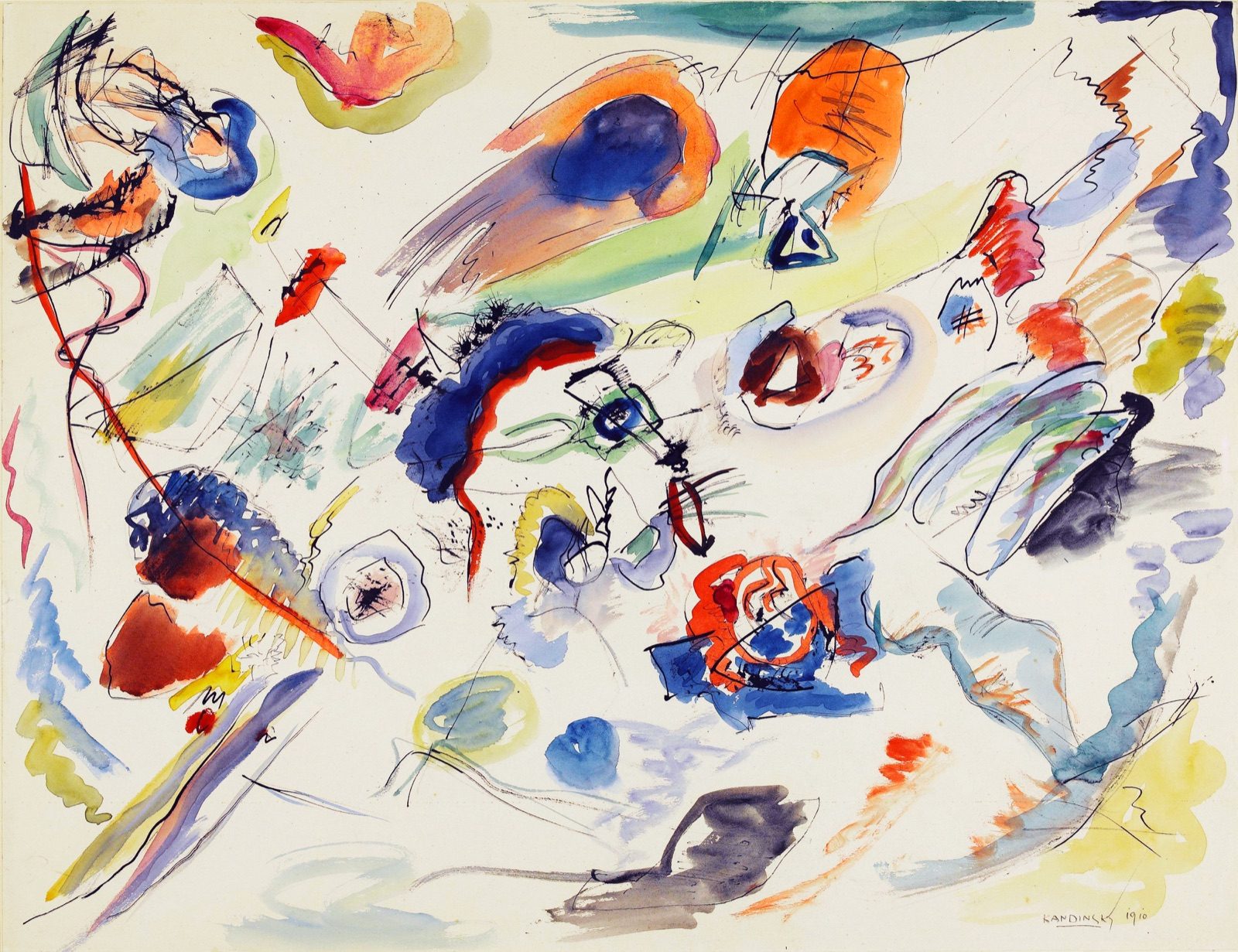
The watercolour usually shown as the starting point hangs in the graphic art collection of the Centre Pompidou in Paris. The museum's collection record gives its formal title as "Sans titre" (Untitled), its medium as "mine graphite, encre de Chine et aquarelle sur papier" (graphite pencil, Chinese ink and watercolour on paper), and its dimensions as 49.6 by 64.8 cm. It entered the collection as inventory number AM 1976-864, a gift from the artist's widow, Nina Kandinsky, in 1976.
Two details in that same record pull against each other. The back of the sheet carries Kandinsky's handwritten inscription, reading "Kandinsky 1910 // Aquarelle 1910 / (abstraite)". But the date field in the Centre Pompidou's catalogue, the field a researcher would cite, reads 1913. The museum that owns the work and transcribed that inscription into its database has, in effect, dated the object three years later than the artist dated it himself.
The catalogue does not erase the older claim; it just no longer endorses it as fact. The Pompidou's teaching materials for this work still record its popular, attributed title as "Première abstraction, aquarelle", literally "first abstraction, watercolour", the name several generations of art history absorbed as settled. The formal catalogue entry and the informal legend now sit on the same page, disagreeing with each other.
Why the redating holds up
A backdated inscription is a strong claim to make about a working artist, so it is worth asking what evidence moved the date. The Pompidou's published resource on the work sets out the reasoning in terms of what changed in Kandinsky's technique and when: the independence of colour and line from any descriptive job, what the museum's text calls the mark's "autonomie", is a quality that only appears in his output from 1911 onward. Colour patches that float in an indeterminate space rather than sitting inside a drawn contour are, by the same account, a feature of work later than 1912. Measured against those two markers, this sheet reads as a piece of 1913, not 1910.
That kind of dating is stylistic, not documentary, comparing one undated object against a body of dated ones, which is why it is a scholarly consensus rather than a certified fact. But it is the same method conservators use to date any undocumented sheet of paper, and it is why the Pompidou's database, not a popular retelling, now carries 1913 as the object's date.
A parallel body of abstract work already existed in Stockholm
Even a corrected 1913 leaves Kandinsky short of first, because someone else had already got there and left a larger, dated body of work behind. Hilma af Klint, born in Stockholm in 1862 and academically trained as a painter of landscapes and botanical studies, spent her twenties and thirties inside Swedish spiritualist circles; the Guggenheim's account of her describes her attending seances from the age of seventeen and immersing herself in Theosophy alongside her conventional training.
In 1905 she recorded hearing what she took to be an instruction from a spiritual source, telling her, in words the Guggenheim has preserved, "You are to proclaim a new philosophy of life." Between November 1906 and March 1907 she painted a group of canvases now known as the Primordial Chaos series, working with no recognisable subject at all. Tate's magazine, Tate Etc, states the comparison directly: "a Swedish painter by the name of Hilma af Klint had created her first abstract painting in her Stockholm studio in 1906, five years before him" — him being Kandinsky, on the date long attached to his name.
The Ten Largest, painted on the studio floor
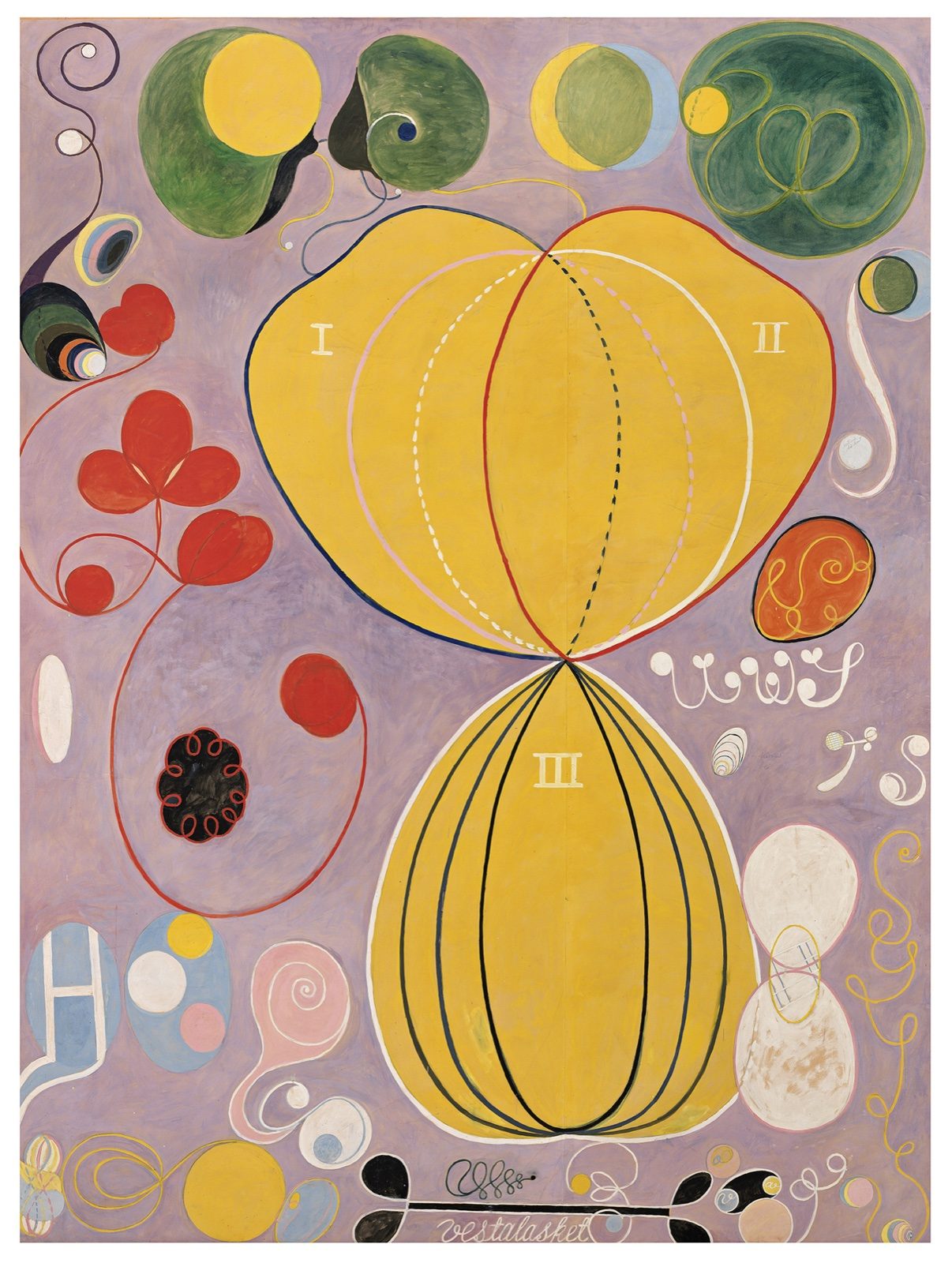
Af Klint followed that series with an even larger undertaking. Moderna Museet's collection guide records that "the monumental images that make up the suite The Ten Largest were painted in egg tempera on paper mounted on linen" across the second half of 1907, worked on sheets laid on the studio floor because the tempera dried too quickly to manage upright. Each of the ten canvases, some over three metres tall, took roughly four days to complete. The series traces four phases of a life — childhood, youth, adulthood and old age — through spirals, looping tendrils and unmodulated fields of colour with no horizon, no figure and no object anywhere in the frame.
None of it was made for a gallery wall. Af Klint painted within a private circle of four other women, later called The Five, who held regular seances and recorded what they described as messages from spiritual sources; the paintings were, by her own account, executed under that guidance, not composed as exhibition pieces. That context is exactly why the work stayed outside art history for so long: it was never made to enter the conversation Kandinsky was having in Munich. Non-representational art has found unconventional doorways more than once: decades later, a Los Angeles psychiatrist's 1950s LSD studies pushed professional artists toward their own unplanned departures from recognizable subject matter, a different route to a broadly similar kind of break.
Two trains on the same tracks, and only one line got a platform
Tate Etc's account of the two painters is careful not to claim influence in either direction: "Without knowing of each other's existence, the two artists seem to have travelled for a long way like two trains on the same tracks." Kandinsky was publishing manifestos, exhibiting with the Munich avant-garde, and co-founding what became Der Blaue Reiter; af Klint showed her abstract work in public only a handful of times in her life, mostly at spiritual gatherings, seldom at art exhibitions. Priority in art history has tended to track publication and exhibition as much as the date on the canvas, and on that ledger Kandinsky had every advantage.
Af Klint compounded her own obscurity on purpose. She left her collection of more than a thousand abstract paintings and works on paper to her nephew with instructions that they remain unseen for a fixed period after her death in 1944, convinced her own era was not ready for them. She was shown to an international audience for the first time only in the mid-1980s, when the art historian Ake Fant introduced her paintings at a Nordic conference in Helsinki. Moderna Museet gave her a dedicated exhibition in 2013. The reassessment reached its widest audience in 2018, when the Guggenheim's Hilma af Klint: Paintings for the Future opened in New York; the museum's account of the show states that "more than 600,000 visitors have attended Hilma af Klint: Paintings for the Future, the highest recorded attendance figure for a single exhibition in the museum's history." Institutions have shaped which abstract pioneers get remembered in more than one case: the Guggenheim's forerunner institution was originally named the Museum of Non-Objective Painting after curator Hilla Rebay, who was pushed out in 1952, the same year the museum dropped the term from its name.
So who actually painted the first abstract picture?
The honest answer is that the question assumes a cleaner finish line than the record supports. If "first" means the earliest dated body of fully non-representational work, af Klint's Primordial Chaos paintings of late 1906 currently hold that position over any work reliably dated to Kandinsky. If "first" means the earliest work that actually entered and shaped the public conversation about abstraction as it happened, Kandinsky keeps the title regardless of what year his own museum now assigns to a single watercolour, because af Klint's work did not reach that conversation until both painters were long dead. Both answers are defensible; they are just answers to different questions wearing the same word.
What the Pompidou's catalogue entry demonstrates, more than a shift in credit from one painter to another, is how much a settled art-historical fact depends on institutions actively maintaining it. The date on a watercolour changed not because a new document surfaced but because scholars re-examined the object against the rest of a career and updated the record. Checking a museum's catalogue fields against the popular story around a work turns up this kind of gap more often than casual readers expect, in much the same way Monet's water lily canvases turn out to document a pond he built and planted himself rather than a scene he simply found.
_by_Wassily_Kandinsky.jpg)
