A print dated 1506 that couldn't have been made in 1506
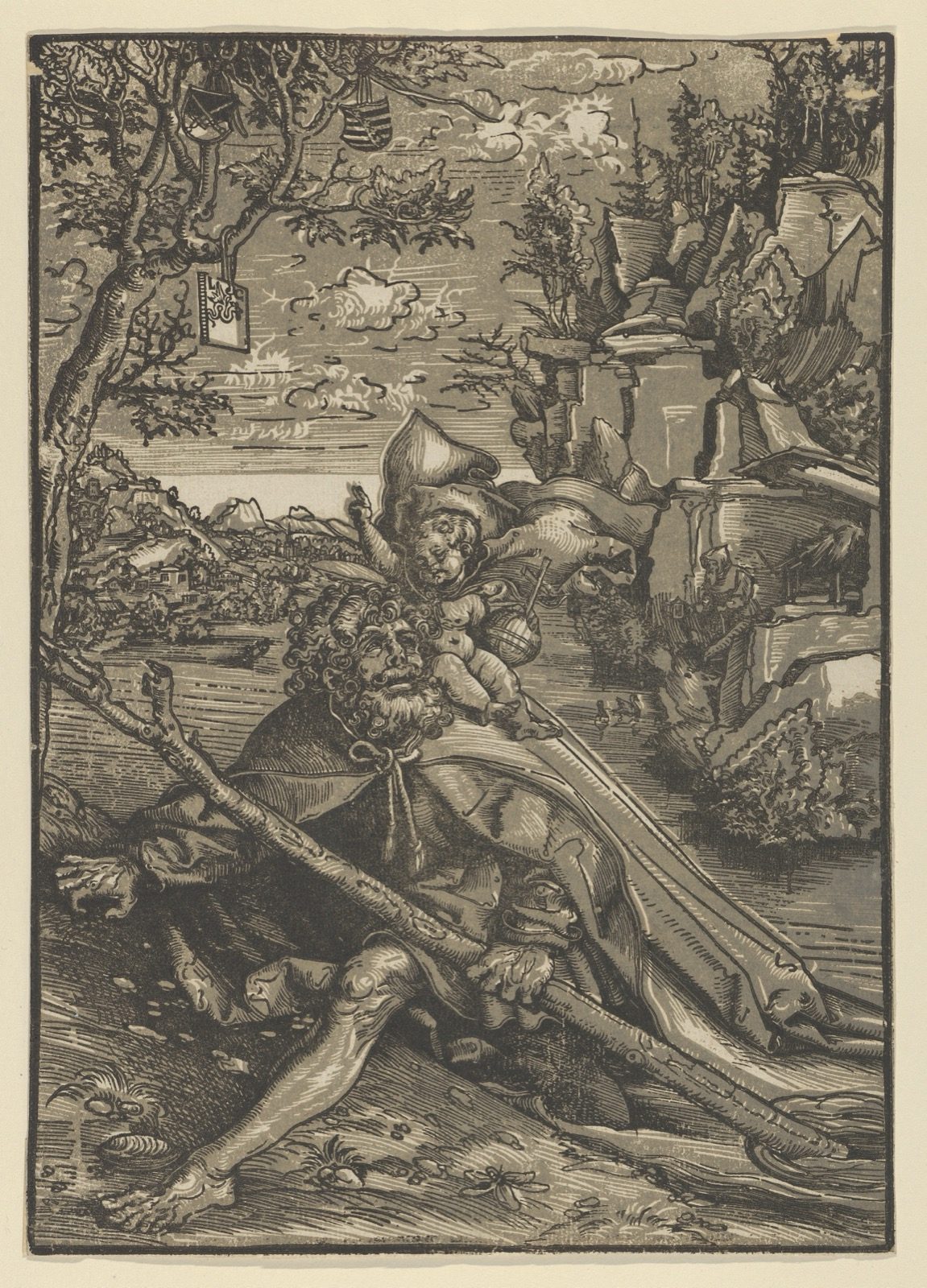
A chiaroscuro woodcut is a color print built from two or more carved wood blocks printed in registration on the same sheet. One block, the key block, carries the black outlines; the others, the tone blocks, add flat areas of color, and the paper shows through wherever a tone block is cut away, standing in for a highlight. The technique imitates a chiaroscuro drawing, ink and white gouache worked over toned paper, in a medium that could be printed dozens of times over instead of drawn just once. The Metropolitan Museum's own object record for Cranach's Saint Christopher describes the physical result plainly, cataloguing the sheet's medium as a chiaroscuro woodcut printed from two blocks, in a late impression pulled from the same worn wood long after the original printing.
The Metropolitan Museum's collection record for one of the earliest surviving examples, Lucas Cranach the Elder's Saint Christopher, dates the print to 1506, following the date Cranach inscribed on the block. The Cleveland Museum of Art holds a different impression of the same print and, in its published description of the object, rejects that date outright: "Although Saint Christopher is dated 1506, it was probably made after 1508, when Cranach was granted permission by Duke Friedrich to use the coat of arms with a winged serpent seen hanging from the tree." The museum's reasoning runs on two separate strands of evidence. Cranach is documented using that particular coat of arms only from 1508 onward, which leaves an authentic 1506 impression carrying it hard to explain. And the tone block itself, the feature that makes the print a chiaroscuro woodcut and not an ordinary line woodcut, appears in Cranach's output only after a 1508 trip to the Netherlands, where the museum's account holds that he learned the technique from a rival working in Augsburg, Hans Burgkmair.
The Art Institute of Chicago holds its own impression of Saint Christopher, catalogued independently, and its online object record lists the date as "c. 1509," not 1506. Two museums cataloguing two physical impressions of the same print, working from the same inscribed date, have each declined to accept it at face value. Cleveland's account goes further than simple doubt: it names what it believes happened. Cranach, on this reading, produced Saint Christopher and a companion print, Venus and Cupid, using tone blocks sometime after 1508, then backdated both to 1506, years before he had any documented reason to have used the technique at all.
A patron's proof, or a rival's commission
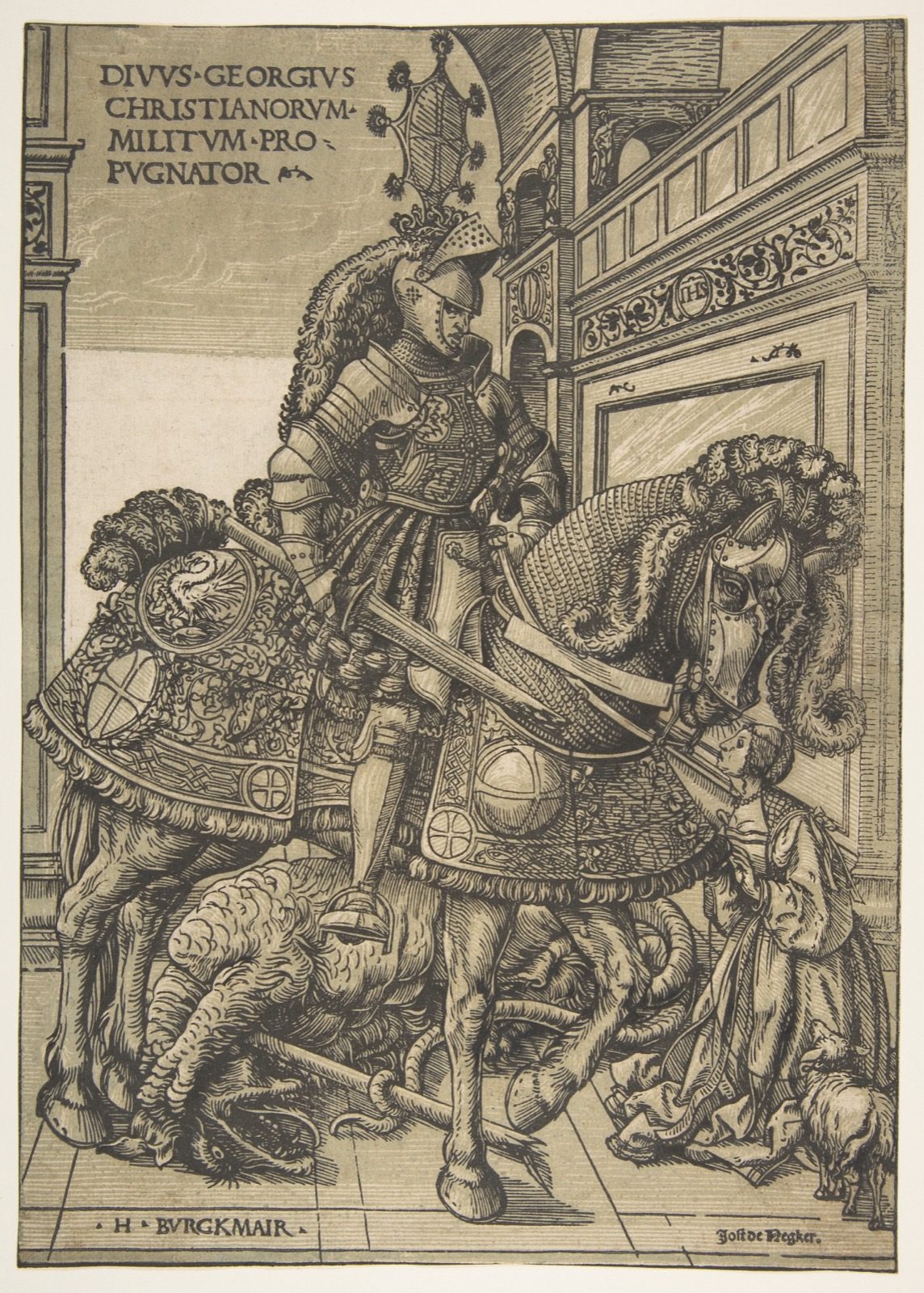
A more flattering account of the same years survives in institutional retellings tied to the Metropolitan Museum's collection. In 1507, Cranach's patron Frederick III, elector of Saxony, sent a proof impression of a Cranach print to Conrad Peutinger, a councillor to the future Holy Roman Emperor Maximilian I based in Augsburg. Peutinger was impressed enough by the print's coloring that he commissioned Hans Burgkmair, an Augsburg printmaker, to produce chiaroscuro woodcuts of his own; the following year, Peutinger sent Frederick two of Burgkmair's results. On this telling, Cranach was demonstrably first, with a finished proof already circulating a year or more before the earliest date Cleveland allows for his tone-block prints, and Burgkmair followed as a direct, commissioned response.
The two accounts do not fit together. If Cranach had a proof impressive enough to send to a foreign councillor in 1507, the technique behind it cannot also be something he only picked up on a trip abroad the following year. Wikipedia's synthesis of the surrounding scholarship acknowledges the contradiction without resolving it, stating that the two-block chiaroscuro woodcut "was probably first invented by Lucas Cranach the Elder in Germany in 1508 or 1509, though he backdated some of his first prints," while also noting a separate, competing view crediting Burgkmair "in all probability" instead, developing the technique for Emperor Maximilian as a cheap way to circulate his image widely. Neither museum record, Cleveland's or the Peutinger account tied to the Met, treats the other as settled.
A third German printmaking center complicates the timeline further. According to the same Wikipedia synthesis, a block-cutter, a formschneider, working in the press of the Strasbourg publisher Johannes Schott is credited as the first to produce a chiaroscuro woodcut printed from three separate blocks, adding another named claimant to a technique that, within a single decade in southern Germany, already had at least two artists and one anonymous craftsman with a documented stake in having done it first.
Vasari gave the invention to Italy anyway
Ugo da Carpi's documented career starts well before his 1516 patent, and none of it involves chiaroscuro. In 1502, back in his home region near Modena, he signed a contract with two local typographers to carve type characters and printing punches, ordinary trade work with no connection to fine-art printmaking. By 1503, records refer to "Ugo's pupils," suggesting he had already opened a small workshop of his own. He is thought to have left for Venice sometime between 1503 and 1509, and once there he spent his first documented years working as an ordinary blockcutter for illustrated books, the kind of trade labor that left him signing his surviving prints as "the cutter," not as a designer. In July 1516, roughly seven to nine years after Burgkmair and Cranach were already working in the technique with documented prints, Ugo petitioned the Venetian Senate for a copyright covering what he described in his petition as a "new manner of printing light and dark." He asked for exclusive rights, for an unlimited period, over every design and woodcut he had made and would go on to make. Two years later, in 1518, Pope Leo X granted him a separate copyright specifically for a four-block chiaroscuro print, The Death of Ananias, depicting the apostles confronting the biblical figure who lied about the proceeds of a land sale.
Giorgio Vasari, writing his Lives of the Most Excellent Painters, Sculptors, and Architects three decades later, settled the invention on Ugo without qualification. A widely used English translation of the relevant passage has Vasari writing: "Ugo was the first to try, and he succeeded well, to work with two blocks, one of which, used like a copper plate, served for hatching the shadows, and with the other he made the color tones, because cutting into the block in intaglio he allowed the white paper to show, which seemed, when it was printed, to be highlights printed in white." The passage makes no mention of Cranach, Burgkmair, or any printmaker working north of the Alps. In the same 1550 book that gave the Renaissance its cast of Italian artists, and in its preface the very word rinascita that the period is named for, Vasari also handed a wholly Italian origin story to a printing technique that had already been circulating in Germany for the better part of a decade before Ugo filed his petition.
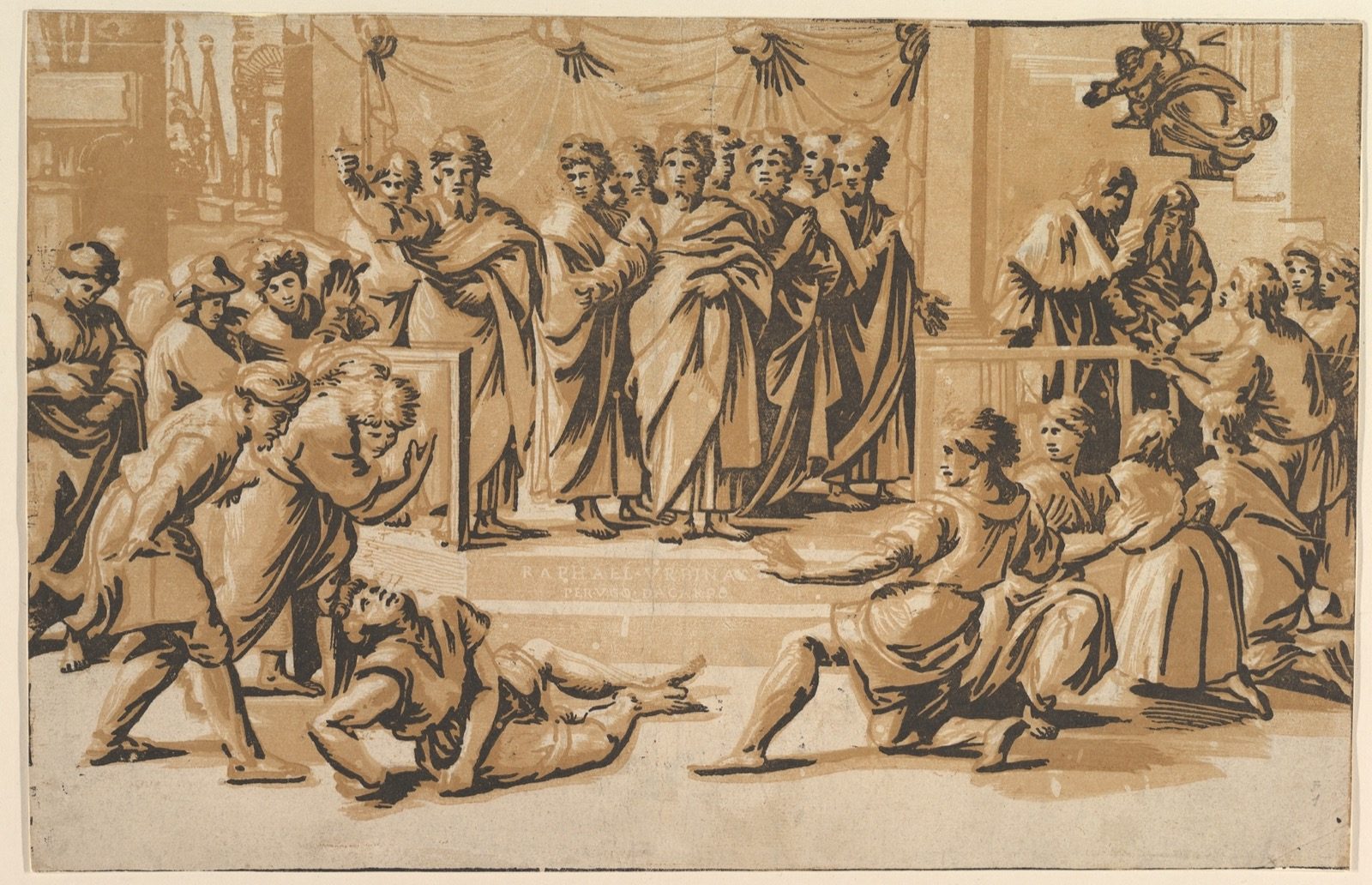
What reference works say now
Modern reference accounts reject Vasari's claim of Italian precedence in plain terms. Wikipedia's synthesis of the scholarship states it directly: "Despite Vasari's claim for Italian precedence in Ugo da Carpi, it is clear that his, the first Italian examples, date to around 1516," seven years past 1509, the latest year even the most cautious dating assigns to the German prints. Rejecting Ugo's priority does not settle the question Vasari's account skipped over entirely, though: which German printmaker actually got there first. The scholarship offers no single answer, only Cleveland's case for Burgkmair as the true source that Cranach copied and concealed, set against the Peutinger-proof account's case for Cranach as the genuine originator that Burgkmair was commissioned to follow.
A separate, looser reading of the term pushes the timeline back even further, and outside Germany entirely. Some sources credit the Italian painter Andrea Mantegna's Triumph of Julius Caesar, produced sometime between 1470 and 1500, as the first chiaroscuro woodcut, years or decades before the German printmakers, and decades before Ugo da Carpi's Venetian filing. That claim rests on a broader definition of chiaroscuro printing than the specific two-block, tone-and-highlight process Cranach, Burgkmair, and Ugo all worked in, and reference accounts that mention it generally treat it as a separate strand of the term's use, not a direct rival claim to the same invention.
What survives across all these accounts is a technique whose origin story keeps failing the same test: a specific date, checked against a specific fact on the ground, that the date cannot explain. Cranach's coat of arms was not his to use until 1508, on a print he dated 1506. Ugo's Venetian Senate petition described his process as new in a year when it was already close to a decade old somewhere else. Vasari's Lives supplied the Renaissance with its name and its cast of artists in the same 1550 book that also invented a murder its subjects could not have committed, and the same author's confident, undocumented account of who invented the chiaroscuro woodcut follows a similar shape: a good story, told without the archival check that later museum records, working from the objects, keep failing to confirm. A ceramic technique three centuries later ran into a related problem, a name borrowed from an older process it never actually used, a reminder that mismatched names and uncheckable origin stories were never unique to sixteenth-century printmaking.