A paragraph that cost more than the painting
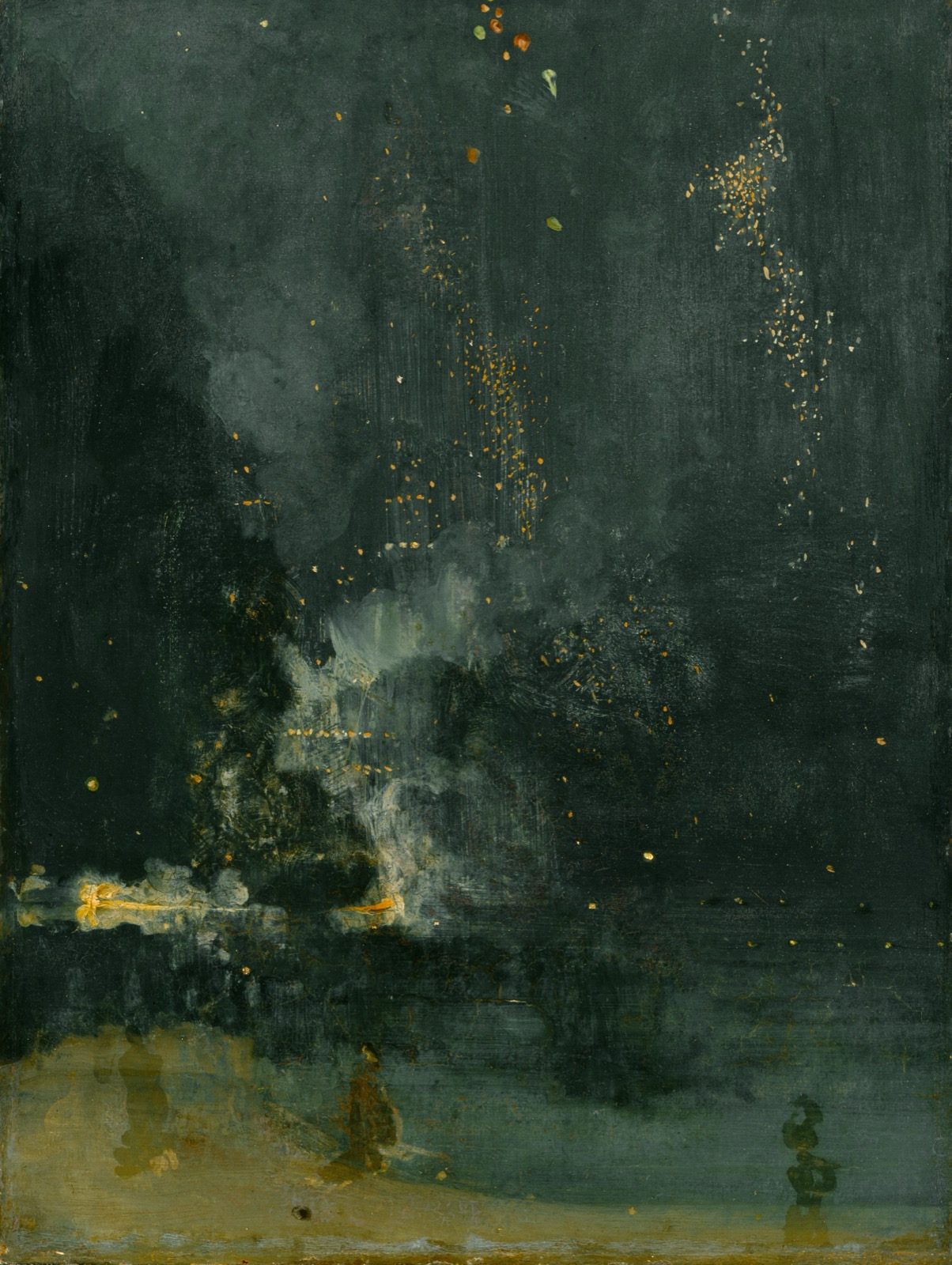
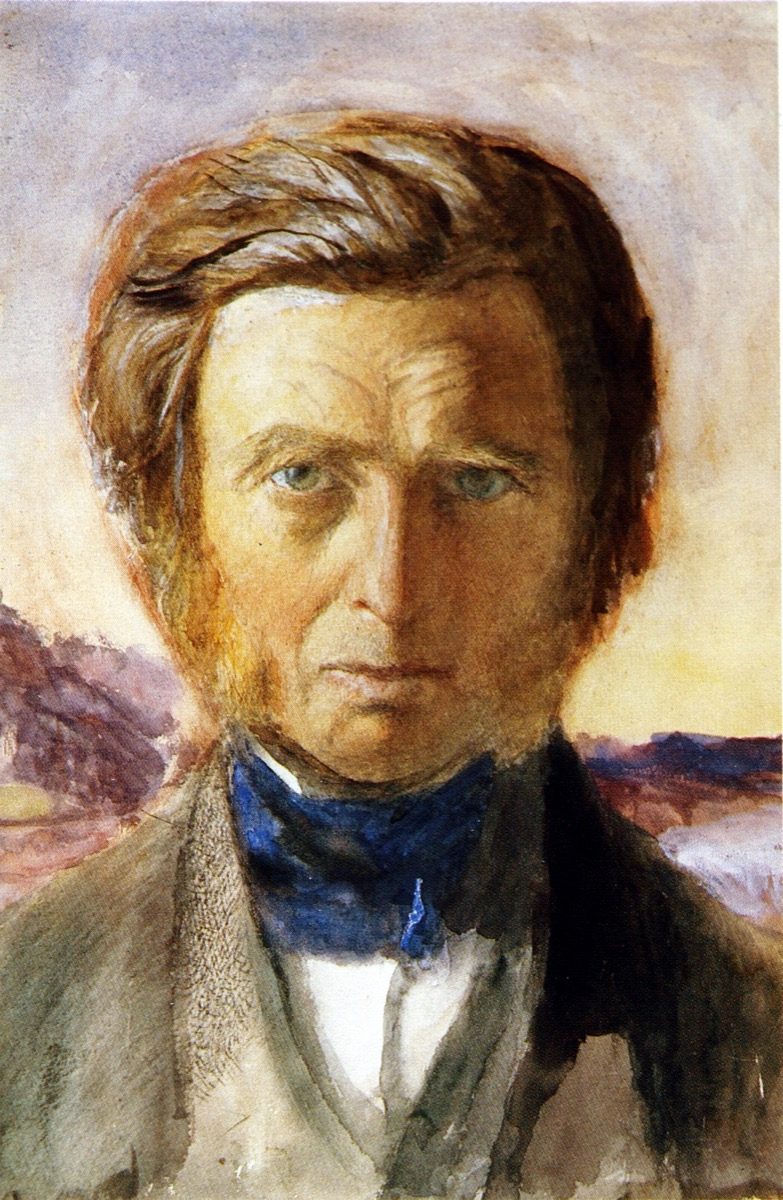
In the summer of 1877, John Ruskin visited the newly opened Grosvenor Gallery in London and saw eight works by Whistler on display, including a small night scene of fireworks bursting over the Thames pleasure gardens at Cremorne. Ruskin wrote up his reaction in Fors Clavigera, the personal periodical he published in irregular monthly letters to working men. "I have seen, and heard, much of Cockney impudence before now; but never expected to hear a coxcomb ask two hundred guineas for flinging a pot of paint in the public's face," he wrote of the painting, which Whistler had titled Nocturne in Black and Gold: The Falling Rocket and priced at 200 guineas.
Whistler sued for libel, claiming one thousand pounds in damages, a figure that was not chosen at random. It matched, almost to the pound, a sum a former patron named Frederick Leyland had recently refused to pay him for an unrelated commission. Ruskin's side pleaded fair comment: that a painting shown to the public could be criticized, however harshly, without exposing the critic to a lawsuit. The harshness itself was out of character for a critic who had spent much of his earlier career championing painters other reviewers dismissed. More than two decades before he savaged Whistler, Ruskin had offered the young Pre-Raphaelite artist Elizabeth Siddal an annual allowance in exchange for first claim on her work, telling associates he rated her promise alongside Dante Gabriel Rossetti's own. The writ went out on 28 July 1877; the case took sixteen months to reach a courtroom, not because either side was stalling, but because the defendant spent most of that time unable to leave his house.
The defendant who couldn't attend his own trial
A jury trial had originally been scheduled for early February 1878. At the end of January, proceedings stopped without warning. Ruskin's mind was giving way. By late February he had suffered a full breakdown, later telling his American friend Charles Eliot Norton that he had lost himself in visions of Saint Ursula and other saints, gripped by what he called "strayed wits" brought on, he believed, by a temporary inflammation of the brain. In March he wrote to Thomas Carlyle that he had gone "heartily & headily mad," describing his terror at the shapes firelight threw across his mahogany bedpost at night.
The trial was pushed to the Trinity court sittings that summer, then pushed again. In late April, Ruskin's solicitor warned that he would be too unwell to appear for several months. A physician who had treated him through the episode, George Parsons, certified in writing that Ruskin remained in a "totally unfit state of health" to prepare a defense. The case did not finally open until 25 and 26 November 1878, and Ruskin never set foot in the courtroom. He deputized the entire defense to his solicitors and to the friends they called as witnesses on his behalf.
A courtroom record that no longer exists
Nineteenth-century English courts routinely destroyed trial records once a case was closed, and Whistler v. Ruskin was no exception. What survives of the two days of testimony comes entirely from newspaper reporters who condensed the exchanges in shorthand for their columns, then set them in type overnight. That secondhand chain matters, because the trial's single most repeated line has drifted slightly from what those reporters actually recorded.
Cross-examining Whistler about how quickly he had painted the Falling Rocket, the attorney general, Sir John Holker, pressed him: "The labor of two days is that for which you ask two hundred guineas." Whistler's reply, as multiple newspapers took it down, was longer than the version usually quoted today: "No. I ask it for the knowledge I have gained in the work of a lifetime." The line drew applause loud enough that the judge, Baron Huddleston, had to threaten to clear the court if it happened again. The popular short form, "I ask it for the knowledge of a lifetime," trims a phrase from a courtroom exchange that nobody alive can check against an official transcript. A painter's courtroom troubles over where art crosses into obscenity turn up again a few decades later and a country away: Egon Schiele's 1912 kidnapping charge in Neulengbach collapsed before trial, but a separate conviction, for showing an erotic drawing where local children could see it, still sent him to jail for 24 days.
The reluctant witness who had asked to testify
Too ill to attend, Ruskin needed friends willing to look at Whistler's paintings under oath and call them unfinished. His chief witness was the painter Edward Burne-Jones, who told the court that the Nocturnes were "an admirable beginning" but "deficient in form" and without composition, testimony he delivered, by most accounts, with visible reluctance.
That reluctance was staged. In 1921 the biographers Elizabeth and Joseph Pennell published The Whistler Journal, and buried in an appendix was a document that had never before been made public: a written opinion Burne-Jones had privately supplied to Ruskin's solicitors ahead of the trial, laying out his case against Whistler in far blunter terms than he used on the stand. Ruskin himself had not sought Burne-Jones out. Writing to the solicitors Walker, Martineau & Co. that November, he described his friend as "chief of men... to whom they might refer for anything which in their wisdom they can't discern unaided concerning me," but the offer to help had come from Burne-Jones more than a year earlier, long before Ruskin decided he needed it.
The grudge behind it predated the Grosvenor Gallery review by a decade. In 1867, Whistler had quarreled with his brother-in-law, the etcher Francis Seymour Haden, over how Haden had handled the death of a mutual friend in Paris, and shoved him through a plate-glass window; when the painter Alphonse Legros took Haden's side, Whistler struck him too. Burne-Jones, loyal to Legros, told an intermediary at the time that he wanted to "take Whistler on" himself. He never confronted Whistler directly. The libel trial, eleven years later, gave him a courtroom instead of a duel, and by his own later account he still hadn't finished with the idea of a fight: after the trial he wrote to a friend that if it ever came to an actual duel, the weapons would be "pots of oil paint" and he would choose "prussian blue as the most effective weapon I know."
A verdict built to insult both sides
The jury deliberated and returned a verdict for Whistler, technically a win, then set damages at one farthing, the smallest coin in circulation, and declined to award him the costs of bringing the case at all. In his instructions to the jury, Huddleston had floated exactly this outcome in advance, describing "contemptuous damages, to the extent of a farthing or something of that sort" as the appropriate response to a case that, in his view, should never have been brought to court in the first place. The jury took the hint almost to the letter.
The verdict answered nothing about whether Ruskin's review was fair criticism or malicious libel; it simply told both men their fight had been a waste of the court's time. Whistler had his moral victory and a coin worth a quarter of a penny. Ruskin, spared paying a real sum, still lost the case in every way that mattered to his standing as a critic willing to say what he thought. Art-market lawsuits keep landing on that same kind of non-answer: more than a century later, a $20 million lawsuit over a disputed Andy Warhol self-portrait ended when the collector who filed it ran out of money to keep fighting, leaving no court ruling on whether the painting was genuine.
The debt that came before the verdict, not after
Whistler was declared bankrupt in May 1879, and the standard version of events treats the trial's costs as the cause. His own letters tell a fuller story. Through 1876 and into 1877, Whistler spent a year decorating a London dining room for Leyland, the commission now known as the Peacock Room, and by the time it was finished he told the collector William Graham he could not repay a hundred-pound advance because the job had proved "anything but remunerative... Indeed it has left me very ill off." Leyland, furious at the final scope and cost of the redecoration Whistler had carried out largely without his sign-off, refused to pay the balance, and that unpaid balance, not the libel case, is the sum Whistler tried to recover by suing Ruskin for exactly one thousand pounds.
The Peacock Room shortfall wasn't the only drain on his finances that year, either. In the same months he filed suit, Whistler committed to an elaborate new house and studio on Tite Street, designed by the architect E. W. Godwin, a project Whistler was by his own later admission poorly positioned to afford in 1877. Two debts, not one, were compounding at the same time the libel case dragged on. Losing the case, and being left to cover his own legal bills with no damages to offset them, accelerated a collapse that was underway on its own terms. The trial arrived on top of debts Whistler had already run up, at a moment when he could least afford another year without income.
The resignation Ruskin blamed on the wrong thing
Shortly before the trial opened, Ruskin wrote privately to Dean H. G. Liddell at Oxford to say he intended to resign his post as Slade Professor of Fine Art, attributing the decision entirely to his health. Two days after the farthing verdict, he wrote to Liddell again, this time recasting the resignation as a matter of principle: "I cannot hold a Chair from which I have no power of expressing judgment without being taxed for it by British Law."
The reframing didn't quite hold up. The passage a jury had just ruled on came from Fors Clavigera, a personal periodical Ruskin wrote and published on his own account, not from any lecture or publication tied to his Oxford chair. Scholars examining the resignation have pointed out that blaming the verdict for a professorship it had no legal bearing on let Ruskin recast an illness-driven retreat as a principled protest, and the reframed version, not the original explanation to Liddell, is the one that stuck in the public record of why he left Oxford.