A landscape finished five months before the model arrived
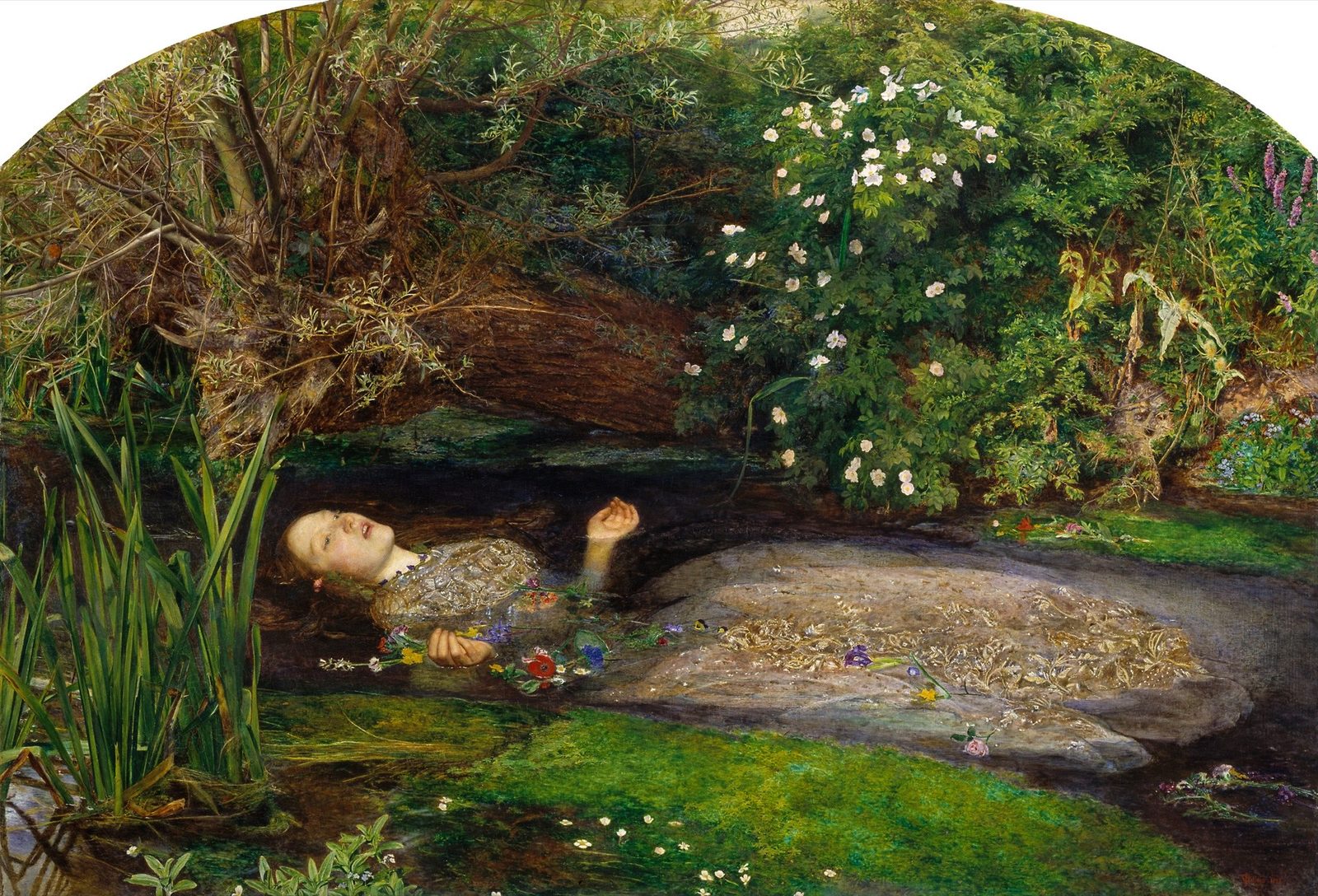
In the summer of 1851, Millais left London for Ewell in Surrey and set up his easel on the bank of the Hogsmill River, a small tributary of the Thames, to paint the landscape that would become the setting for Ophelia before he had painted a single inch of the figure who would drown in it. He and fellow Pre-Raphaelite William Holman Hunt, who was painting The Hireling Shepherd nearby that same season, shared the conviction that a picture's setting deserved the same close observation as its human subject, which is why Millais painted the river, the overhanging willow, and the wildflowers on its banks from direct observation before he had a model in front of him at all.
The work outdoors ran from July to December 1851, by most accounts eleven hours a day, six days a week, sitting cross-legged under an umbrella at the water's edge. Millais described the ordeal in a letter to Mrs. Combe, wife of his patron Thomas Combe, that has been quoted ever since: "I sit tailor-fashion under an umbrella throwing a shadow scarcely larger than a halfpenny for eleven hours, with a child's mug within reach to satisfy my thirst from the running stream beside me." Only once the landscape was essentially complete, deep into winter, did Millais return to his studio at 7 Gower Street in London (numbered 83 at the time; the street was renumbered later) to paint the figure of Ophelia herself, working from a model against a canvas that had already spent five months recording a stretch of riverbank in a different season, the kind of directly observed working process that leaves none of the gaps in the documentary record that surround earlier, undocumented commissions like the Uffizi's uncertain account of who ordered The Birth of Venus.
Truth to nature, painted one wet patch at a time
The extraordinary time Millais spent on the landscape is itself evidence of a working method the Pre-Raphaelite Brotherhood, which Millais had co-founded with Dante Gabriel Rossetti, William Holman Hunt, and four others in 1848, treated as doctrine, not personal habit. The group's shorthand for its guiding principle was truth to nature: painting a subject from direct, sustained observation of the real thing, without relying on memory or studio convention. For Ophelia's background, that meant Millais would not begin painting the water, the willow, or any individual wildflower until he was sitting in front of it on the actual riverbank at Ewell, session after session, through an English summer and autumn, adding each plant to the canvas only once he could see it in bloom.
The brotherhood also worked with a technical method suited to that doctrine, applying oil paint onto a ground of wet white lead paint rather than letting the ground dry first, a method conservators now generally call wet white. Painting into a wet ground kept the colour glazed on top of it bright and luminous, since paint sinks and dulls once it soaks into an already-dried, absorbent surface. It also meant Millais had to finish each small area of canvas before that patch of white dried underneath him, forcing him to work the picture in a patchwork of freshly primed sections, never moving across the whole canvas at once, and making later corrections to any already-finished passage extremely difficult to carry out cleanly.
The dress cost four pounds, the illness cost more
For the figure, Millais chose Elizabeth Siddal, a milliner's assistant and aspiring painter and poet who modeled for several Pre-Raphaelite Brotherhood members. He clothed her not in a costume made for the sitting but in a genuine antique gown, bought secondhand specifically for the picture. He wrote of the purchase at the time: "To-day I have purchased a really splendid lady's ancient dress-all flowered over in silver embroidery-and I am going to paint it for 'Ophelia'...it cost me, old and dirty as it is, four pounds." Millais painted Siddal through the winter, positioning her fully dressed in a bathtub of water in his studio, with oil lamps placed underneath the tub to keep the water warm during the long sessions needed to capture Ophelia floating.
On one of those sittings the lamps went out, unnoticed by Millais as he worked, and the water around Siddal turned cold without her complaining or breaking the pose. She fell seriously ill afterward, with a chest complaint biographers have generally described as pneumonia or a severe cold, and needed a doctor's ongoing care. Her father held Millais directly responsible and wrote to him threatening legal action, demanding fifty pounds in damages to cover the medical bills, a sum more than twelve times what the dress itself had cost. Millais did not contest responsibility outright; he ultimately settled the matter and paid for Siddal's doctor, though at a lower, unrecorded figure than the fifty pounds first demanded.
A death scene Shakespeare never put on stage
Ophelia's drowning has no theatrical staging tradition for a painter to draw on, because Shakespeare's text never actually shows it happening. The only account of her death in Hamlet arrives secondhand, in a report Queen Gertrude delivers to Laertes in Act 4, Scene 7, opening with the line "There is a willow grows aslant a brook, that shows his hoar leaves in the glassy stream." Gertrude describes Ophelia climbing out onto the willow to hang a garland of flowers, a branch giving way, and Ophelia falling into the brook, where her spread clothing keeps her afloat for a time while she sings fragments of old songs, seemingly unaware of her own danger, before the soaked clothing grows heavy enough to pull her under.
Because no production of Hamlet in Shakespeare's lifetime, or for centuries afterward, staged this scene directly, Millais had nothing theatrical to adapt when he set out to paint it, unlike a painter tackling a moment audiences had already watched actors perform. Every visual choice in the composition, Ophelia's posture in the water, her expression, the arrangement of the flowers Gertrude describes her scattering, had to be built from those eighteen lines of verse rather than copied or adjusted from an existing staging. That gap between one of the play's most famous events and its total absence from the stage is part of why Millais's picture, rather than any theatrical production, became the image most audiences now associate with how Ophelia died.
Flowers that could not have bloomed on the same day
Because Millais painted the Hogsmill riverbank across five months spanning summer into winter, the plants in the finished picture include species that never actually flower together in an English river landscape at the same time of year. Accounts of the painting's botany, drawing on research the Tate has published on the picture, note that the willow, the nettles at Ophelia's right hand, and the daisies, violets, and poppies scattered through the water bloom across different points of the growing season, not within any single week Millais could have observed directly. He painted what he saw as each plant came into flower over the months he sat at the riverbank, then assembled the results into a single continuous scene that compresses a season's worth of botany into one moment.
Despite that compression, Millais rendered each individual plant with enough precision that his own son, the naturalist and author John Guille Millais, later wrote in his biography of his father that a professor teaching botany, unable to take a class of students out into the countryside, brought them to see the flowers in Ophelia instead, on the grounds that they were as instructive as the real plants would have been. Several of the flowers also carry symbolic weight tied to Shakespeare's text or to the Victorian language of flowers: willow and pansies are conventionally read as symbols of forsaken and unrequited love, poppies as death, daisies as innocence, and violets as faithfulness and the death of the young, an interpretive layer added by later readers rather than a fact written into the canvas itself, the same caution that separates the Louvre's documented account of the Mona Lisa from the folklore that has grown up around it.
The model's career, and a marriage cut short
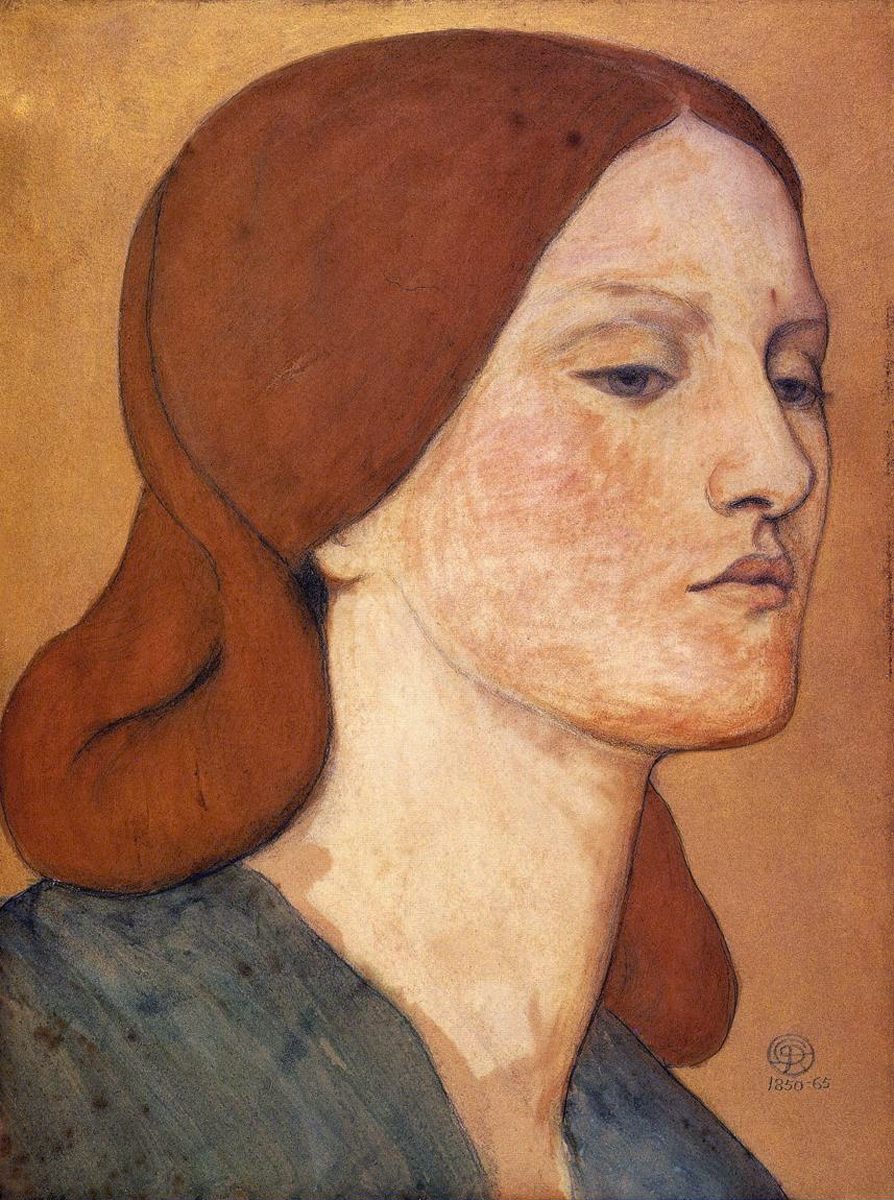
Elizabeth Siddal was not simply a professional artist's model. Within a few years of sitting for Ophelia she was producing her own drawings, paintings, and poetry, encouraged in part by Dante Gabriel Rossetti, who was both her artistic partner and her romantic one. In 1855 the critic John Ruskin, already the Pre-Raphaelites' most influential champion, offered Siddal a quarterly allowance amounting to £150 a year in exchange for the right to whatever work she produced, telling associates he considered her at least as promising an artist as Rossetti himself. She exhibited alongside Rossetti and others in a Pre-Raphaelite exhibition in 1857, though Ruskin's arrangement with her ended that same year.
Siddal and Rossetti married in 1860, a union Rossetti marked with a wedding portrait of her titled Regina Cordium. She died in February 1862, at thirty-two, of an overdose of laudanum, the opium tincture Victorian doctors prescribed freely for pain and insomnia and that she had used for years by the time of her death. The illness that put her under a doctor's care after the Ophelia sitting a decade earlier was, by her biographers' account, one of several bouts of poor health that recurred across her adult life; no source establishes a direct medical line between the cold bathwater in Millais's studio and the addiction that eventually killed her, and the connection is better treated as an open question than a settled fact.
Mocked at the Royal Academy, canonized within a lifetime
The painting already had a buyer before the public had a chance to see it. On 10 December 1851, while Millais was still working on the studio portion of the canvas, the art dealer Henry Farrer bought Ophelia directly from him for 300 guineas. The picture changed hands several more times over the following decades among Victorian collectors before Sir Henry Tate acquired it in the early 1890s, meaning the reviewers who tore into the picture at the Royal Academy in 1852 were judging a work whose commercial value the market had already settled months earlier.
When Ophelia was exhibited at the Royal Academy in London in 1852, the response split sharply along lines of technique versus subject. Critics who praised Millais's brushwork often objected to the ordinary, unglamorous setting he had chosen for a tragic Shakespearean death. A reviewer in The Times wrote that "there must be something strangely perverse in an imagination which souses Ophelia in a weedy ditch, and robs the drowning struggle of that lovelorn maiden of all pathos and beauty," and a further review in the same paper said Millais's Ophelia in her pool "makes us think of a dairymaid in a frolic." Other outlets took the opposite view: the Morning Chronicle in 1852 called the painting "startling in its originality."
The reversal in reputation took decades, not centuries. The picture entered the national collection in 1894 when the sugar magnate and collector Sir Henry Tate presented it, along with dozens of other works, to found what became Tate Britain, where it carries the accession number N01506 today. It has since become one of the gallery's most reproduced and requested images, and its influence is visible in later painters who returned to the same subject and pose, including John William Waterhouse's own Ophelia paintings decades afterward. Edvard Munch's most famous painting followed a similar arc from hostile debut to canonical status, though its own hostile reception came at home, when Kristiania audiences first saw it in 1895.

.jpg)