Age, maker and price are separate questions
Sellers use the word antique loosely, and for paintings there is no single age line that everyone applies. Take two pictures from 1915, a hotel-lobby landscape and a documented portrait. Both are old, and the market prices them very differently. Age is the cheapest thing to claim and the least useful for working out what a picture is worth.
That leaves three questions about any antique oil painting. Physical evidence speaks to its age, paperwork and expert opinion to its maker, and the price follows the maker more than it follows the date. The sections below take them in that order.
Read the back and the edges first
A painting's back and tacking edges keep a record of what has happened to it. The Cincinnati Art Museum's conservation blog shows how much one picture can tell. Frank Duveneck's nude study, which the museum acquired in 1915, had its folded-over edges pressed flat onto the front, and documents suggest that was done in the late 1930s. Under ultraviolet light a pale blue-green glow shows an artist-applied natural resin glaze, and the glaze stops at an old fold line in the tacking margin. The conservators read that as support for the idea that Duveneck finished the painting while it was wrapped around a smaller stretcher.
Two points carry over to a painting at home. A newer stretcher or a changed canvas size does not make the paint newer. The Duveneck edges were reworked in the late 1930s, after the artist's death in 1919, and the picture was still his. And the evidence lives in the edges and the surface layers, so a conservator should look before anyone cleans, trims or re-stretches. Before that, photograph the front, back, edges, frame, labels and any inscriptions.
Craquelure suggests age, and forgers know it
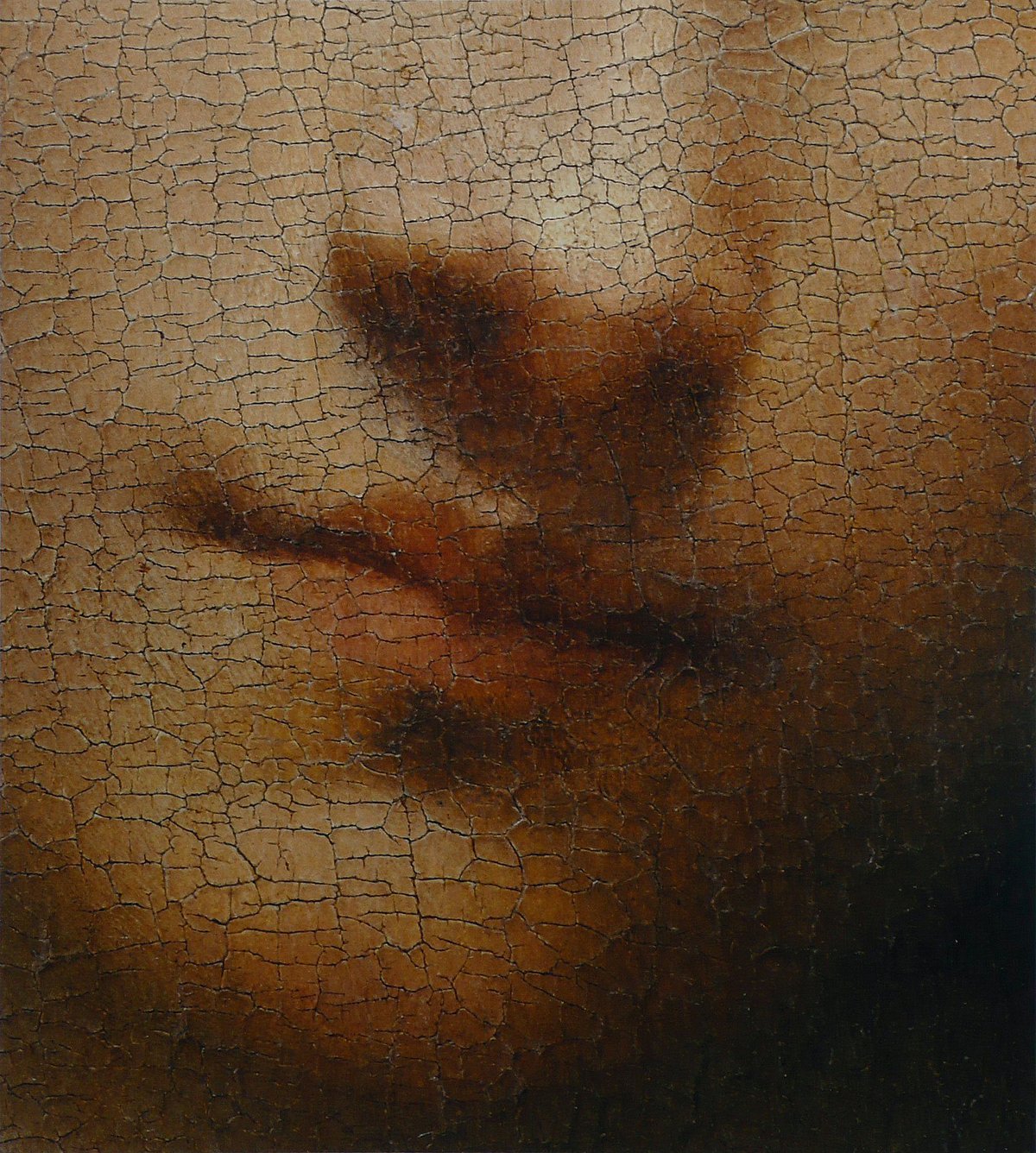
Craquelure is the network of fine cracks that opens across paint and varnish over time. The detail at the top of this page comes from the Kunsthistorisches Museum's Boy with an Arrow, catalogued under Giorgione and dated to about 1500. It shows the dense web an oil painting on a wooden panel can carry after five centuries.
Cracks like these usually come with age, though they cannot date a painting alone. Han van Meegeren, the Dutch forger who sold paintings as Vermeers, used phenol-formaldehyde (Bakelite) to harden paint so it would appear centuries old, as Wikipedia's current article states. The current Wikipedia page, checked 12 Oct 2026, does not report a commission's examination of eight paintings, Albertol resin, or material found in the cracks. That method alone cannot establish a general test for authenticity.
So a convincing pattern is a reason to keep checking. The Canadian Conservation Institute describes cracks in one or more varnish, paint or ground layers. Cracks need not affect every layer, and their alignment cannot establish authenticity on its own.
Pigments set a floor under the date
Many pigments have a first date, and finding one in an original paint layer means the picture cannot be older than that date. The table gives the dates from published pigment histories. Use usually came later than first availability, and identifying a pigment takes a sample or instrument analysis in a lab, so treat this as background for reading a technical report, not a home test.
| Pigment | First date in the published histories | What finding it in an original layer means |
|---|---|---|
| Prussian blue | About 1704, Berlin | The painting cannot be older than the early 1700s. |
| Chrome yellow | Lead chromate preparation published by Vauquelin in 1809 | The painting cannot predate the early 19th century. |
| Synthetic ultramarine | Guimet developed his process in 1826 and won the Paris prize on 4 February 1828 | Synthetic ultramarine points to the late 1820s or later: it was developed in 1826 and sold commercially in 1828. |
| Cadmium yellow | Cadmium found in 1817; pigment production delayed until about 1840 | Cadmium yellow points to the 19th century or later; commercial production began around 1840. |
| Titanium white | Composite pigments from 1916; pure titanium dioxide widely available by 1928; pure rutile form from 1957 | A picture dated 1880 with it in the original paint is a later picture. |
The titanium white row comes with a caution from the conservators who built that timeline. Their summary says a titanium white paint cannot be dated just by finding barium or calcium sulfate in it, because manufacturers added sulfate fillers to many paints anyway. Dates also work in one direction. A late pigment in an original layer proves the picture is later, but a palette of old pigments proves nothing alone, since van Meegeren mixed his paints from old formulas to pass inspection.
One anachronism settles the question, while any number of old-looking features leave it open.
Attribution sets the price
Market value follows who the picture is by. Catalogues signal their confidence in set phrases, and a conservation firm's guide to the vocabulary describes a ladder. Fully attributed works carry the highest value, works described as Circle of an artist, made in the artist's immediate environment, come next, School of sits between Circle of and After, and copies After the artist usually rank lowest, though the guide notes important exceptions.
That ladder is why two paintings that look alike can sell far apart, and why a catalogue's exact wording deserves a slow read. For the top end of what a secure attribution can reach, see the price records for the most expensive painting in the world. For the other kind of question, whether a popular painter's work is worth anything at all, see Thomas Kinkade's market.
Valuation and authentication are separate jobs, and the purpose of the valuation shapes the number. The International Society of Appraisers, founded in 1979, is a personal property appraisers' association with a public directory of members. For the materials and condition side, a paintings conservator can examine the picture. For wider background on how paintings are made, see the guide to art techniques.
What to do with a painting you already own
Start by recording what is there before changing anything. Photograph the front, the back, the edges, the frame and every label, stamp or inscription, and note whether the stretcher and tacks look original or replaced. Write down where the painting came from and anything the previous owner said about it, because that history is the beginning of a provenance.
Then look for the maker. A signature or label gives a name to search alongside auction results, and a missing signature does not mean the picture is minor. Treat a name from a label or a family story as a lead to test, since the ladder above shows how much depends on the attribution holding up.
Last, decide what the number is for. Insurance, estate and sale valuations can differ, so tell the appraiser the purpose up front. Leave cleaning, varnish removal and re-stretching to a conservator, since those steps remove the very evidence discussed above.