Two paintings behind one search result
Search "the lovers painting" and one image comes back: two heads wrapped in white cloth, kissing. Two separate oil paintings answer to that description. Both were painted by Rene Magritte in Paris in 1928, both are close to the same size, and they now hang in two different countries.
The New York canvas shows the couple facing each other, mid-kiss, the cloth pressed flat against both faces. It is at the Museum of Modern Art, oil on canvas at 54 by 73.4 centimetres, catalogued as accession number 530.1998, a gift of the collector Richard S. Zeisler. The Canberra canvas turns the same idea a different way: the couple faces the viewer instead, cheek to cheek under the same kind of cloth. It hangs at the National Gallery of Australia, oil on canvas at 54 by 73 centimetres, accession number 90.1583, purchased by the gallery in 1990.
Neither museum's catalogue entry uses a roman numeral. MoMA lists its picture simply as The Lovers; the National Gallery of Australia lists its picture as Les Amants, The lovers. The "Lovers I" and "Lovers II" labels most retellings use to keep the two straight came later, from dealers and writers sorting the series after the fact, not from either institution's wall label.
The National Gallery of Australia's catalogue note ties its picture to a wider group of veiled-figure paintings Magritte made in Paris across 1927 and 1928, including L'histoire centrale (The central story), from 1927, and L'invention de la vie (The invention of life), from 1927 to 1928. The cloth over the lovers' faces, in other words, wasn't a one-off device invented for a single canvas. It was a motif Magritte kept returning to across roughly two years, of which the two museum paintings are simply the best known and most reproduced examples.
The set is larger still. Magritte painted at least two more canvases on the same veiled-couple idea that same year, known today as The Lovers III and The Lovers IV. Both remain in private hands, rarely exhibited and far less written about than the pair the museums hold.
A legend about his mother, and math that doesn't add up
Nearly every write-up of the veiled faces reaches for the same backstory. On 24 February 1912, Magritte's mother Regina drowned herself in the River Sambre at Chatelet, Belgium. It was not her first attempt. Her body was not found until 12 March, seventeen days later by calendar count, though some retellings round that gap up to three weeks. The detail attached to almost every version of the story is that young Magritte stood at the riverbank and watched his mother pulled from the water with her wet nightgown wrapped around her face, the supposed source of the cloth in The Lovers and several related paintings from 1927 and 1928.
That specific detail is the one scholarship has walked back. Wikipedia's entry on Magritte states plainly that later research discredited the eyewitness story, and suggests it may have originated with the family's nurse rather than with Magritte himself. Reviewing Magritte scholarship for the New York Review of Books in 2018, Regina Marler goes further, calling the riverbank tale a family legend, now discredited. Magritte was born on 21 November 1898, which puts him at thirteen years old when his mother died, not fourteen, a number a fair few retellings repeat without doing the arithmetic.
Even the surrounding facts don't fully agree. Wikipedia states the gap as sixteen days, but a straight calendar count from 24 February to 12 March in 1912, a leap year, comes to seventeen; the New York Review of Books account rounds the same gap to three weeks instead. None of those three numbers is wildly wrong, seventeen days is a full week short of three weeks, but the small drift between even the most reputable accounts is a low-stakes demonstration of how loosely details get repeated once a story is in general circulation, long before it reaches the far less reliable claim that a thirteen-year-old boy stood there to see any of it.
Magritte's account of the day, given decades later in a third-person sketch of his own life, left the riverbank out entirely: "In 1912, his mother Regina is tired of life. She throws herself into the Sambre." That account leaves out both the child at the water's edge and the cloth.
He was just as resistant to explaining his pictures on any other grounds. Asked what a painting meant, he tended to turn the question back on the asker: "It does not mean anything, because mystery means nothing either, it is unknowable." William Blake left behind a comparable mismatch between what actually happened and what later writers made of it, though the direction runs the other way: the astrologer hosting Blake's nightly sketching sessions took the results far more seriously than Blake himself apparently did.
What the ownership records actually show
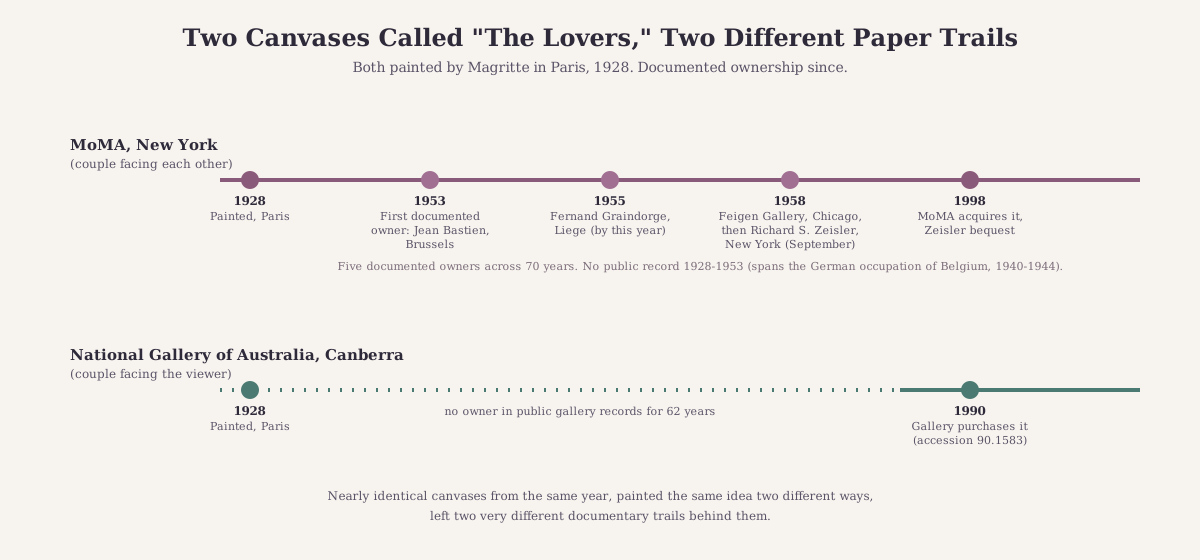
MoMA's own provenance research lists five sets of hands between the painting's completion and the museum's door: Jean Bastien in Brussels, by 1953; the Belgian Surrealist E.L.T. Mesens, who worked in Brussels and London; the collector Fernand Graindorge in Liege, by 1955; a dealer named Hecker Jensen in Basel; the Richard L. Feigen Gallery in Chicago, by 1958. From there, Richard S. Zeisler bought the canvas in New York in September 1958 and kept it privately for forty years before it reached MoMA in 1998, as a bequest after his death.
Mesens is worth a pause. He was not a passing collector but a Surrealist in his own right and one of Magritte's dealers, which means the painting spent part of the 1950s inside the same small Belgian circle that had promoted Magritte's work since the 1920s, before it left Europe for an American collector's rooms.
That chain also has a gap worth naming. MoMA's published record for the painting starts in 1953, twenty-five years after Magritte finished it in 1928, a stretch that covers the German occupation of Belgium from 1940 to 1944. Museums began publishing this level of ownership detail on pre-1946 European paintings largely because of the 1998 Washington Conference on Holocaust-Era Assets, which pushed institutions to identify and disclose exactly this kind of unaccounted-for stretch. Nothing in MoMA's public listing for The Lovers flags the gap as a concern, but the gap is there, undocumented rather than resolved.
The Canberra canvas carries a much thinner paper trail by comparison. Public gallery records show no owner before the National Gallery of Australia itself, which purchased the painting in 1990, sixty-two years after Magritte finished it. Two canvases from the same year, within a few millimetres of the same size and built around the same idea, left two very different documentary trails: one working through five collectors and a Surrealist dealer across three decades, the other surfacing in the historical record only once, at the point of a single museum purchase. A provenance chain running through one family for even longer than that turns up at the Louvre, where John Martin's 1841 Pandemonium stayed inside a single family for 151 straight years, then took another decade and several more changes of hands after leaving the family before the Louvre finally acquired it.
Two readings, and Magritte's refusal of both
Two explanations for the cloth circulate beyond the mother story. One ties it directly to trauma resurfacing in paint. A second, which shows up across gallery guides and general art writing rather than in anything Magritte said himself, reads the barrier as being about intimacy in general: that even two people kissing cannot fully know each other, that something always stays covered.
Magritte pushed back on both readings, and on the whole project of decoding his work. He rejected psychoanalytic interpretation specifically, insisting there is "only one mystery: the world," not a private meaning buried inside any single canvas. Describing his own method in a 1938 lecture in Antwerp, he called it a "systematic search for an overwhelming poetic effect through the arrangement of objects borrowed from reality", the language of composition, not confession.
Other artists kept borrowing the image
The image has resurfaced outside museum walls more than once. Spanish director Pedro Almodovar restaged it almost directly in his 2009 film Broken Embraces, where Penelope Cruz's character kisses her husband through a bedsheet in a shot that mirrors Magritte's composition beat for beat.
Musicians have reached for it too. Gerard Way of My Chemical Romance has named the painting as a reference point for the cover art of the band's 2004 album Three Cheers for Sweet Revenge, another instance of the veiled kiss doing the job Magritte gave it originally: turning a familiar gesture into something a viewer can't quite finish reading.
None of that resolves anything, which might be the most fitting outcome available for this particular picture. Magritte spent his career objecting to exactly this kind of tidy backstory, insisting a canvas wasn't a puzzle with a solution hiding underneath it. On the specific mystery of where these two canvases came from and why they look the way they do, the documented record has ended up agreeing with him more than most retellings do.