A required submission, not a free subject
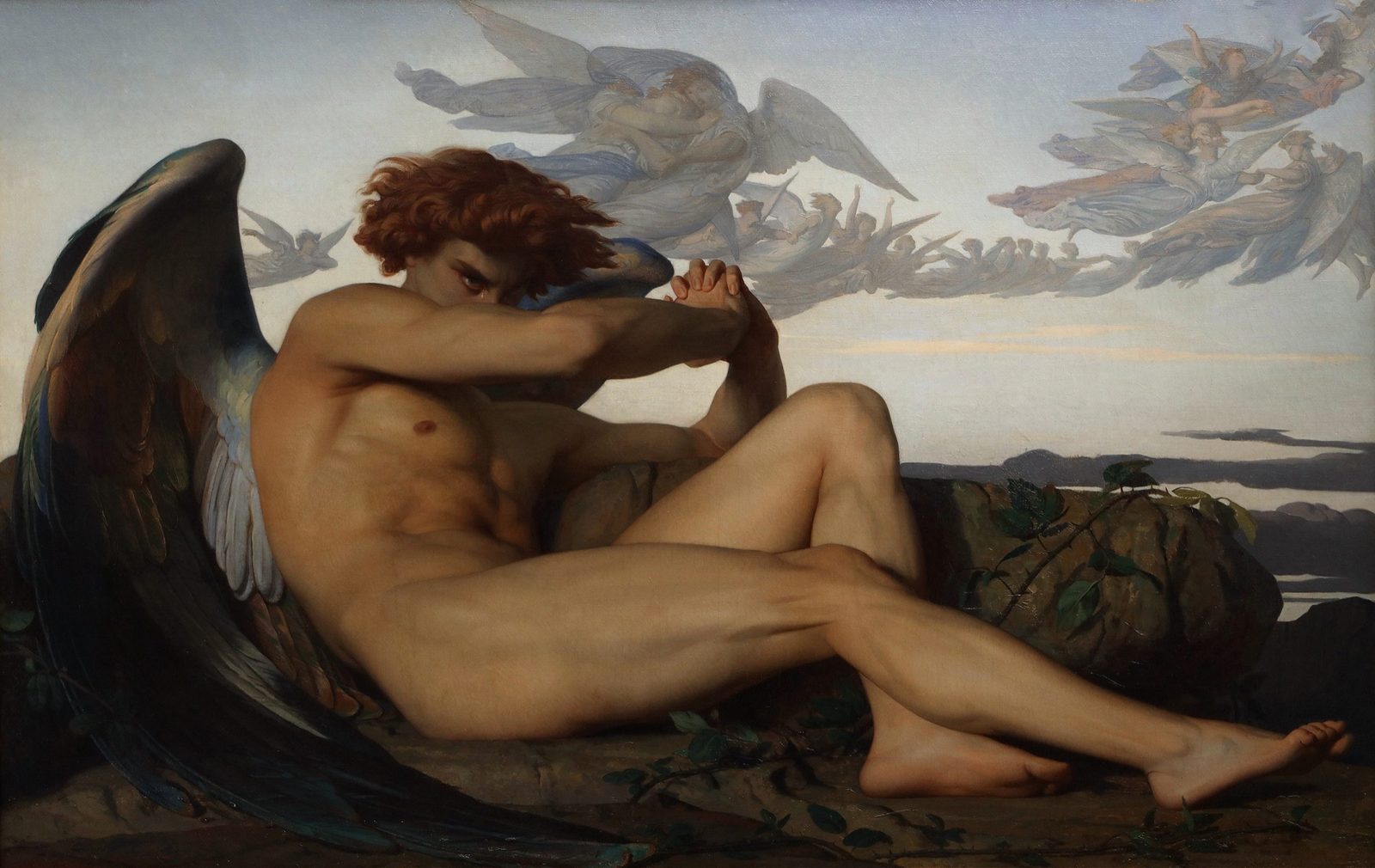
Cabanel won the second Grand Prix de Rome in 1845, a state scholarship awarded through the École des Beaux-Arts in Paris that sent its winners to the Villa Médicis in Rome for several years of subsidized study. In exchange, residents had to send prescribed proof of their progress back to Paris throughout the stay, works the institution's records call envois de Rome. The Fallen Angel, painted in 1847 and carried into early 1848, was Cabanel's mandatory second-year envoi, judged by the same Parisian academicians who had sent him to Italy in the first place.
For that submission he picked a subject the Musée Fabre's collection notice describes as then rarely represented in French painting: the biblical fall of Lucifer, drawn from passages in Ezekiel, Isaiah, and the Book of Revelation, filtered through John Milton's 1667 epic Paradise Lost, which had shaped how European artists pictured the scene for nearly two centuries by the time Cabanel took it up.
He didn't reach the final composition in one sitting. A detailed 1846 oil study survives today at the Musée Comtadin-Duplessis in Carpentras, a separate French museum roughly 100 kilometres from Montpellier, and AGORHA, the academic art-history database run by France's Institut national d'histoire de l'art, records a second, related pencil drawing whose location has been unknown since it last surfaced at a Paris sale on 10 May 1944.
The finished canvas was shown at the Villa Médicis in Rome in April 1848, later than scheduled. AGORHA's institutional record attributes the delay to the political unrest then underway in Rome, the opening stage of the revolutions that swept the Italian states that year. Cabanel was hardly the only painter whose most famous religious work came with terms he hadn't set for himself; more than three centuries earlier, Michelangelo agreed to paint the Sistine Chapel ceiling only after papal allies talked him back to Rome, and then spent years disputing with the pope over how the job would be carried out.
What Cabanel said the picture was about
Cabanel explained his intent directly, in a letter to his friend and patron Alfred Bruyas, a Montpellier collector who separately supported Gustave Courbet and Eugène Delacroix. The Musée Fabre's collection notice quotes the letter at length. In the art historian Tom Gurney's English rendering of the same passage: "I depict two natures, two races, one inexorably doomed, predestined to evil and misfortune, finally to fall; while the other chaste and pure rises radiantly towards God glorifying him. However, the main motif of my painting is the evil genius, Satan!"
The rest of the letter, in Cabanel's own French, describes Satan as a figure God had once been pleased to cover in the graces of divine beauty, now reduced to a broken power bowing his head before the creator he had dared make his rival. Cabanel adds that Satan hides the shame of his defeat while remaining proud, desperate, and vindictive, and that the legion of angels visible in the sky above, swaying through the air in happiness while singing God's glory, exists mainly to remind Satan, by contrast, of the splendor he has lost.
By Cabanel's account, the painting is a moral and theological composition built around one character's fall from grace, not a study of the male nude for its own sake. That distinction matters for what happened when the Academy actually looked at it.
What the Academy actually reacted to
The fullest documented account of how Cabanel's peers received the painting comes from the Musée Fabre itself, which has held the canvas since 1889. Its official notice describes the reaction in specific, restrained terms: the mannerism of the pose, the deliberate pursuit of originality, and the feverish pathos of the picture displeased members of the Academy, who showed themselves somewhat startled by the painter's spirit of independence.
Cabanel put it more bluntly himself, in a separate letter to Bruyas that the museum also quotes: "Enfin je suis pour eux maintenant une espèce de renégat de leur école" (in the end, I am now, to them, a kind of renegade from their own school).
Notice what that primary record does and doesn't say. It documents academic disapproval of the pose and the manner, not outrage directed at Satan as a subject, and it describes no public scandal in the press or at a Salon jury, the kind that later attached to paintings like Manet's Olympia in 1865. Some later English-language summaries of the painting describe its 1848 reception as highly controversial. The institution that holds the canvas and quotes the letters directly records something narrower: a startled, disapproving Academy, not a documented public uproar. A similar gap between a popular caption and the documented record shows up in Frida Kahlo's The Broken Column, usually described as a recovery painting made after her spinal surgery even though the medical record she left behind places it before.
The beauty built into the fall
The Musée Fabre's formal analysis places Cabanel's figure in a specific artistic lineage, describing it as faithful to the lesson of antiquity, meaning the Belvedere Torso, and of the great masters of the Renaissance, meaning Michelangelo and Raphael. The museum's account has Cabanel setting his life-size figure close to the canvas's edge, immersed by contrast in an almost abstract landscape built from grey and lilac-blue harmonies, with the sensual curve of the wing doubling as a couch for the body and the face half-hidden and shadowed by the raised arm.
That description lines up with what Cabanel told Bruyas about Satan's beauty surviving the fall intact. The painting insists that damnation and physical beauty occupy the same body at once, which is close to the exact tension the Academy's reaction singled out: not the theology, but the manner in which that beauty was staged for the viewer.
Cabanel kept returning to the figure rather than leaving it behind in 1848. That same year he produced a gouache companion piece titled L'Ange du soir (The Evening Angel), which the French edition of Wikipedia describes as a calmed counterpart to the oil painting: the angel now dressed in loose drapery and showing no visible anger. It reads as a second attempt at the same subject with the friction removed, made in the same year the Academy had been startled by the first. Millais's Ophelia, another mid-Victorian painting this site has covered, went through a comparable multi-stage production of its own, its river landscape finished months before its model was ever posed for the figure, a reminder that paintings now treated as single, settled images were often built up across separate, disconnected sessions. Another fall, Icarus's, was painted twice in opposite ways.
Forty years in the family, then a donation
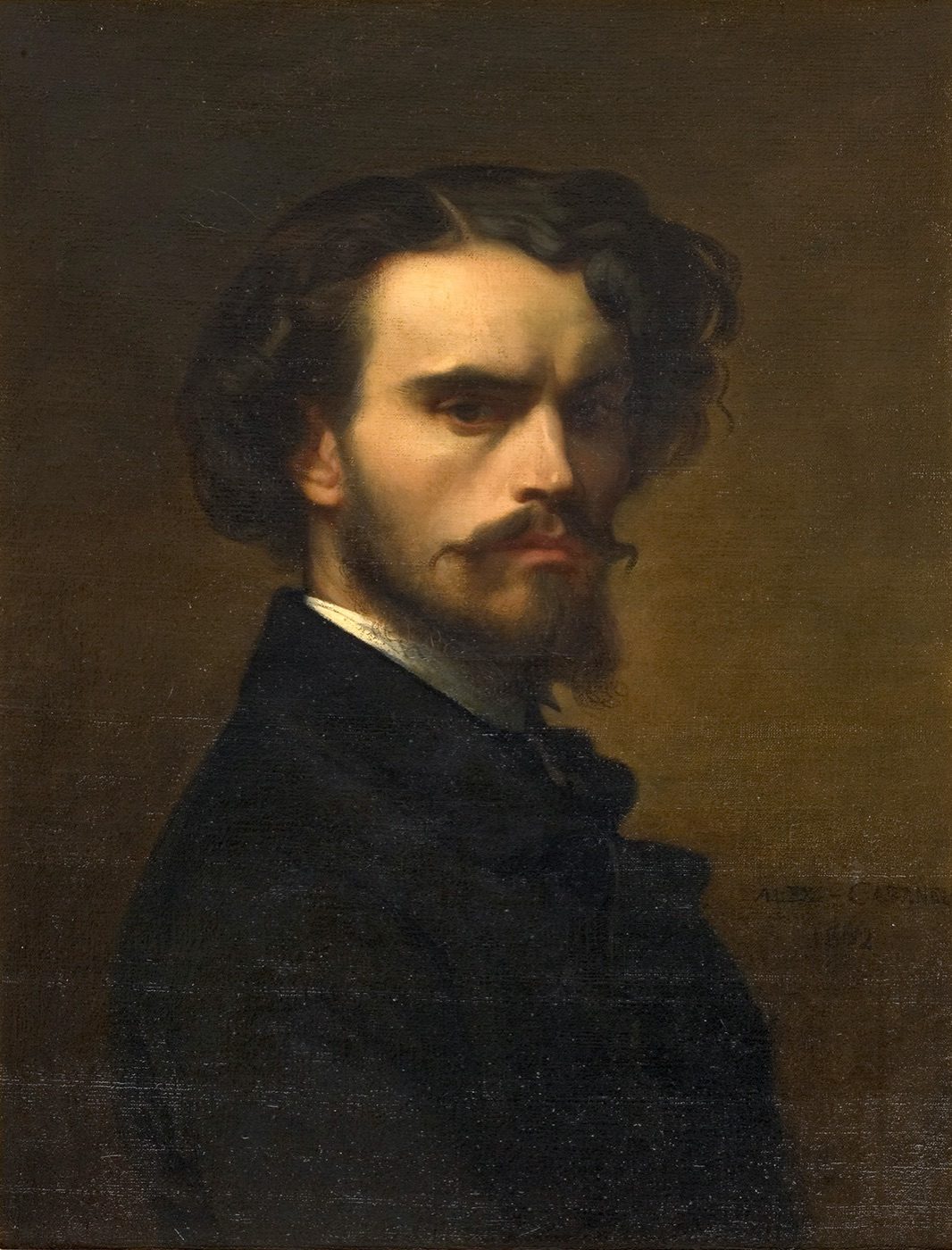
The finished canvas didn't enter a public collection right away. It stayed in Cabanel's personal Paris collection for the rest of his career and life, more than 40 years, until his death on 23 January 1889.
It was then sold at the Galerie Georges Petit in Paris, in the estate sale of Cabanel's holdings held 22 to 25 May 1889, listed as lot 70. The Musée Fabre's provenance record for the painting states it was probably repurchased by the family, a hedge in the museum's wording that suggests even the institution holding the painting today isn't fully certain how it moved from that sale back into Cabanel relatives' hands.
Later that same year, Alexandre's brother Barthélémy Cabanel gave the canvas to the Musée Fabre in Montpellier, the city where Alexandre had been born in 1823. It has remained there since, catalogued under inventory number 889.2.1, a number whose first four digits record the year of accession, 1889.
Two records, two sets of numbers
The Musée Fabre's website today gives the canvas as 121 × 189.7 cm. AGORHA, the INHA's academic art-history database, lists a different figure for the same painting, 120.5 × 196.5 cm, while explicitly citing Musée Fabre, Montpellier as the source of its measurement.
The two records disagree by half a centimetre in width and by almost 7 centimetres in height, even though both claim the same institution as their source. English Wikipedia's infobox for the painting, 120.50 by 196.50 cm, matches AGORHA's figure rather than the museum's current website. French Wikipedia's infobox, 121 by 189.7 cm, matches the museum's site instead. Neither language edition flags the mismatch.
There's no way to settle which figure is current from outside the museum's internal files, and this piece doesn't attempt to. What the gap resembles is the situation this site found in Goya's Saturn Devouring His Son, another canvas whose documented history turned out to be less settled than the confident, single-number captions built around it suggest, sometimes because a scholar disputes attribution outright, and sometimes, as here, because two records that both cite the same primary source simply don't match each other.

.jpg)