A word borrowed from ten books of hymns
Mandala is Sanskrit for circle, and its first documented appearance has nothing to do with a picture. The word shows up in the Rig Veda, a collection of 1,028 hymns composed in an early form of Sanskrit and traditionally dated to roughly 1500 to 1200 BCE. There, mandala names each of the text's ten books: Mandala 1 through Mandala 10, a purely organizational label, the same way a modern reader might say "Book Four" of an epic poem. India's Vedic Heritage Portal, run by the country's Ministry of Culture, still lists "Mandala Krama" among the recitation traditions built around those ten divisions. Nothing about that structure describes a circular drawing.
This gets flattened in a lot of general-audience writing about mandalas. World History Encyclopedia's own entry on the subject calls the images that later accompanied Vedic recitation "the oldest mandalas in the world," treating the Rig Veda's textual divisions as though they were illustrated from the start. No surviving Vedic manuscript or archaeological find backs that claim; the ten books are a system for organizing hymns by ritual lineage and poetic meter, not a set of diagrams. A word doing two different jobs, one bookkeeping and one visual, gets easy to blur once enough retellings pile up. This site ran into a close cousin of that problem once already: a single sixteenth-century book that both named an entire art-historical period and planted a fabricated murder inside it, where the documented origin of a word and the story later built on top of it drifted apart for three centuries before anyone checked the burial records.
The picture is much younger than the word
The mandala most people actually picture, a circle divided into precise, symmetrical zones with a deity or symbol at the center, belongs to a different and much later tradition: Tantric Buddhism, which developed in India from around the sixth century CE onward. The earliest physical evidence of mandalas as drawn or painted objects comes from Tibetan sketches of the 8th and 9th centuries, followed by cloth paintings and temple murals from the 11th and 12th centuries. Even the most generous reading of the Rig Veda's textual "mandalas" leaves a gap closer to two thousand years than to one before anything matching the familiar picture survives in the archaeological or art-historical record.
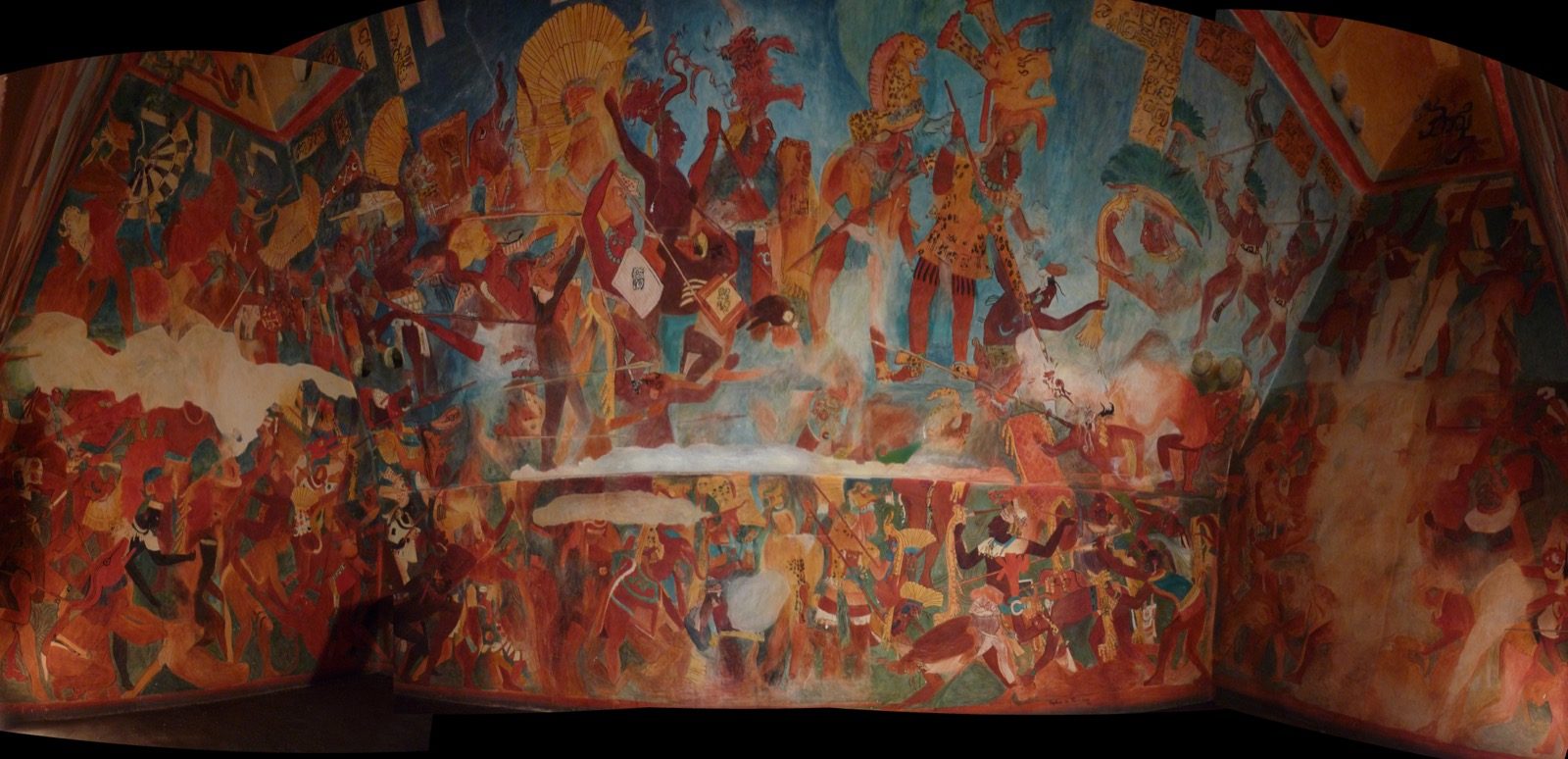
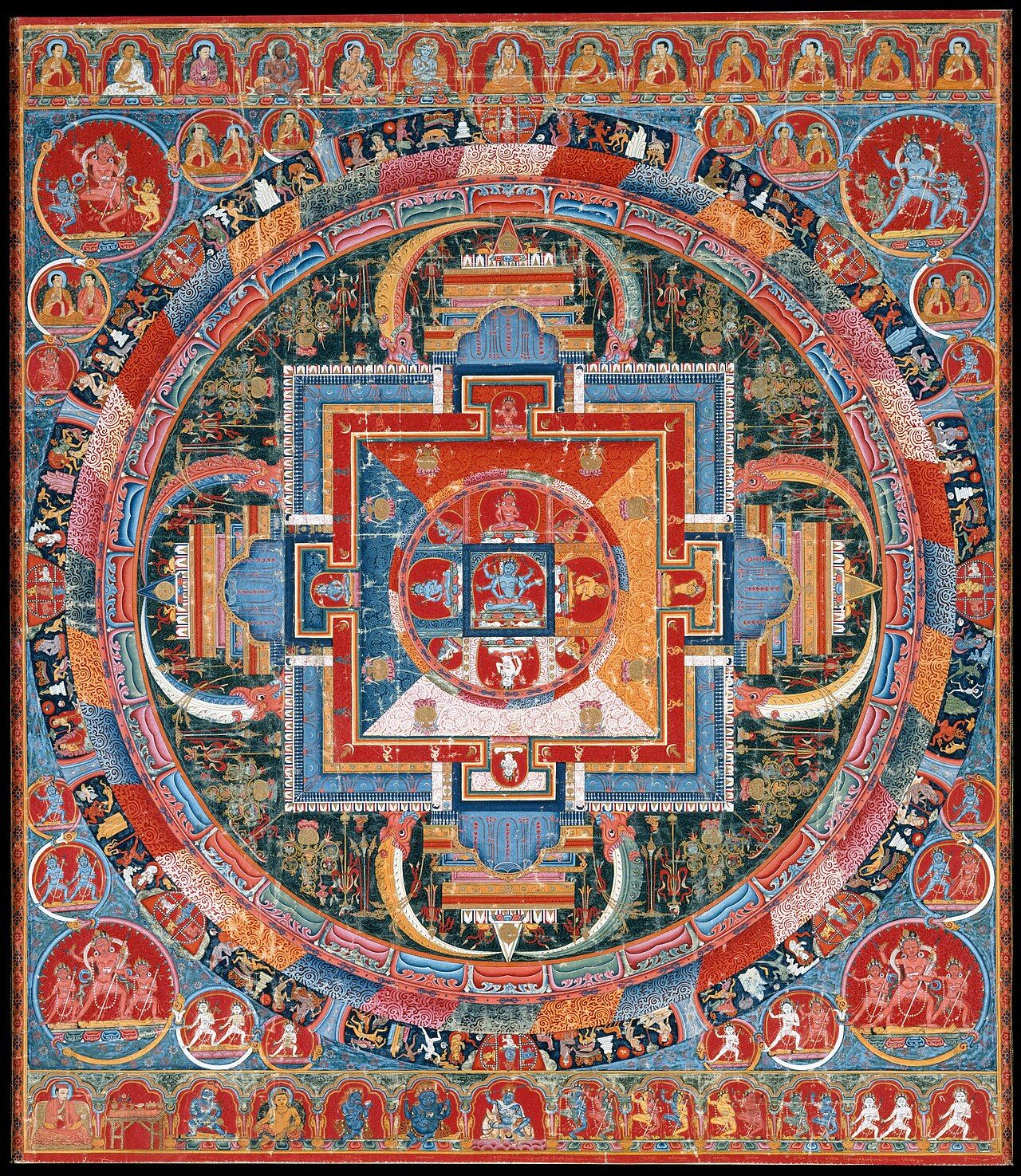
That later tradition is what filled the Metropolitan Museum of Art's Robert Lehman Wing from September 19, 2024, to January 12, 2025, in an exhibition called Mandalas: Mapping the Buddhist Art of Tibet. The Met's own materials describe it as bringing together more than 100 paintings, sculptures, textiles, and ritual objects, most dating from the 11th to 15th centuries, alongside a mandala commissioned for the show from the contemporary Tibetan artist Tenzing Rigdol, who used the form to address climate change and collective responsibility rather than a Buddhist deity. One painting from roughly that same window survives at the Met itself: a late 14th-century cloth mandala centered on the six-armed goddess Jnanadakini, likely made as part of a set of forty-two ritual mandalas known as the Vajravali, its central figure surrounded by eight emanations, four protective goddesses at the gateways, and an outer register showing the lamas of the Sakya school's own spiritual lineage. That is the object at the top of this page: a surviving example of the tradition, painted roughly six centuries after the earliest known Tibetan sketches of the pictorial form itself, and nearer three millennia after the Rig Veda had already used the same word for something else entirely. A different culture's visual record has its own history of overturning comfortable assumptions: murals uncovered at the Mexican site of Bonampak in 1946 ended decades of scholarly certainty that the Classic Maya were a peaceful civilization.
Built over days, swept away on purpose
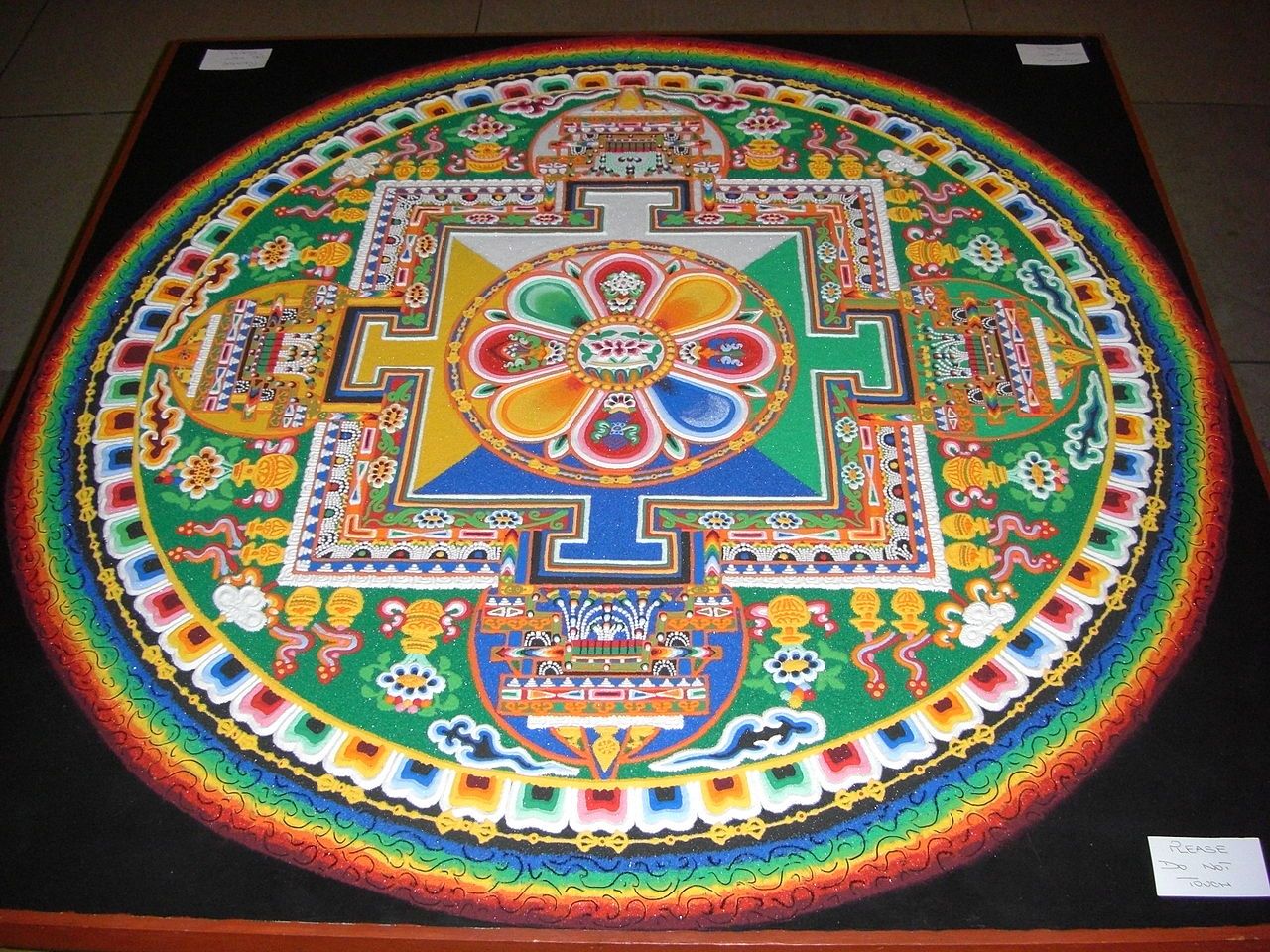
A large share of mandala-making was never meant to last. The Smithsonian's National Museum of Asian Art describes monks consecrating a site with chants and music, then drawing a mandala's design from memory before filling it in, grain by grain, with millions of particles of colored sand over the course of several days. Once finished and formally consecrated, the mandala is deliberately destroyed: the monks sweep the colored sand together and disperse it into flowing water, a ritual enactment of Buddhist teaching on the impermanence of all constructed things. Navajo sand painting has a sacred rule of its own, and one weaving broke it.
The museum has staged this itself. Monks from Drepung Loseling Monastery, exiled from Tibet and now headquartered in Karnataka, India, with an additional institute in Atlanta, Georgia, built a sand mandala inside the Smithsonian's own Sackler Gallery, completing and then dispersing it into Washington's Tidal Basin on January 27, 2002. Nothing about the sand or the mandala's design stayed behind in the collection; the museum's own record of the event is a set of photographs, not an object.
The same ritual outside a monastery
The dispersal ritual is not confined to museum programming or to Tibet itself. In May 2008, a sand mandala depicting Chenrezig, the bodhisattva of compassion, was built and exhibited inside the Palace of Westminster, home of the UK Parliament, to mark a visit by the Dalai Lama on May 21 of that year. A legislative chamber more associated with parliamentary debate than Buddhist ritual hosted, for a few days, an object built specifically to be taken apart.
Six years later, the Dalai Lama performed that dismantling himself. According to the Office of His Holiness the Dalai Lama's own account, on July 16, 2014, at the close of the 33rd Kalachakra Empowerment in Leh, Ladakh, he stood by the eastern gate of the mandala, made three circumambulations of what the text calls the mandala palace, then took pinches of sand, removing the syllables representing each deity in order. Monks swept the remaining sand into an urn, and the Abbot of Namgyal Monastery, carrying it under the Dalai Lama's supervision, walked to the nearby Indus River and poured the sand in, rinsing the urn with river water afterward. A sand mandala built inside the Westminster Parliament and one dismantled on the bank of a Himalayan river six years later are, procedurally, the same ritual performed at opposite ends of its own range.
Carl Jung folded the shape into psychology, without the theology
The word and the image both eventually crossed into a context that had nothing to do with Buddhist ritual. The Library of Congress's own exhibition on Carl Jung's Red Book, the notebook in which the Swiss psychiatrist recorded the visions and dreams that followed his 1913 break with Sigmund Freud, records that Jung was already drawing mandala-like circular images himself before he had studied the Tibetan tradition that produced them. He came to treat the circle divided into quarters, what he called "the squaring of the circle," as one of psychology's oldest recurring patterns, writing that it functioned as "the archetype of wholeness."
Jung kept working with the shape well past the Red Book years. At his stone retreat at Bollingen, on the shore of Lake Zurich, he carved a monument in 1950 to mark his seventy-fifth birthday. One face of the stone carries a Latin dedication; another carries a mandala centered on Telesphorus, a minor Greek deity associated with healing and convalescence, ringed by a Greek inscription describing him as one "who roams through the dark regions of this cosmos and glows like a star out of the depths." A psychiatrist working in Switzerland had, by his own account, arrived at a version of the same geometric structure independently, then spent decades folding the Tibetan word onto it after the fact. This site's look at the earliest fully abstract paintings found a related current running under a different name in roughly the same period: Hilma af Klint's non-representational canvases grew directly out of her own circle of Swedish Theosophists and seance sitters, the same general decades in which Jung's own psychic material was pushing him toward the mandala as an image of psychological order rather than religious devotion.
One museum's exhibition, another museum's closure, the same year
Institutional interest in mandala imagery did not fade in 2024. It just split between two very different outcomes. While the Met was preparing its Tibetan mandala exhibition for that September, the Rubin Museum of Himalayan Art closed the doors of its only physical home, at 150 West 17th Street in Manhattan's Chelsea neighborhood, on October 6, 2024, after twenty years. Founded in 2004 as the first museum in the United States dedicated entirely to Himalayan art, the Rubin had, by its own count, welcomed more than 2.5 million visitors and mounted over 145 exhibitions in that space, including an interactive installation called the Mandala Lab that had already begun a separate touring run through Europe starting in 2022. Rather than reopen elsewhere, the museum describes itself now as operating without a permanent building, through loans, partnerships, and traveling shows.
The comparison this site made a point of tracing in its own look at the vocabulary now taught in every studio-art foundation class applies again here, from the opposite direction: that piece found a system many people assume is ancient turning out to date only to a 1968 textbook, an invented framework mistaken for inherited law. The mandala runs the reverse risk. A tradition with real, documented depth, Tantric Buddhist ritual objects with surviving 14th-century examples and an unbroken practice of construction and deliberate destruction still performed today, is exactly the kind of subject easy to flatten into a single, borrowed word's much older and unrelated first appearance in a set of Vedic hymns.