He didn't want the job
Michelangelo left Rome abruptly on April 18, 1506, after Pope Julius II refused to grant him an audience over payment for marble Michelangelo had already sourced for the pope's planned tomb. Furious, Michelangelo told his servants to empty his studio and sell off its contents, then went home to Florence, abandoning the tomb project he considered his real calling. Two years later, in 1508, Julius wanted him back. He used a go-between, Cardinal Francesco Alidosi, to offer a 500-ducat payment and a new contract, for the ceiling of the Sistine Chapel in place of the tomb project he had shelved.
Michelangelo did not want that job either. He suggested the pope give it to his younger rival Raphael instead. According to Michelangelo's contemporary biographer Giorgio Vasari, the pope stayed persistent partly because the architect Donato Bramante, who had Julius's ear and disliked Michelangelo, pushed the pope to insist, calculating that a sculptor forced into an unfamiliar medium would fail in public. Michelangelo signed the contract on May 8, 1508, for a fee fixed at 3,000 ducats, worth roughly $600,000 in gold value as of 2021. He would spend much of the next four and a half years telling anyone who would listen that the job was a mistake. He wrote to his father that painting was not his profession, and is recorded as saying much the same thing directly to Julius: it was not his art. He meant it. Sculpture was the discipline he trained in and the one he returned to for the rest of his career, including the tomb project Julius had shelved to get him painting a ceiling instead.
The scaffold fight
Bramante, as the pope's own architect, proposed the obvious solution for reaching a ceiling more than 60 feet up: hang a platform from ropes threaded through holes bored straight into the vault. Michelangelo objected on two counts. The holes would show once the fresco covered the rest of the surface, forcing him to paint carefully around each one, and he doubted the rig was safe. When he asked Bramante how the holes would be filled in afterward, Bramante reportedly told him they would deal with that later, which Michelangelo took as proof Bramante either didn't know how to solve the problem or didn't much care whether Michelangelo's work suffered for it.
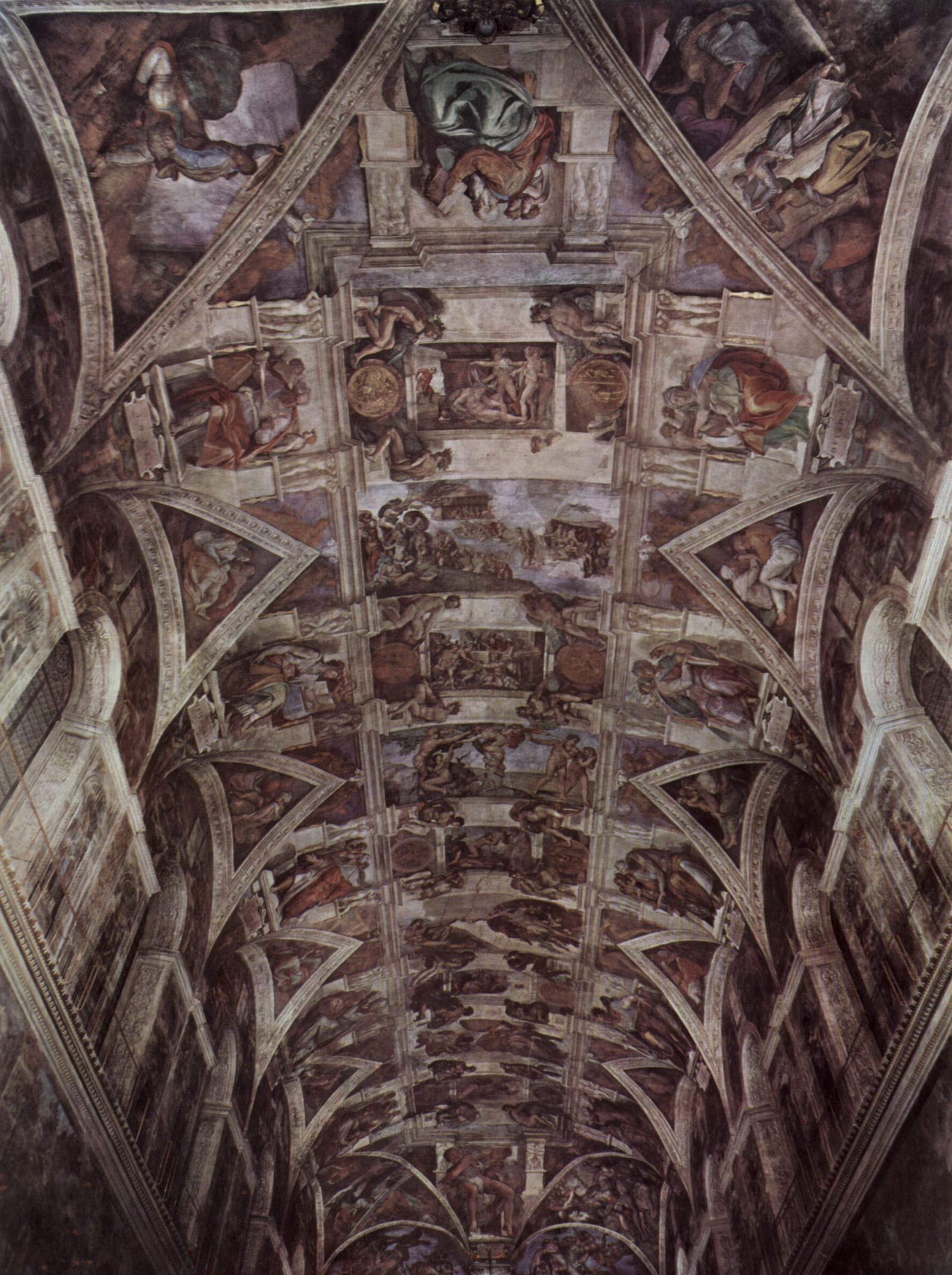
Michelangelo took the complaint to Julius directly and got permission to build his own scaffold instead. His design was freestanding: a wooden platform on brackets set into holes drilled above the chapel's upper windows, clear of the floor so services could continue underneath and clear of the vault so no rope holes interrupted the plaster. The builder Piero Roselli constructed it to Michelangelo's specifications and then roughcast the ceiling's surface himself, preparing it for the first layer of plaster. The arrangement worked well enough that when conservators mounted their own scaffolding for the ceiling's restoration more than four and a half centuries later, they reused the same holes above the windows that Michelangelo's carpenters had cut in 1508.
Standing, not lying down
The image most people carry of Michelangelo on his back, brush held straight up, dripping paint into his own face, comes from a much later retelling and above all from the 1965 film "The Agony and the Ecstasy," not from any account written while he was alive. Michelangelo's platform sat roughly seven feet below the vault. He and his assistants stood on it, arms raised over their heads, necks craned backward to face the ceiling. It was standing work, done for hours at a stretch, that bent the body forward and up rather than laying it flat.
Physical evidence backs the standing account over the reclining one. Michelangelo sketched himself at work in the margin of the same manuscript page that carries his sonnet about the ordeal, and the figure in that sketch is upright, arms overhead, not prone. When restorers rebuilt scaffolding for the 1980 to 1994 cleaning, they matched their platform to the original bracket holes in the cornice, holes positioned for a standing rig set below the ceiling rather than for ropes hung from within it.
The sonnet he sent a friend
Sometime around 1509, a year or so into the job, Michelangelo sent a sonnet to Giovanni da Pistoia, a member of Florence's literary academy who had written to him first. The English translation below, by S. Elizabeth Hall from her 1903 collection of Michelangelo's sonnets, has Michelangelo describing his own body distorted by the posture:
"In this hard toil I've such a goiter grown, / Like cats that water drink in Lombardy, / (Or wheresoever else the place may be) / That chin and belly meet perforce in one. / My beard doth point to heaven, my scalp its place / Upon my shoulder finds; my chest, you'll say, / A harpy's is, my paintbrush all the day / Doth drop a rich mosaic on my face. / My loins have entered my paunch within, / My nether end my balance doth supply, / My feet unseen move to and fro in vain. / In front to utmost length is stretched my skin / And wrinkled up in folds behind, while I / Am bent as bowmen bend a bow in Spain. / No longer true or sane, / The judgment now doth from the mind proceed, / For 'tis ill shooting through a twisted reed."
The poem is not subtle about what a year of overhead work had already done to him, roughly three more still ahead: paint dripping onto his own face, his spine curved into a permanent arch, and by the closing lines, a suspicion that the distortion had reached his judgment along with his back. It reads less like the complaint of an artist confident he was making a masterpiece and more like a man convinced the job had bent him out of shape in every sense.
The first scene he painted grew mold
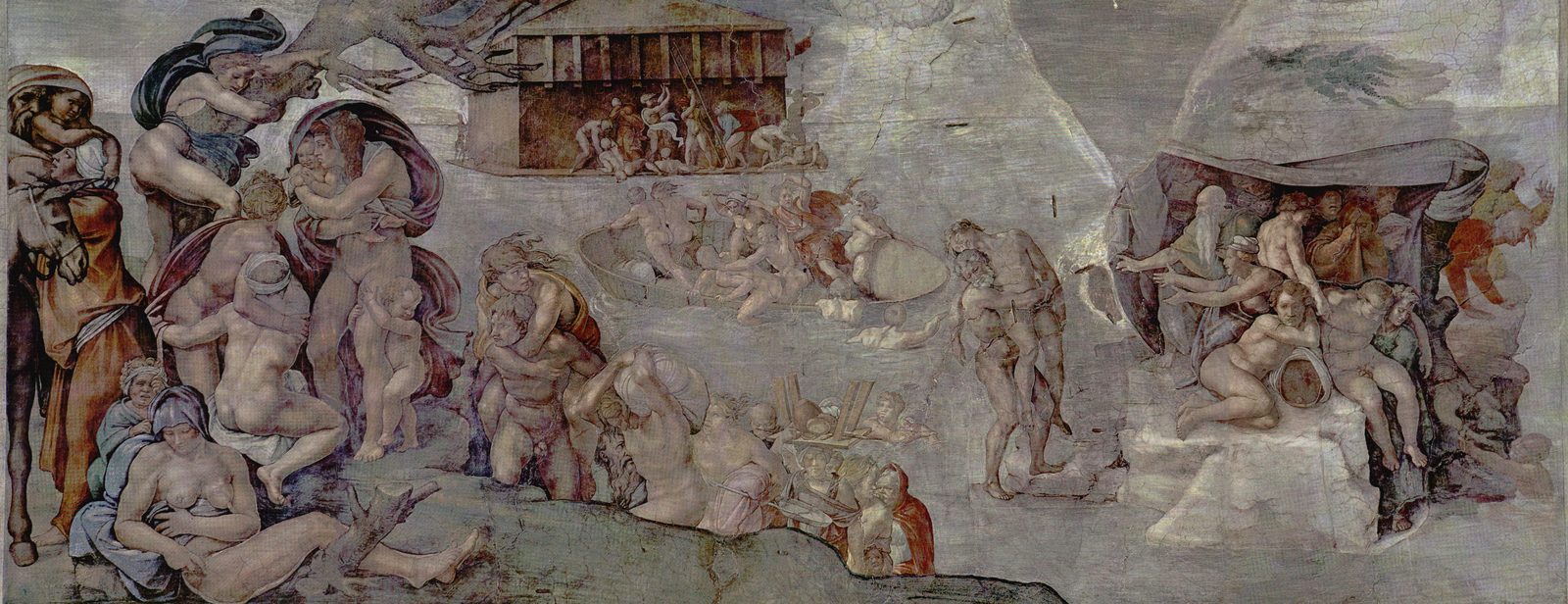
Michelangelo started at the end of the chapel farthest from the altar, painting the scenes that come latest in the Genesis narrative first: the Drunkenness of Noah, followed by the Flood. He would work his way back toward the altar and the earliest scenes, Creation of the Sun, Moon and Planets and the Separation of Light from Darkness, only later. The early panels also give away that he was still calibrating scale. The Drunkenness of Noah and the Flood are crowded with more, smaller figures than the scenes he painted afterward, evidence that he had misjudged how the ceiling's size would read from the chapel floor and adjusted as he went.
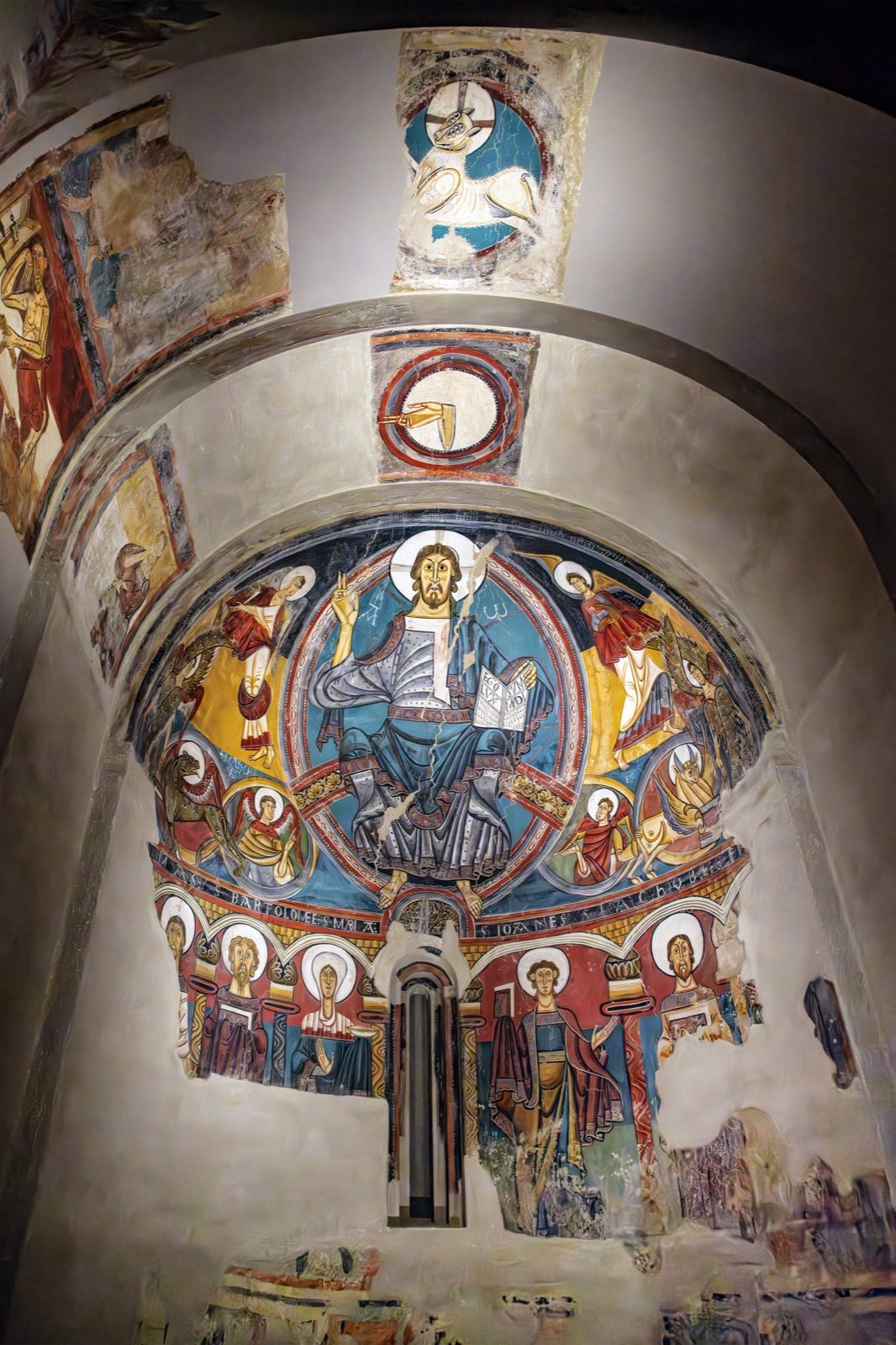
The same opening stretch brought a separate, purely technical problem. Fresco painting requires pigment to be applied to wet lime plaster, called intonaco, so the color bonds chemically to the wall as it dries; the standard Roman method mixed lime with sand for this layer. Michelangelo's crew instead used a lime and pozzolana mix, the volcanic-ash mortar common in Roman construction, and in the chapel's damp conditions it stayed wet too long. Mold began growing across the finished plaster on that first section. Michelangelo, by his own account despairing enough to consider walking away from the whole commission, did not solve it alone. Julius sent the architect Giuliano da Sangallo to look at the problem, and Sangallo told him how to fix it. The crew switched to the standard lime-and-sand mix, and Michelangelo scraped the moldy patch back and started that section over. Earlier Romanesque frescoes had a different contest to survive, a museum beating a dealer by hiring his crew.
How the ceiling actually got painted, one patch at a time
From that point on, the work proceeded by giornata, Italian for "a day's work": a fresh patch of plaster laid each morning, sized to whatever area Michelangelo expected to finish painting before it dried, with the ragged edge scraped back so the next day's patch could be joined to it. The seams between one day's plaster and the next are still visible on the ceiling today, faint borders that map, panel by panel, roughly how long each section took him.
He said he did it alone. He mostly did.
Michelangelo did not walk into the chapel without help. He brought a group of Florentine painters to Rome specifically to assist him, several of them men he had trained or worked alongside in Domenico Ghirlandaio's workshop as a teenager: Francesco Granacci, Giuliano Bugiardini, Jacopo di Sandro, the elder Jacopo l'Indaco, Agnolo di Domenico, and Aristotile da Sangallo. The plan was for them to handle the fresco technique he had not practiced in years while he supplied the design and the figures. It didn't work out that way. Michelangelo judged none of them skilled enough at buon fresco to trust with the actual painting, and rather than keep training them on the job, he dismissed most of the group from the figural work and painted the ceiling's more than three hundred figures himself, keeping assistants mainly for grinding pigments, mixing plaster, and other preparation that didn't touch the brush.
The insistence that he was a sculptor, not a painter, didn't stop the papacy from handing him yet another discipline decades later. In 1546, near the end of his life, he was made chief architect of the new St. Peter's Basilica, where he designed the dome that still shapes Rome's skyline, a building project he took on with the same reluctance and the same eventual command of a craft he had not trained for.
What the cleaning found
The ceiling opened to public view on November 1, 1512, roughly four and a half years after the contract was signed. It stayed under centuries of accumulated soot, candle smoke, and old varnish until a restoration ran from 1980 to 1994, financed largely by the Nippon Television Network Corporation in exchange for exclusive film and photography rights across the project's three phases: the wall lunettes, the ceiling itself, and finally the Last Judgment on the altar wall. The colors under the grime turned out far brighter and more saturated than the muted, brownish palette generations of scholars had assumed was Michelangelo's original intent, a gap large enough that it unsettled specialists who had studied the ceiling for decades. The find set off disagreement, not celebration. The art historian James Beck and the writer Waldemar Januszczak argued publicly that the restoration had stripped away a final layer of shadow and glazing that Michelangelo himself added after the plaster dried, along with the centuries of grime, softening tones the cleaning then erased. The dispute comes down to how much of what came off the ceiling was dirt, and how much was the artist's own hand. Technical imaging has unsettled other old-master surfaces the same way: X-radiography and infrared study of a Neoclassical deathbed scene turned up an entire figure group the artist painted over completely, along with a repositioned chain, a removed hairband, and a window painted out mid-composition.