Pattern gets filed under decoration. The filing is wrong.
Ask someone to name what art is built from and they will usually reach for the same seven words this site has already traced to a specific 1899 classroom textbook: line, shape, form, space, value, color, texture. Pattern is not on that list. The J. Paul Getty Museum's teaching materials on formal analysis place it somewhere else entirely, in a separate category called the principles of design, defined there as "the ways that artists use the elements of art in a work of art." The Getty's own entry for the term is plain: "Pattern is the repeating of an object or symbol all over the work of art. Repetition works with pattern to make the work of art seem active." Balance, emphasis, movement, proportion, rhythm, variety, and unity fill out the rest of that list. Emphasis in particular is absent from the field's founding texts.
That classification sounds like academic housekeeping, but it changes what pattern is doing in a given work. An element is a raw ingredient. A principle governs how ingredients get organized once repetition enters the picture, and that is a different kind of work. Three well-documented objects, spanning close to twenty-six centuries, make the case better than a definition can: a funeral urn from ancient Athens, a tile spandrel from fifteenth-century Isfahan still contested in physics journals, and a nineteenth-century English textile that took its designer six years of failure to manufacture. None of them treats pattern as filler.
A funeral urn organized almost entirely by repeated bands
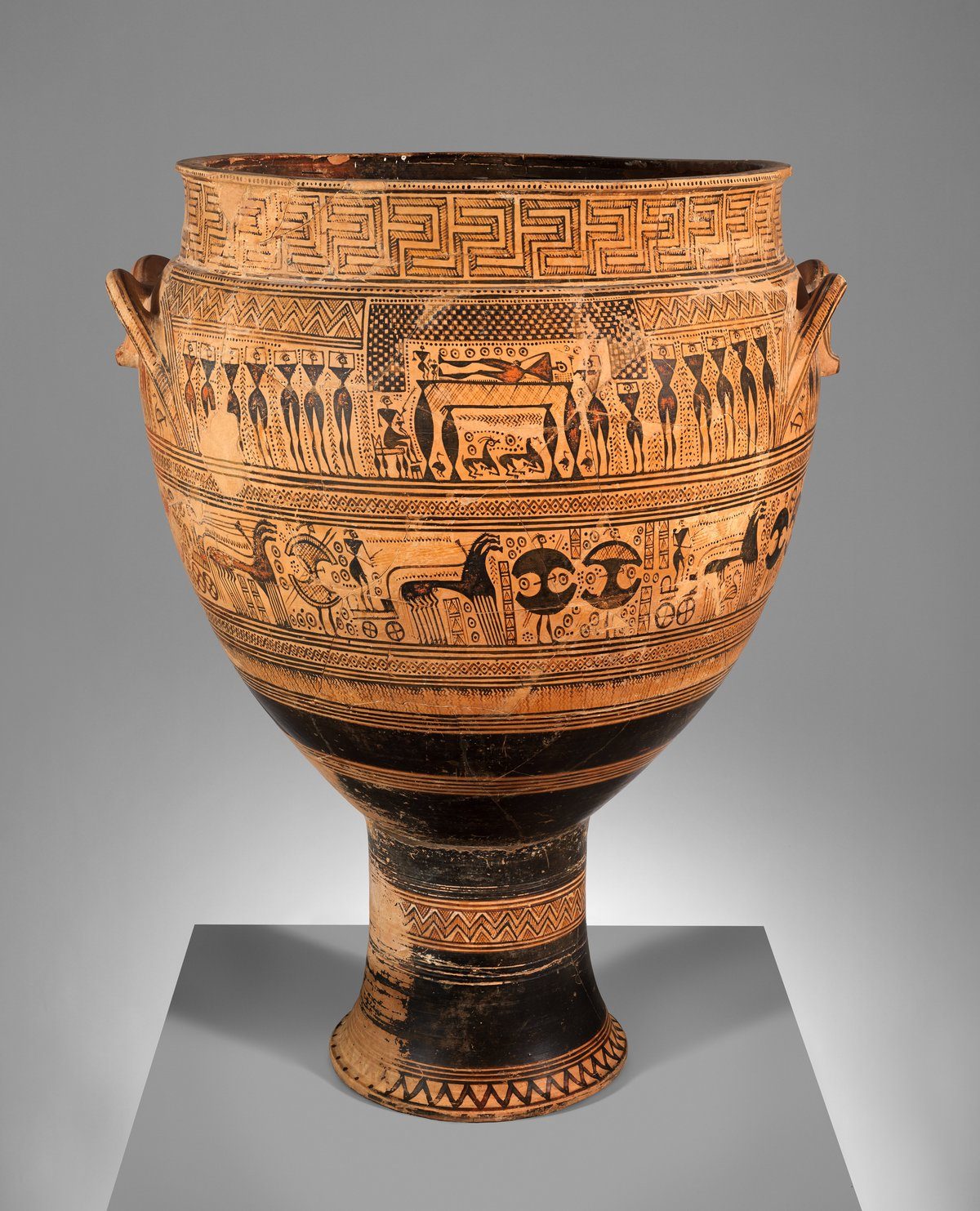
The Geometric Period gets its name directly from what covers its pottery. Classics researchers Jessika Akmenkalns and Debby Sneed, writing for the University of Colorado Boulder's Department of Classics, date the period to roughly 900 to 700 BCE and split it into Early, Middle, and Late phases based on how that geometric decoration changed over time. Vases from the era's Protogeometric predecessor carried simpler concentric circles, checkerboards, and zigzags; by the Middle and Late Geometric phases, workshops had added meanders and more varied lozenge shapes, arranged as bands, or registers, that generally cover a vase from foot to rim.
The krater now in the Metropolitan Museum of Art, attributed to the Hirschfeld Workshop and dated by the museum to about 750 to 735 BCE, is one of the largest surviving examples: 108.3 centimeters tall with a 72.4-centimeter diameter, acquired through the Rogers Fund in 1914. It is also called the Dipylon Krater after the Athens cemetery gate near which it was excavated, and its main scene shows a funeral procession, an ekphora, with the deceased laid out on a bier surrounded by mourners. That figural scene sits inside a frame of pure pattern: meander borders run around the neck, checkerboard and zigzag registers separate the narrative bands from each other, and a chevron border closes out the base. A lower band shows a procession of chariots and shield-bearing foot soldiers, framed on both sides by the same zigzag and dot borders repeated throughout the vase.
Akmenkalns and Sneed note that some scholars have called Geometric art "primitive" or "not very complicated," verdicts built largely on how much of the surface is covered in what looks, at a glance, like abstract filler. They push back directly, writing that judgments like these "can undermine the greater concepts suggested in the images and the extent to which pottery as an art form had progressed by this period." The pattern is not incidental to the krater's funerary function. It is the structure that tells a viewer where the ritual scene starts and where ornament resumes. Gold-ground decorative surfaces have their own story of survival by accident of politics: the best-preserved sixth-century Byzantine mosaics anywhere sit not in Constantinople but in a Ravenna church that had already left Byzantine rule before the empire's harshest iconoclasm began.
A 1453 tiling and a physics argument that is still unresolved
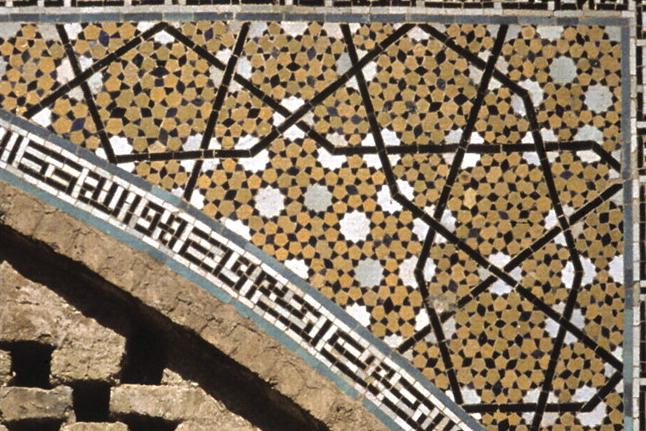
By around 1200 CE, tilers working on Islamic religious and civic buildings had developed a technique modern researchers call girih tiles: a small set of equilateral polygons, each scored with lines, that interlock to build complex star-and-polygon patterns without a builder needing to plot every intersection by hand. Physicist Peter Lu, then a Princeton graduate student, and his co-author Paul Steinhardt argued in a 2007 Science paper that the technique kept getting more sophisticated over the following two centuries, and that its most advanced known example survives on a spandrel of the Darb-i Imam shrine, built in Isfahan, Iran, in 1453. That project carried more weight in this setting than it might have elsewhere: figurative imagery is broadly avoided in Islamic religious architecture, which left geometric and calligraphic ornament, the Kufic border visible around the spandrel itself, to carry a share of the representational work that figural painting and sculpture carried in other traditions.
The mechanism they describe works at two scales at once. A viewer standing back sees one decagonal pattern; a viewer standing close sees a second, smaller pattern nested inside it, generated from the same girih tiles subdivided by a consistent rule. That self-similar subdivision, a shape repeating inside itself at a smaller scale, is the property Penrose tilings are built on, which is why Lu and Steinhardt treat the Darb-i Imam spandrel as different in kind from earlier, simpler girih patterns, not simply a fancier version of the same trick.
Steinhardt's summary of the paper, published on his university page, states the claim directly: the evolution of Islamic girih tilings between the thirteenth and fifteenth centuries produced "a tessellation with nearly perfect quasicrystalline order in the Darb-i Imam shrine in Isfahan, five centuries before the discovery of Penrose tilings and quasicrystals in the West." Quasicrystalline order is a narrow, specific claim: a pattern that never repeats on a regular grid but still has long-range order, a structure mathematician Roger Penrose formalized in the 1970s and physicist Dan Shechtman observed in an actual metal alloy in April 1982, a finding so far outside accepted physics at the time that Shechtman has said colleagues mocked him for it before he won the 2011 Nobel Prize in Chemistry.
That claim did not go unchallenged. Danish mineralogist Emil Makovicky published a comment in Science later in 2007 arguing that the Darb-i Imam pattern actually repeats on a regular, periodic grid and does not display true quasicrystalline order, and that the unusual discs Lu and Steinhardt had highlighted within it were adapted from an earlier, smaller pattern at the Maragha tomb tower and not independent evidence of a genuine breakthrough. Lu and Steinhardt published a response defending their reading in the same issue. Both papers remain in the published record, and neither side appears to have retracted its position since.
A stolen-strawberry print that took six years to manufacture
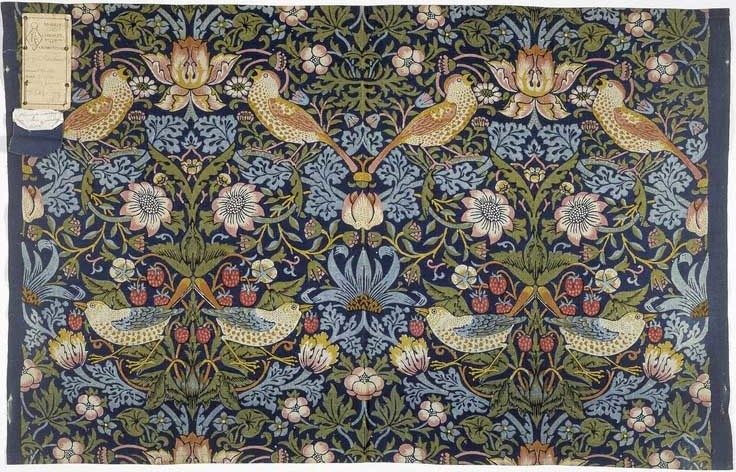
William Morris registered the Strawberry Thief design on 11 May 1883, according to the Victoria and Albert Museum's collection record for the piece, an indigo-discharged and block-printed cotton furnishing fabric showing thrushes lifting fruit from a garden bed. The V&A's record traces the idea to Morris's own kitchen garden: thrushes at his Oxfordshire home, Kelmscott Manor, kept stealing the strawberries, and he answered the nuisance by turning it into a repeating pattern.
Indigo discharge printing reverses the usual order of operations. Instead of printing color directly onto blank cloth, workers first dye an entire length of fabric a uniform, deep indigo blue, then apply a bleaching agent through carved printing blocks wherever the finished design needs a lighter tone, removing pigment instead of adding it. Morris admired the depth of color and crispness of detail the process produced, but the V&A's record notes he first attempted it in 1875 and did not get it working until 1881, after he moved his manufacturing into a factory at Merton Abbey, near Wimbledon. Strawberry Thief, printed two years later, was one result of that six-year effort.
The repeat itself required its own separate mastery. A single indigo-discharge block print has to tile edge to edge without a visible seam, so Morris's birds, strawberries, and trailing foliage were drawn to interlock across the repeat boundary, the same structural requirement the girih tiles and the meander registers were solving in their own centuries. For the Arts and Crafts movement Morris helped found, getting that repeat to work by hand, on a technique most English manufacturers had abandoned in favor of faster chemical dyes, was itself the argument he was making against industrial textile production.
What a funeral vase, a shrine tiling, and a stolen-strawberry print actually share
None of these three cases uses pattern as a finishing touch applied once the important decisions were already made. The meander bands on the Hirschfeld Krater organize a funeral scene into legible registers, telling a viewer where ritual narrative ends and pure ornament begins. The girih tiling on the Darb-i Imam spandrel is treated by two physicists as evidence for a specific, falsifiable mathematical claim, contested seriously enough that a rival scholar built a published rebuttal around disputing it. And Strawberry Thief exists at all only because Morris spent six years failing to reproduce a centuries-old dyeing process before he considered the pattern finished enough to sell.
The same logic shows up elsewhere on this site in sharper form. Aboriginal dot painting, which grew out of a 1971 mural at the Papunya settlement school, developed its now-famous dotting technique specifically so artists could sell paintings to outside buyers while concealing the sacred ceremonial content underneath from anyone without the ritual standing to see it, a case where pattern's job is encoding secrecy rather than announcing skill. Victorian majolica glaze borrowed its name from a genuinely older Italian process it never used, a mismatch the V&A's collection record calls out directly. Pattern keeps doing specific, checkable work across all of these objects. Calling it decoration is usually the least accurate word available.