Hagia Sophia's oldest mosaic is three centuries younger than the building
When Justinian I's Hagia Sophia was consecrated in 537, its interior was not a bare shell waiting for later decoration. Emerson Swift's 1934 study for the American Journal of Archaeology describes the original scheme plainly: "Throughout the entire Church of Hagia Sophia at Constantinople the surfaces of all vaults and arches above the level of the marble revetment were encrusted originally with gold mosaic." Swift quotes the sixth-century court historian Procopius on the same point, in three words: "The entire ceiling is covered with real gold." On top of that gold ground, the original scheme carried, in Swift's phrase, "great figure compositions instinct with the awful dignity of a dogmatic and powerful faith," a full population of saints, angels, and emperors worked in colored glass tesserae.
None of that sixth-century figural decoration is on the walls today. The Byzantine Iconoclasm, an imperial campaign against religious images that ran in two waves, roughly 726 to 787 and then, more severely, 815 to 843, targeted exactly this kind of figural church mosaic across the empire. The second wave ended only with the Council of Constantinople, convened by the regent Theodora, whose delegates confirmed the restoration of icons on 11 March 843 and walked in procession to Hagia Sophia itself carrying an icon of the Virgin. Even after that restoration, it took another generation before the church regained a major figural mosaic: the enthroned Virgin and Child that still fills the apse today was unveiled, according to a scholarly study of the mosaics by Ernest Hawkins and Cyril Mango, around 867. The occasion is recorded in a sermon Patriarch Photius delivered from the ambo of the church itself on 29 March 867, in front of Emperors Michael III and Basil I, a text whose surviving manuscripts title it a homily "delivered from the ambo of the Great Church, on Holy Saturday, in the presence of the Christ-loving Emperor, when the form of the Theotokos had been depicted and uncovered." Photius treated the unveiling as a bigger event than a separate diplomatic win he described in the same sermon, calling it proof of the definitive defeat of the Iconoclast position. Whatever Justinian's original mosaic program looked like, no scholar has been able to reconstruct it from surviving material at Hagia Sophia itself; the building's oldest standing figural mosaic dates from over three centuries after its consecration.
Ravenna kept its gold because Constantinople lost the city first
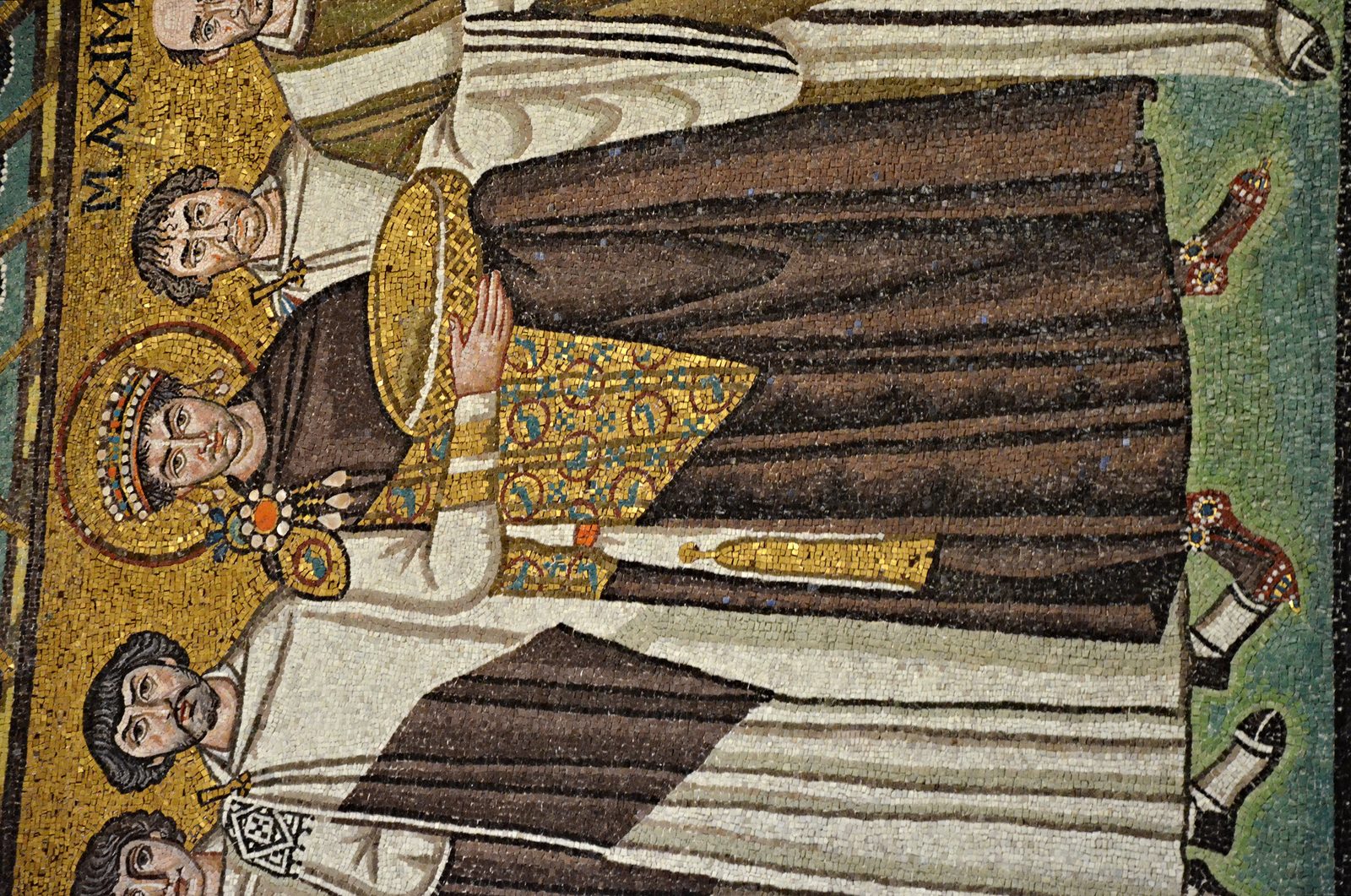
The best-preserved sixth-century Byzantine mosaics anywhere are not in the empire's capital at all. They are in Ravenna, on Italy's Adriatic coast, inside the Basilica of San Vitale. Construction began in 526 under Bishop Ecclesius, while Ravenna was still under Ostrogothic rule, and Bishop Maximian completed the building in 547, following Justinian's reconquest of Italy. A local banker and architect, Julius Argentarius, financed the project; Wikipedia's account of the building's history puts the final cost at 26,000 solidi. Converting that into a modern weight of gold is not as settled as it looks: Wikipedia's own figure for the sum is 16.38 kilograms, but the standard late Roman solidus weighed about 4.45 grams of gold, which would put 26,000 of them closer to 116 kilograms, roughly seven times more. This account cannot resolve which conversion is right, only flag that the two published numbers for the same 26,000 solidi disagree sharply. What that spending bought is, in Wikipedia's description, "the largest and best-preserved specimens" of Byzantine mosaic art "outside of Istanbul," inside what is separately described as the only major church from Justinian's reign to survive virtually intact anywhere.
San Vitale's completeness is not an accident of luck so much as an accident of politics. Byzantine rule over Ravenna, organized as the Exarchate of Ravenna, collapsed in 751, when the Lombard king Aistulf took the city, pulling it out of Constantinople's direct political reach. That break came six decades before the Second Iconoclasm (815-843), the longer and more thoroughly documented of the two anti-image campaigns, even began. It is not a claim that Ravenna's churches were untouched by the earlier, less severe First Iconoclasm (726-787) while the city was still nominally Byzantine; it is a claim that the city had already left Byzantine administration behind by the time the harsher, later campaign proceeded across Constantinople's core provinces. San Vitale's mosaics, worked in the years right after the building's completion in 547, simply were not in the room when that later campaign happened.
How mosaicists made cold glass throw off light like fire
Byzantine gold tesserae are not solid metal. Swift's 1934 study lays out the manufacturing process still used to explain them: a thin, faintly tinted glass slab was coated with a delicate layer of beaten gold or, on occasion, silver, held in place with an adhesive as simple as gum arabic. Over that gold, workers flowed a second, very thin layer of glass, which protected the metal and, in Swift's account, "greatly enhanced its brilliance." The finished slab was then broken up into small, irregular cubes, each one, in Swift's description, "measuring less than a quarter of an inch on a side." Wikipedia's overview of Byzantine technique adds the groundwork beneath the tesserae: a multi-layer plaster bed, its top coat a fine mix of crushed lime and brick powder, onto which artists sketched their design using strings, compasses, and calipers before setting the individual pieces by hand.
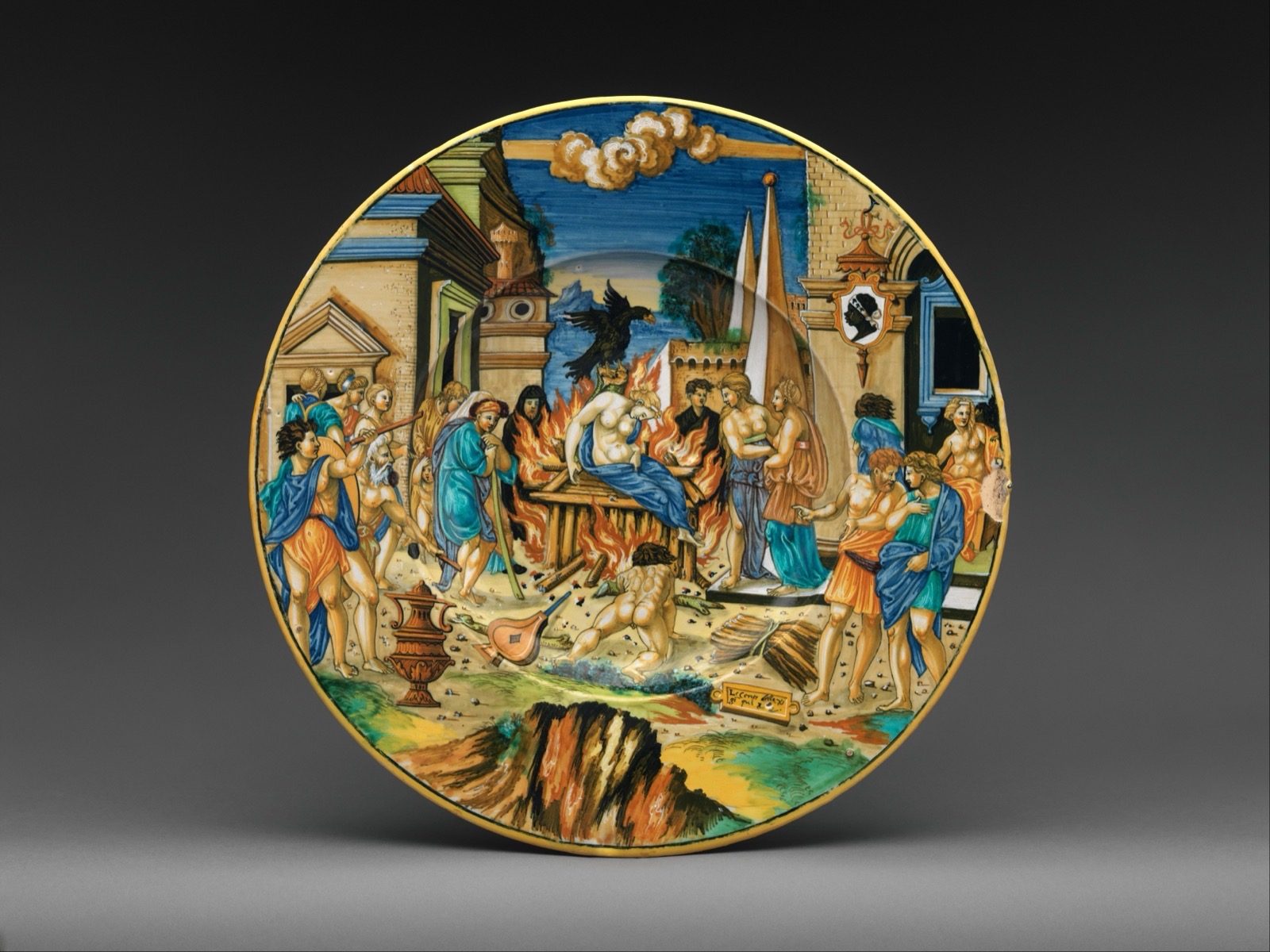
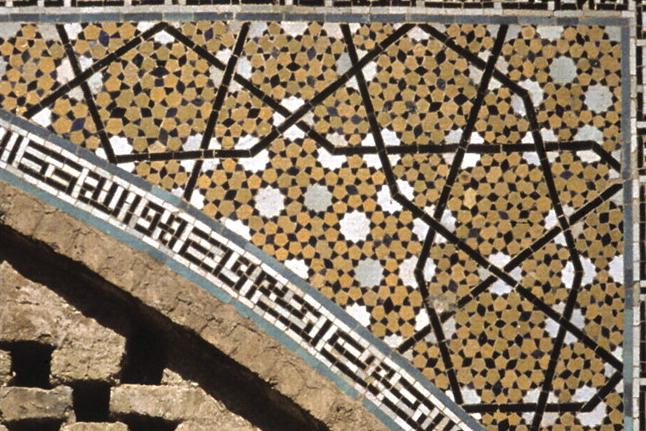
The shimmer that made this gold ground famous did not come from the gold leaf alone. Swift's close study of the surviving tesserae beds inside Hagia Sophia found that setters angled each gold cube on purpose: the tesserae, he writes, "were not set normal to the surface of the plaster but inclined outward and downward, in order to catch the light and reflect it with a shimmering, twinkling vibration to the eye of the spectator below." That deliberate tilt, repeated across thousands of individual cubes on a curved vault lit only by oil lamps and daylight, is what produced the moving, unstable glitter that medieval writers reached for sun and fire imagery to describe. Not every detail of the technique was settled even by the twentieth century: Swift's 1934 article spends a full page working through, and mostly ruling out, competing theories for a reddish substance found on the back of the gold tesserae, a manufacturing detail that a craft over a thousand years old had still not fully given up to scholarship as late as 1934. Repeated, structural ornament does comparably serious work in other media too: a funeral krater, a 1453 Islamic tile spandrel, and a nineteenth-century English textile design all use pattern for more than decoration.
Whitewashed, restored, and covered again: Hagia Sophia's modern mosaic history
The apse Virgin and Child was far from the last mosaic Hagia Sophia acquired, and far from the last one to be hidden. After the Ottoman conquest of Constantinople in 1453, the building became a mosque, and later Ottoman-era work covered a number of its figural mosaics with whitewash and plaster rather than destroying them outright, leaving the images physically intact but invisible for centuries.
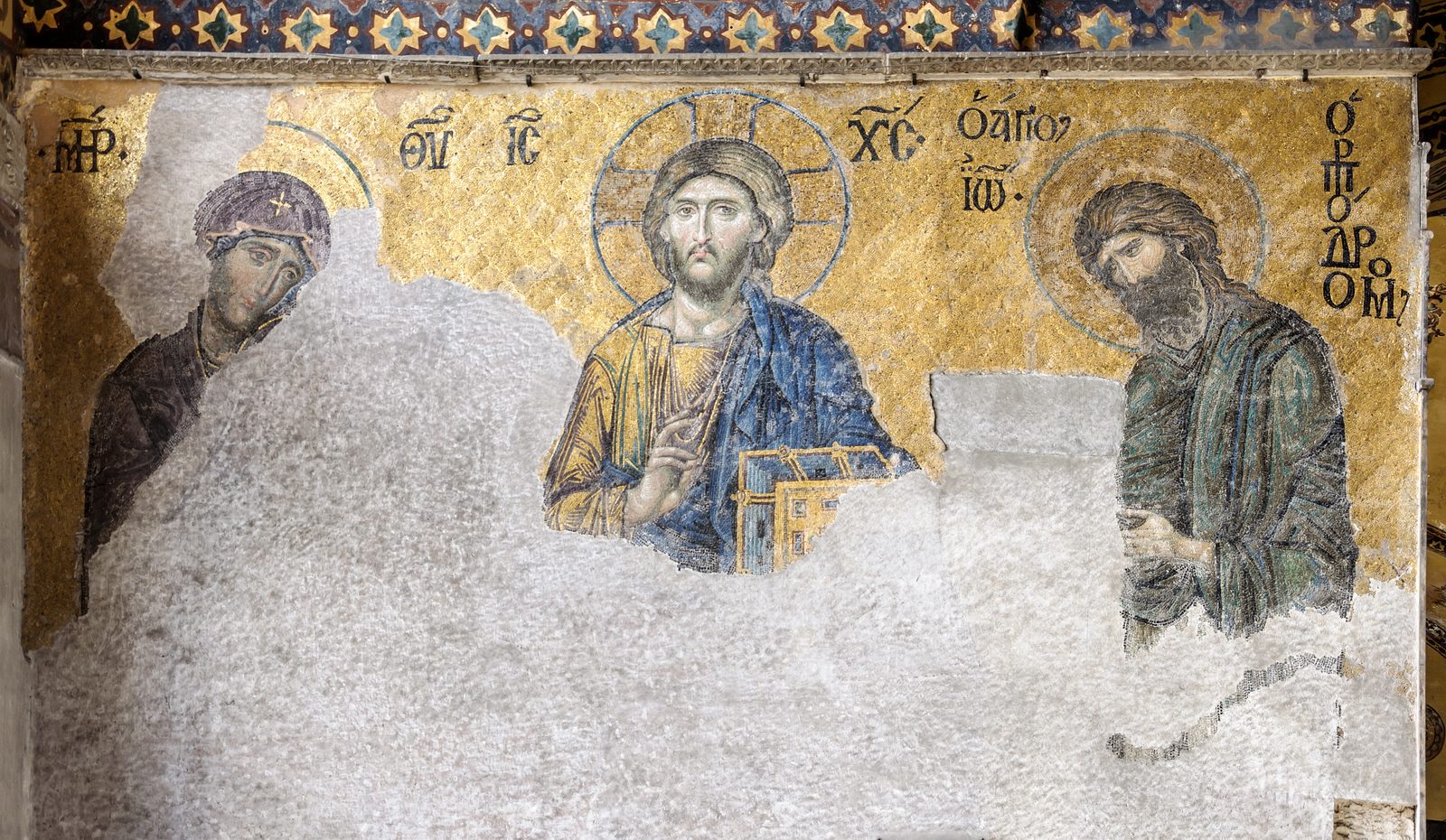
Their recovery came from an outsider. Thomas Whittemore, an American Byzantinist, founded the Byzantine Institute of America in 1930 and, according to Dumbarton Oaks' account of his career, obtained permission from Mustafa Kemal Ataturk in June 1931, with the American ambassador Joseph Grew helping secure it, to uncover and conserve Hagia Sophia's mosaics. Whittemore's team began the physical restoration work in 1932, a campaign that continued for close to two decades and included the apse Virgin and Child, the imperial-gate mosaic, and the Deesis panel showing Christ flanked by the Virgin and John the Baptist. The building was formally redesignated a museum in 1935, putting the newly uncovered mosaics on permanent public view for the first time since the Ottoman conquest.
That status did not hold permanently. In 2020, Turkey's Council of State annulled the 1934 decision establishing the museum, and Hagia Sophia was reclassified as an active mosque. Multiple outlets, including Al Jazeera, The Art Newspaper, and Balkan Insight, reported at the time that Turkish authorities planned to cover the building's figural Christian mosaics, among them the images facing the direction of prayer, with curtains or projected light during prayer times, since figural imagery is not traditionally displayed in the sightline of Muslim prayer, while leaving them uncovered and visible to visitors between services. The mosaics that Whittemore's team spent nearly twenty years freeing from Ottoman-era whitewash are, as a result, visible today on a schedule rather than permanently, a second and much more recent chapter in a building whose relationship to its own figural mosaics has now shifted at least three times: covered under the Ottomans, uncovered as a museum, and covered again on a rotating basis as a mosque.
The Renaissance built its own origin story by insulting this technique
Byzantine mosaic did not simply fall out of fashion once panel painting took over in Western Europe; it was written out of the record on purpose. Giorgio Vasari's 1550 Lives of the Most Excellent Painters, Sculptors, and Architects credits Giotto with a decisive break from what Vasari's Italian text calls the goffa maniera greca, the clumsy Greek manner, a label historians have since applied broadly to the Byzantine-influenced painting that dominated Italian churches before Giotto's generation. Vasari's habit of pinning a whole style's flaws on an outside group was not limited to painting: he used the same move on architecture, blaming pointed arches and flying buttresses on the Goths despite that architectural style not appearing anywhere in Europe until centuries after the historical Gothic kingdoms had fallen.
The label stuck in art-historical shorthand even though, by the time Vasari was writing in the 1550s, the tradition he was dismissing had already left a wider mark than his own "clumsy" verdict allowed for. Byzantine cloisonne enamel, a related luxury medium built on the same fused-gold logic as mosaic tesserae, had already given Venice's Basilica di San Marco a gold altarpiece, first commissioned in 976 and carrying more than eighty pieces of Byzantine cloisonne enamel added over the following two centuries, the whole ensemble on public display centuries before Vasari ever picked up a pen. Byzantine mosaic conventions had also already traveled directly into medieval European painting rather than staying confined to the empire that produced them: Romanesque church murals across eleventh- and twelfth-century Europe borrowed the same flat, frontal figures and geometric drapery associated with Byzantine mosaic, filtered through Italy into village churches as far from Constantinople as the Catalan Pyrenees.
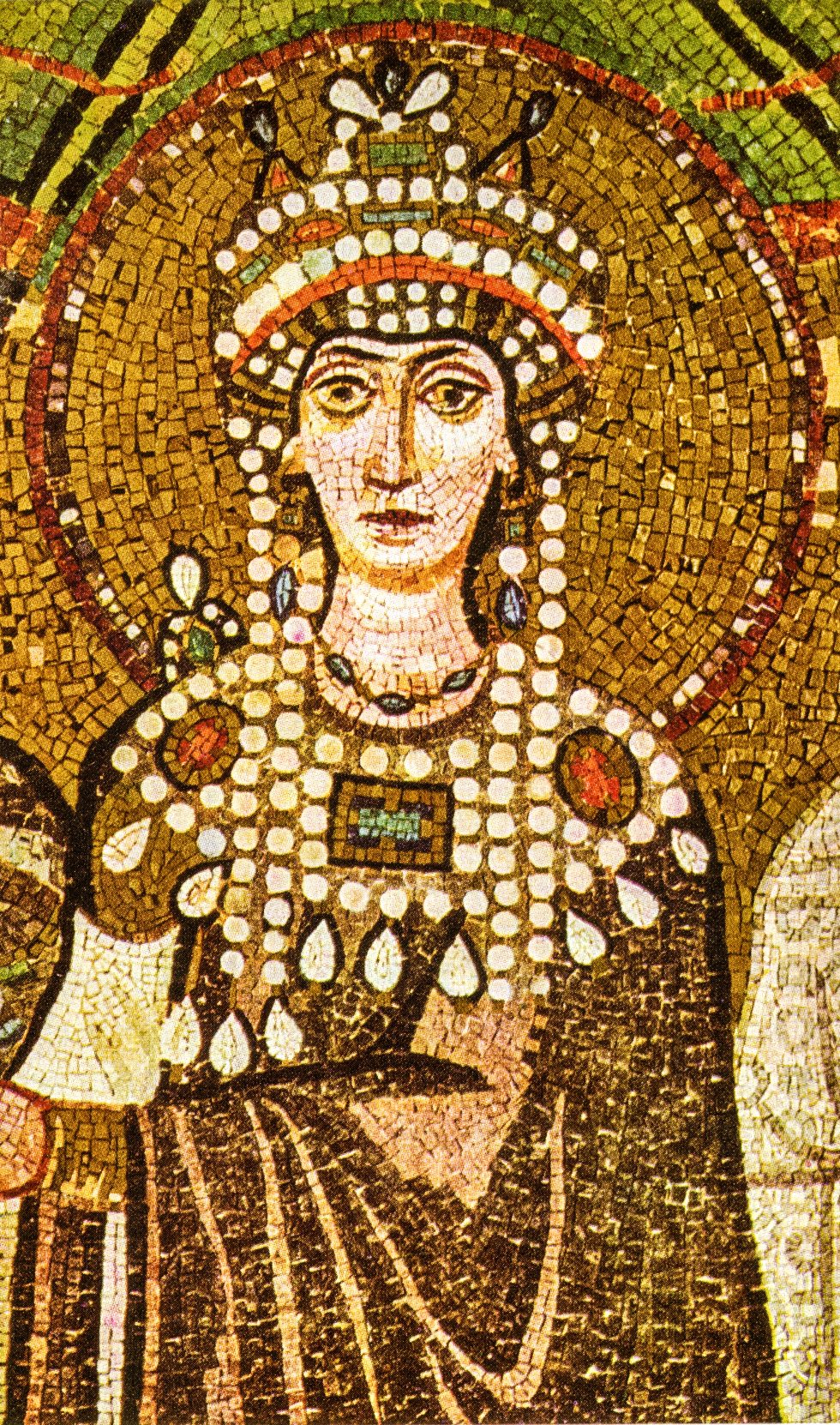
Some artists went looking for the source material directly. Gustav Klimt traveled to Ravenna in December 1903 specifically to study the Theodora mosaic inside San Vitale, and the gold-ground paintings of his Golden Phase followed in the years immediately after that trip. A technique Vasari's generation dismissed as clumsy was, three and a half centuries later, exactly what one of Europe's most celebrated painters crossed the Alps to learn from.