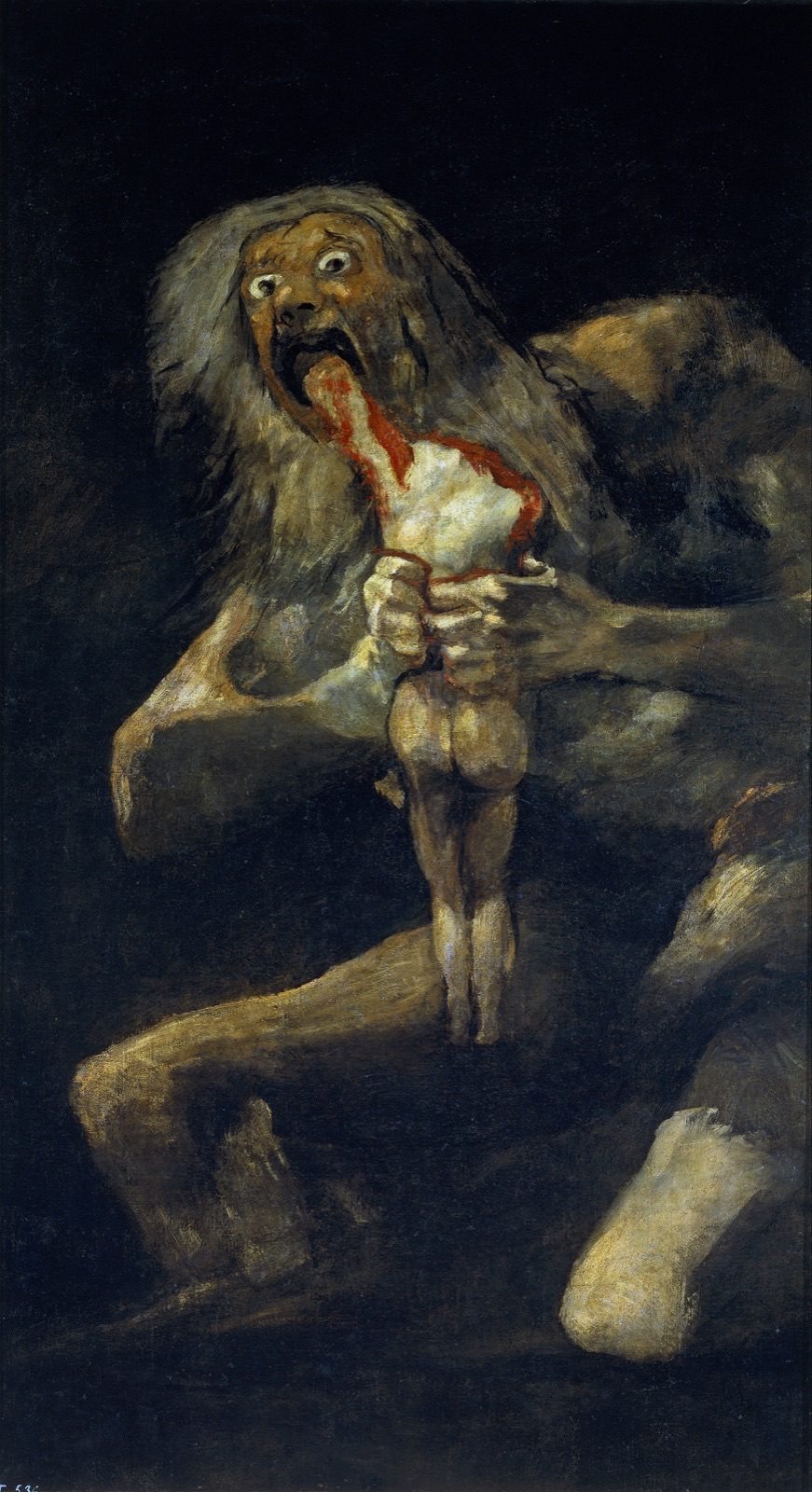
A god eating his son, painted on a dining room wall
Saturn Devouring His Son shows the Roman god Saturn, conflated in myth with the Greek Titan Cronus, in the act of eating one of his own children. Francisco Goya painted it directly onto the plaster wall of a room in his own house, in a mixed technique applied straight to the wall rather than to canvas, sometime between about 1819 and 1823. The Museo del Prado, which now holds the work under accession number P00763, lists it at 143.5 by 81.4 centimetres.
It is one of fourteen paintings together known as the Black Paintings (Pinturas negras), all made on the walls of the same house within the same few years and named for their dominant palette of black, ochre and blood red as much as for their subject matter. Within the house, Saturn hung alongside several of the others in a room on the upper floor that had been used as a dining room. That upper floor's construction date is precisely what later became the center of a formal challenge to Goya's authorship, covered further below. Goya bought the house on 27 February 1819. It was already called Quinta del Sordo, the Estate of the Deaf Man, after an earlier owner who had been deaf, not after Goya, even though Goya himself had been profoundly deaf since a severe illness in 1792-93, a coincidence guidebooks have gotten backwards for two centuries.
He was 73 when he began covering the walls, and had nearly died only weeks earlier. At the end of 1819, probably from typhoid fever, he came close to dying. He commemorated his recovery in a separate 1820 painting, Self-Portrait with Dr Arrieta, now at the Minneapolis Institute of Art, which inscribes his own account of it: "Goya gives thanks to his friend Arrieta for the expert care with which he saved his life from an acute and dangerous illness which he suffered at the close of the year 1819 when he was 73 years old." The Black Paintings were made in the years immediately after that brush with death, in a house he would leave for good in 1824, when he moved to Bordeaux, where he died in 1828.
Two Saturns hang a few rooms apart
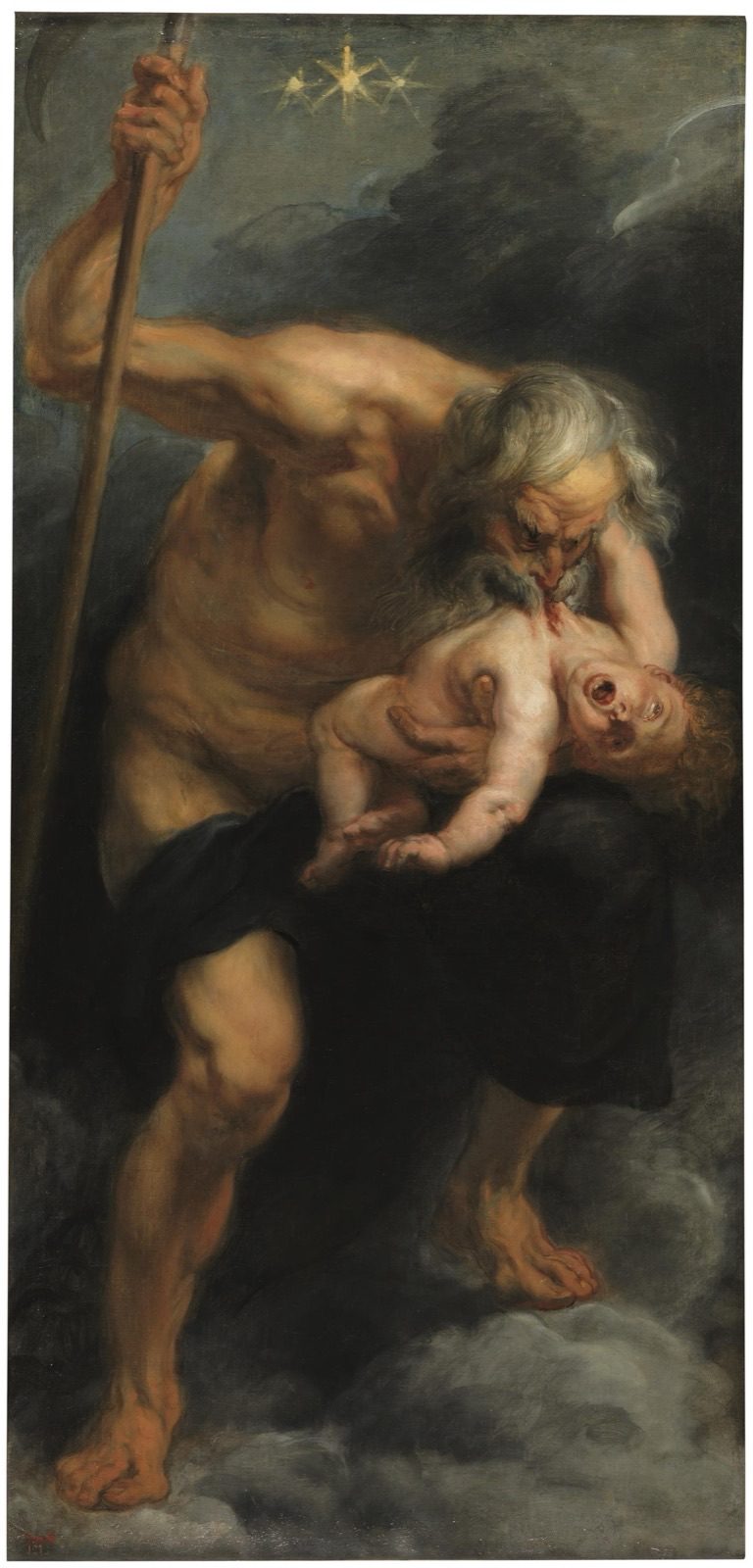
The Prado owns a second, much earlier painting of the identical mythological subject: Peter Paul Rubens's Saturn, painted around 1636-38 for a royal hunting lodge, the Torre de la Parada, commissioned by Philip IV of Spain, and now catalogued under accession number P01678. The two paintings, roughly 180 years apart, hang in the same museum and could not treat the same myth more differently.
Rubens gives Saturn a full mythological setting: a muscular, classically posed old man biting into the side of an infant who is still visibly, agonisingly alive, painted with the anatomical control and warm colouring typical of Baroque history painting made for a royal patron. Goya strips almost everything else away. There is no landscape, no attribute identifying Saturn as a god beyond his wild white hair and bulging eyes, and the child in his grip has already been reduced to a headless, faceless mass of flesh, one remaining hand caught in Saturn's fist. Where Rubens paints a myth being illustrated for a palace wall, Goya paints an act that has stopped being about mythology and started being about madness. Rubens completed his version as one piece in a larger mythological cycle commissioned for a hunting lodge outside Madrid; Goya answered to no patron at all, which is part of why the two paintings, made for entirely different purposes almost two centuries apart, now read like arguments about what the same myth is even for.
Fourteen paintings, maybe fifteen
The Black Paintings are usually counted as fourteen because that is how many arrived at the Prado, not necessarily how many Goya painted. Antonio Brugada's 1828 inventory of the house lists seven murals on the ground floor and eight on the upper floor, fifteen in total, one more than the number that ever reached the museum. The gap has a specific documented cause: the French critic Charles Yriarte visited the Quinta del Sordo in 1867, seven years before Martínez Cubells began transferring the other fourteen to canvas, and described an additional mural that had already been taken down and moved to the Marquis of Salamanca's Vista Alegre Palace.
Most specialists identify that missing work as Heads in a Landscape (Cabezas en un paisaje), a cluster of five faces in the lower corner of a mountain scene, now held by the private collector Stanley Moss in New York. Its documented ownership trail runs further back than any of the fourteen canvases in the Prado: recorded in an 1846 inventory of Madrid's Vista Alegre Palace while it belonged to Queen María Cristina de Borbón, inherited by her daughter the Infanta María Luisa Fernanda, sold in 1859 to the financier José de Salamanca y Mayol, passed down to the Duke of Galliera by 1892, and later sold in Paris to the collector Contini Bonacossi before reaching its current owner. By the time d'Erlanger's restorer was peeling the other fourteen off Goya's walls in the 1870s, this one had already been inherited, sold, and relocated from Madrid to Seville, years before the rest of the series had even left Goya's house.
That earlier trail is also the weakest link in the story. Fundación Goya en Aragón, the scholarly foundation that catalogues Goya's documented works, states plainly that some authors have questioned the painting's authenticity. The fifteenth Black Painting, if it belonged to the same series at all, is the one member of the group nobody can walk up to in a public museum, and the one whose place in the set is argued over rather than assumed.
The wall that no longer exists
Goya died in Bordeaux in 1828, and the Quinta del Sordo changed hands several times afterward. In 1873, the French-German financier Baron Émile d'Erlanger bought the property, apparently intending to show the murals at the 1878 Exposition Universelle in Paris. Between 1874 and 1878, under the direction of restorer Salvador Martínez Cubells, the fourteen paintings were physically stripped from the plaster and transferred onto canvas so they could travel, a difficult technical process that, across the series, is documented to have caused real and irreversible paint loss.
After the Paris exhibition, d'Erlanger donated the transferred canvases to the Spanish state in 1881; they went on permanent public display at the Prado in 1889. The original house stood empty for another two decades and was demolished in 1909 as Madrid's Carabanchel district expanded outward. That means the wall Goya actually painted on no longer exists in any form, anywhere. Every version of Saturn Devouring His Son anyone has looked at since 1889, in the museum or in reproduction, is the canvas Martínez Cubells produced, not the surface Goya left behind. It is a different kind of alteration from the slow chemical pigment change conservators have measured, decades later, in Van Gogh's own canvases, but it is the same reminder that almost nothing from this period survives completely untouched by later hands.
The scholar who argued Goya never painted this
The earliest documentary record of the Black Paintings' existence dates from 1828, the year Goya died, when the Spanish painter Antonio Brugada, a friend of Goya's, drew up an inventory of the works decorating the Quinta del Sordo. Brugada's list, made after Goya's death rather than during his lifetime, is the closest thing to a contemporary catalogue the series has, and it is the document both sides of the authorship dispute described below have had to argue around rather than a record that settles the question outright. Goya himself never titled, signed or wrote about any of the fourteen paintings; the names now attached to them, including Saturn, were assigned afterward, starting with Brugada's own attempt to identify the mythological and folkloric figures he was cataloguing.
In 2003, the Madrid art historian Juan José Junquera published research that directly challenged Goya's authorship. Working from property deeds for the Quinta del Sordo, Junquera argued that the house was a single-storey building at the time Goya owned it, while the room that held this painting and eight of the other thirteen Black Paintings sat on an upper floor. If that floor was added only after Goya left for Bordeaux in 1824, he reasoned, Goya could not have painted the works found in it.
Junquera's proposed replacement author was Goya's own family: his son Javier, or possibly his grandson Mariano, working from a financial motive, since paintings attributed to the already-celebrated Francisco Goya would fetch far more than work credited to his son. Most Goya scholars, including the longtime specialist Nigel Glendinning, rejected the argument, pointing out that the property records are ambiguous about how many storeys the house actually had, that Javier is not otherwise documented as a painter of remotely this ambition, and that the brushwork and pigments match Goya's other late canvases. The Museo del Prado's own catalogue continues to list the Black Paintings as autograph works by Goya.
The dispute has never been closed by hard forensic evidence the way some Frida Kahlo authentication cases have been resolved by pigment and paper analysis. No infrared study, pigment dating or newly discovered document has settled the Junquera question either way; it remains an argument from indirect documentary evidence on both sides, a less tidy answer than the confident wall label in the Prado's own galleries suggests. Authorship disputes over a single canvas can run for just as long without a forensic resolution elsewhere: a Caravaggio Narcissus has had its authorship argued since 1913, and a 1995 X-ray restoration meant to settle the question instead left conservators reading the same paint layers two different ways.
Not necessarily a child
Even setting the authorship dispute aside, the painting's own subject resists the label usually attached to it. The Museo del Prado's own published encyclopedia entry, written by the scholar Valeriano Bozal, argues that the figure being eaten lacks the mythological attributes that would confirm it as Saturn's child, and that the proportions of its body could belong to a young woman rather than an infant. In Bozal's reading, that possibility pairs the image with the panel that hung facing it in the same room, Judith and Holofernes: if a young, beautiful Judith kills an older, powerful man in one picture, an old Saturn devouring a young woman would be reading it in reverse.
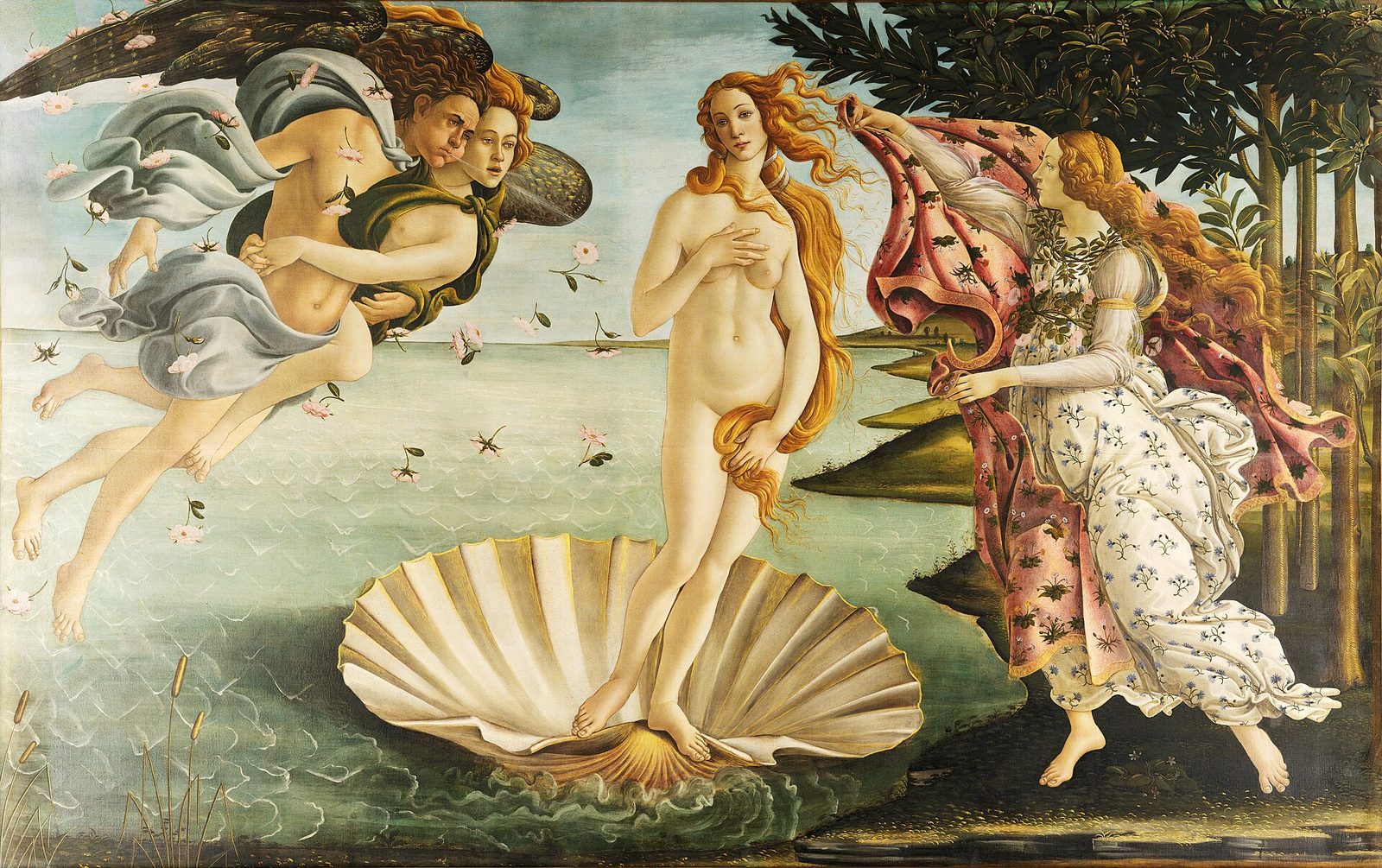
English-language scholarship reaches a similar conclusion from a different angle. Wikipedia's sourced summary of the painting notes that the Goya scholar Fred Licht has questioned the traditional title itself, pointing out that the figure carries none of Saturn's usual attributes, such as a scythe or hourglass, and that the smaller body does not resemble that of an infant, or arguably even an anatomically accurate human at all. The sex of the consumed figure, on both readings, cannot be determined with certainty. Licht has proposed going further still, reading the image as an inversion of antisemitic blood-libel imagery, in which the larger figure projects European fears about Jewish people rather than illustrating a scene from classical myth. It is one more reading built on a title assigned well after Goya's death, not one he ever confirmed. Painted portraits raise a similar identity question from a different angle: whether Sandro Botticelli's posthumous "Simonetta" portraits even depict Simonetta Vespucci at all remains disputed, and a 2026 medical paper now argues over how she died rather than just who she was.
What the painting is actually about
Goya left no letter, diary entry or inscription explaining any of the Black Paintings, so everything written about their meaning is inference rather than documented fact, and several different readings coexist rather than one displacing another. One reading is political and rests on straightforward chronology: Goya painted the series across the Trienio Liberal of 1820-1823, Spain's brief experiment with constitutional rule under the 1812 Constitution, which ended that autumn when a French army, the so-called Hundred Thousand Sons of Saint Louis, restored Ferdinand VII to absolute power and opened the repressive decade that followed. Set against those three years of civil conflict between liberals and royalists, one common reading treats a father devouring his own child as a figure for a country turning on its own people, though Goya left nothing in writing to confirm he intended that reading specifically.
A second reading is personal, and sits closer to Goya's own documented biography. He began painting the walls at 73, in the same house and years in which he had just survived the near-fatal illness described in his own words on the Arrieta portrait discussed above. Read against that timeline, an old man's fear of his own mortality, or of a son who would outlive him, fits the image at least as plausibly as any specific political allegory. A third reading treats the subject as being about the destructive weight of paternal authority in general, independent of any particular Spanish political context.
None of these is the painting's official meaning, because it does not have one. The Prado's own materials present the Black Paintings' significance as unresolved rather than settled, and on a picture this thinly documented, that may be the single most accurate sentence anyone can write about it. It puts Saturn Devouring His Son in the company of other famous, disturbing paintings whose meaning keeps getting re-argued rather than closed, pictures that stay unsettled not for lack of scholarly attention, but because the artist never left enough behind to settle them.

.jpg)
