A cowboy from Wyoming becomes a household name overnight
On August 8, 1949, Life magazine ran a feature on Jackson Pollock under the headline "Jackson Pollock: Is he the greatest living painter in the United States?" Written by Dorothy Seiberling and illustrated with photographs by Martha Holmes and a now-famous Arnold Newman portrait of Pollock standing in front of his 18-foot canvas Summertime: Number 9A, the piece reached a magazine with a circulation of roughly five million. It framed him as a paint-slinging cowboy out of Cody, Wyoming, a hook so effective that the Cody Enterprise, the hometown paper, opened its own inquiry into Pollock's background because nobody there had ever heard of him.
The reaction split along predictable lines. Dan Miller, who ran the general store near Pollock's home in Springs, later recalled that neighbors made peace with the article by deciding Life magazine was crazier than Pollock. The painter Willem de Kooning, seeing the photographs, joked that Pollock looked like some guy who worked at a service station pumping gas. Pollock himself reportedly refused to look at the article the day two fellow painters, James Brooks and Bradley Walker Tomlin, brought copies out to show him in Springs, though he kept stacks of the issue on a shelf afterward and pulled them out for visitors. Within weeks of the piece running, he bought a used 1941 Cadillac convertible for $500, a small, concrete sign of a working painter whose income had just changed shape. Public scrutiny of a painter's private conduct and its effect on how his work gets read shows up in a starker, legal form decades earlier and a continent away: Egon Schiele's 1912 arrest on a kidnapping charge collapsed before it reached trial, though a separate obscenity conviction still sent him to jail for 24 days.
What the fame was actually worth, in dollars
The sales record for the rest of 1949 shows the Life article converting into real, if modest, money rather than instant riches. In October, the collector and fellow painter Alfonso Ossorio bought four paintings outright. A one-man show at the Betty Parsons Gallery running from November 21 to December 10 sold thirteen more works for a combined $3,600. Across the whole year Pollock sold thirty-five canvases for a total of $13,870, of which $4,578 went to the gallery, according to the historian Serge Guilbaut's account of the period. The buyers included John D. Rockefeller, Ossorio again, the collector Edward Root, the publishing executive Lee Ault, the Museum of Modern Art, and Duncan Phillips of the Phillips Collection.
Set against the scale of the Life feature, an average sale price under $400 a canvas is a reminder of how narrow the art market for an American painter working outside mural commissions still was in 1949, fame in a five-million-circulation magazine notwithstanding. It took another year, and a very different kind of publicity, for Pollock's working process itself to become the story rather than the paintings it produced.
Four weekends in front of Hans Namuth's camera
Hans Namuth, a photographer who had already published stills of Pollock at work, returned to Springs in the fall of 1950 with a movie camera and spent four consecutive weekends filming him paint outdoors, the sessions that became the short film Jackson Pollock 51. At some point during the shoot Pollock began working on a sheet of plate glass laid across two sawhorses so Namuth could film from underneath and show the paint landing from the canvas's own point of view. Accounts of whose idea the glass was disagree: Lee Krasner, Pollock's wife, later pushed back on the standard version in an interview with Barbara Rose, saying she was present when Pollock produced a sheet of glass and simply decided to paint on it, and that she had always assumed he got the idea from Marcel Duchamp rather than from Namuth.
Pollock discussed the glass painting himself in a radio interview recorded in his studio in late 1950, describing it as something new for him: "That's the first thing I've done on glass and I find it very exciting. I think the possibilities of using painting on glass in modern architecture, in modern construction, terrific." The finished work, now catalogued as No. 29, 1950, survives today at the National Gallery of Canada in Ottawa, made with black and aluminum enamel paint, string, beads, coloured glass, and pebbles worked into the surface, a hybrid of painting and low relief that Pollock never repeated at that scale.
The night that ended two years of sobriety
Namuth finished filming Pollock in the last cold days of November 1950, in the same narrow window as that year's Thanksgiving, which fell on November 23. Exactly which day is disputed: one detailed published timeline of Pollock's 1950 dates the final session to Saturday, November 25, two days after Thanksgiving; another account of the same events places it on the Saturday before; Namuth himself, in a later interview, described the blowup as following directly from the emotional strain of that last day of outdoor filming, with dinner served to a large group of friends that same evening. What multiple accounts agree on is what happened once the two men came in from the cold: Pollock, who had been sober for roughly two years by most accounts, poured himself a tumbler of bourbon. An argument with Namuth followed, escalating into a volley of each man calling the other a phony. Pollock tore a strap of cowbells off the studio wall and swung it around, and with dinner guests already seated and food on the table, he grabbed one end of the table and shouted "Should I do it now?" Namuth answered "Now?" and Pollock turned the whole table over: plates, glasses, meat, and gravy across the floor, with the family dogs lapping at the mess. Accounts differ on whether the meal itself was turkey or roast beef, a small enough detail that it says something about how many times this particular story has been retold since. Krasner's only recorded response was to announce that coffee would be served in the living room.
According to the account the journalist Sarah Boxer compiled for the New York Times in 1998, Pollock never stopped drinking again after that night. He put off bringing the finished glass painting in from outdoors until it was covered in rain and dead leaves, and his subsequent work moved toward a more restrained, at times figurative style, a reversal of the open, all-over drip technique that had made him famous the year before.
What changed after that night
Pollock's 1951 output turned darker in nearly every sense. He began painting in black enamel on raw, unprimed canvas, a body of work now known as the Black Pourings. When he showed them at the Betty Parsons Gallery, none sold at the exhibition itself; Parsons later placed a single one with a friend at half the asking price. Meanwhile the language used to describe what Pollock did for a living was hardening into something Pollock had never used himself. In December 1952, the critic Harold Rosenberg published "The American Action Painters" in ARTnews, arguing that for painters like Pollock "the canvas began to appear...as an arena in which to act, rather than as a space in which to reproduce, re-design, analyze, or 'express' an object," and that "what was to go on the canvas was not a picture but an event." The term action painting stuck to Pollock for the rest of his career and after, and Rosenberg's essay is generally credited with giving the loose, still-unnamed circle of New York painters he was writing about the label, the New York School, that art historians still use for the group today.
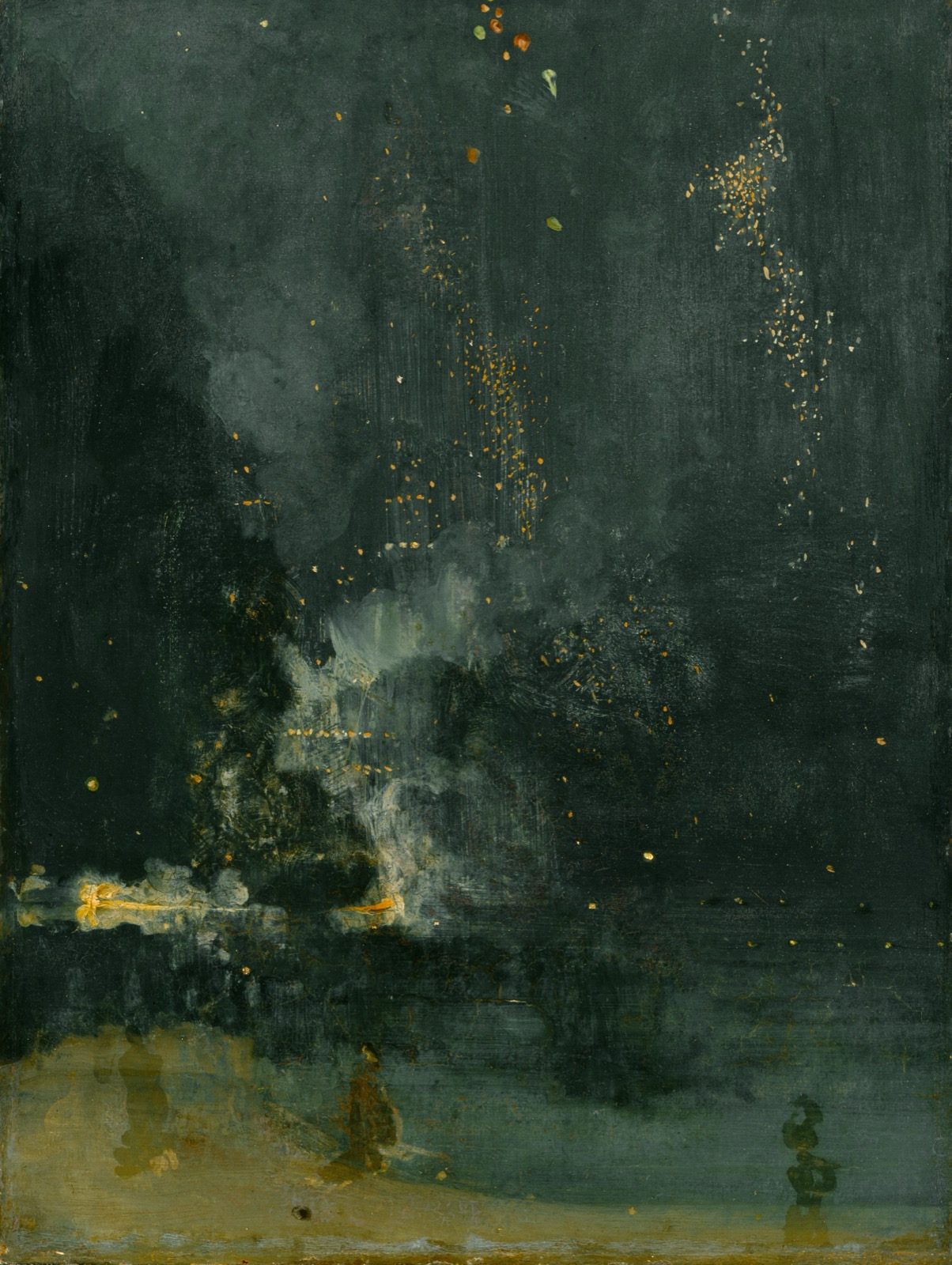
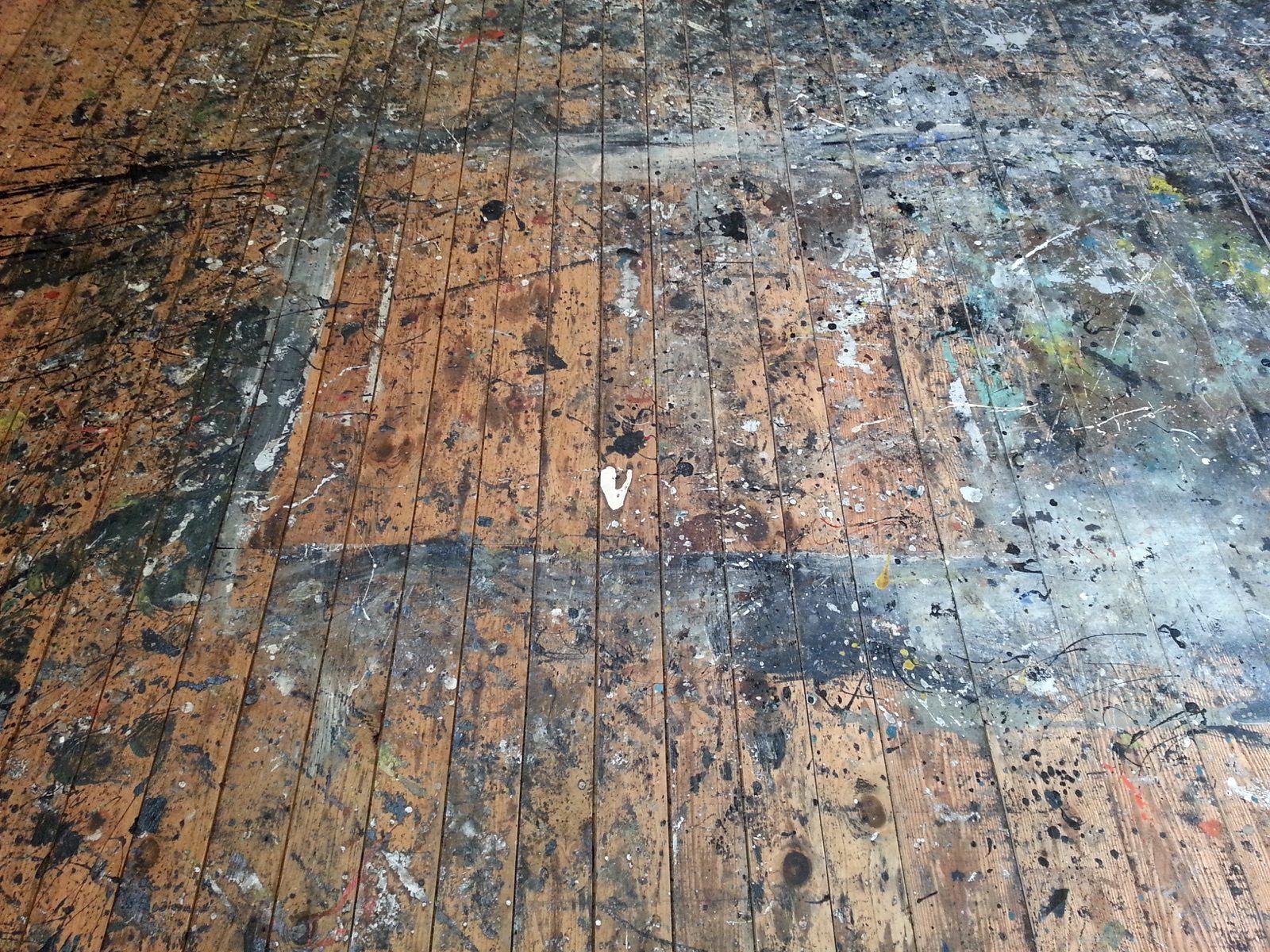
Pollock's own description of his process, narrated for Namuth's camera during the same 1950 shoot that ended in the table incident, reads far more plainly: "I don't work from drawings or color sketches. My painting is direct. I usually paint on the floor. I enjoy working on a large canvas, I feel more at home, more at ease, in a big area. Having the canvas on the floor, I feel nearer, more a part of the painting." Nothing in that narration mentions performance, an audience, or an arena. Rosenberg's essay named a movement; it did not describe how the artist most identified with it talked about his own work, a gap between a critic's label and an artist's own words familiar from what Andy Warhol said about wanting to be a machine, a line that outlived his own explanations of it in much the same way. A critic's harsh public verdict on a painter has ended up in a courtroom before: John Ruskin's review of a Whistler nocturne led to an 1878 libel trial that technically named Whistler the winner, though the jury awarded him just a farthing in damages.
The year he didn't paint, and the night that ended it
By 1955 Pollock's productivity had thinned to two finished paintings for the entire year, Scent and Search. In 1956 he painted nothing at all, working instead on sculpture at the sculptor Tony Smith's home, sand-cast pieces of wire, gauze, and plaster with the same heavily textured surfaces that marked his paintings. His marriage to Krasner was unraveling under the weight of his drinking and an affair with the painter Ruth Kligman, and by August Krasner had left to visit friends in Europe. Pollock's alcoholism long predates the 1950 filming, and no biographer treats the table-flipping night as a medical cause of what followed nearly six years later; what the record supports is a documented turning point after which his sobriety, once resumed for two years, was never regained.
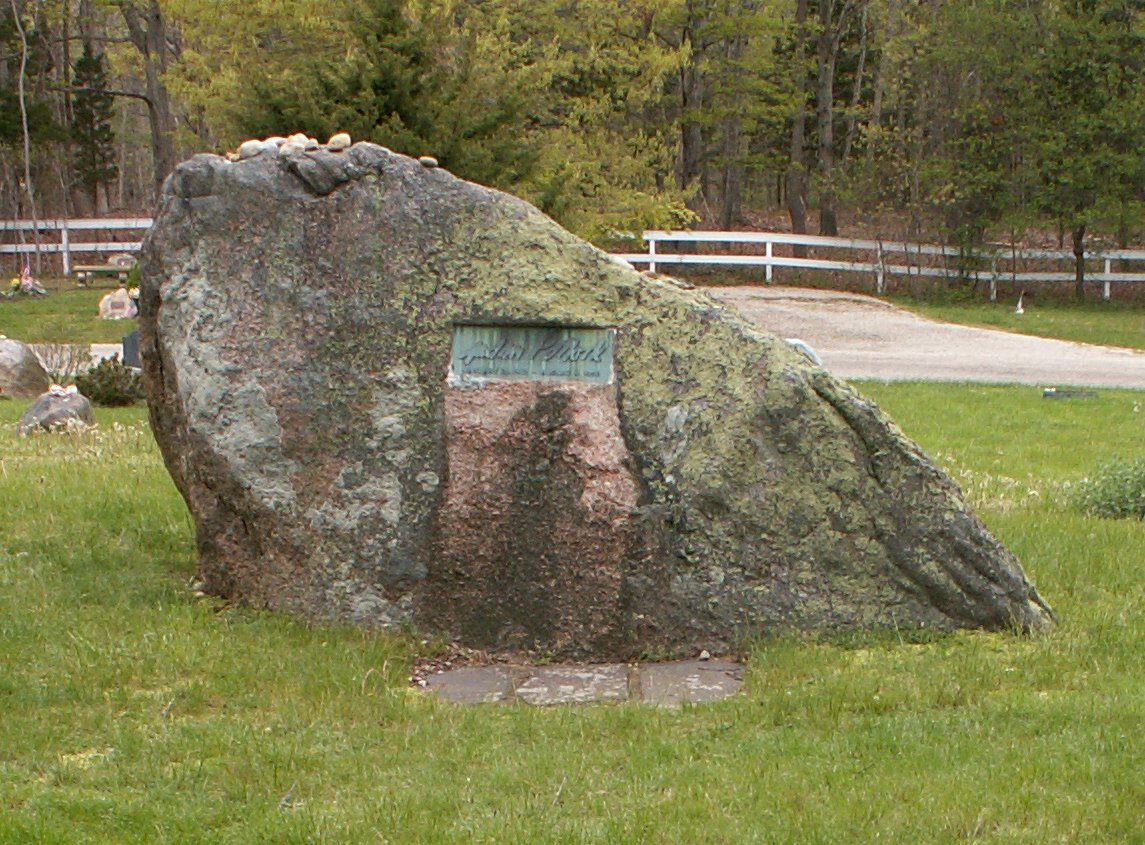
On the night of August 11, 1956, at around 10:15 p.m., Pollock, who had been drinking, lost control of his Oldsmobile convertible less than a mile from his home in Springs and crashed. He and one of his passengers, Edith Metzger, were killed; the other passenger, Ruth Kligman, survived. Krasner returned from Europe as soon as she heard the news. Pollock is buried in Green River Cemetery in Springs, his grave marked by a large natural boulder Krasner selected, with her own, smaller grave placed in front of his after her death in 1984, a quieter echo of a decline that had a single traceable night in late November 1950 at its start, nearly six years earlier, not unlike the way Van Gogh's own final, most mythologized months get read backward through the ending rather than forward from how the work was actually made.