What the Uffizi's own record actually says
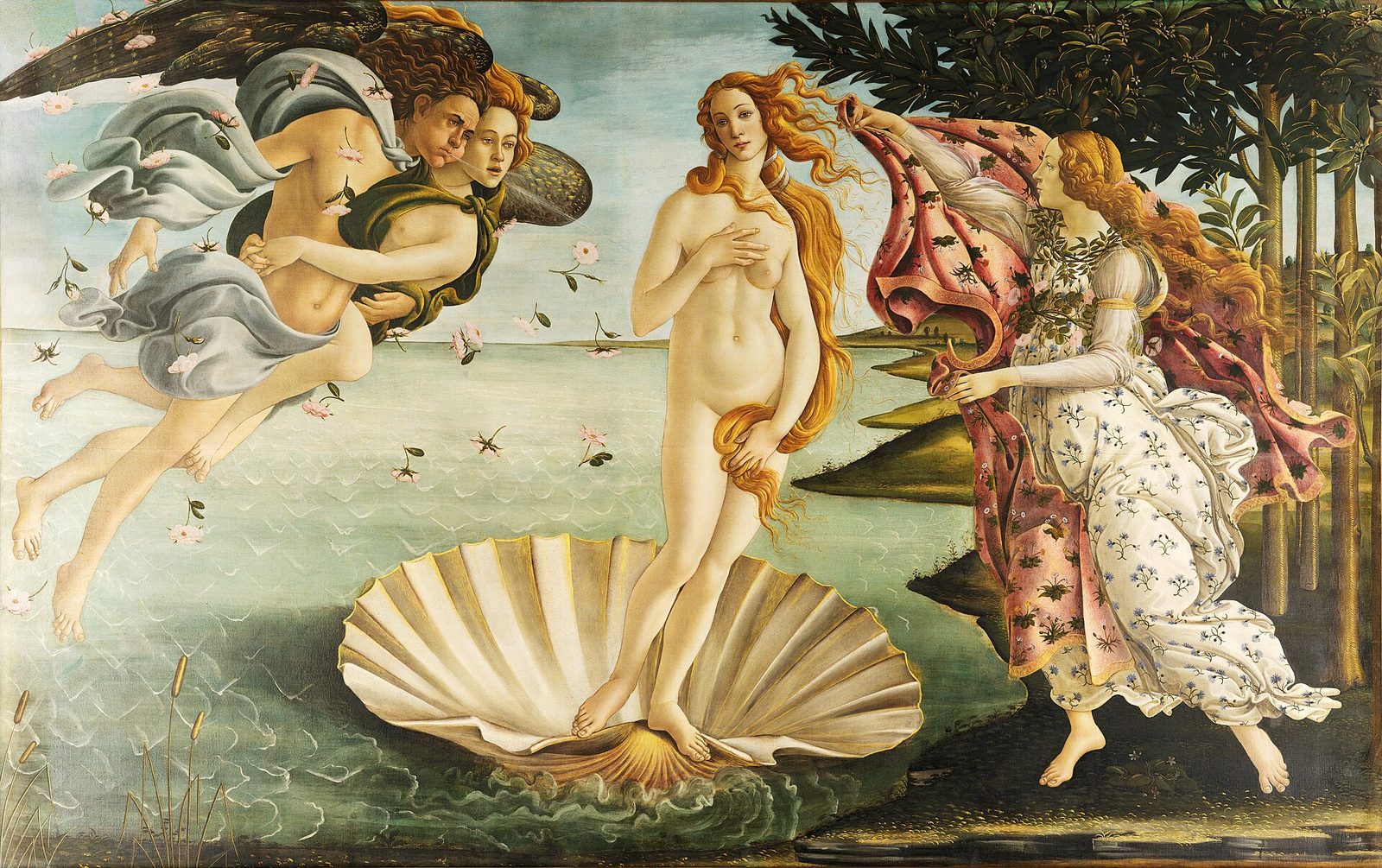
The Uffizi's own collection page describes the scene precisely: "the goddess of love and beauty arriving on land, on the island of Cyprus, born of the sea spray and blown there by the winds, Zephyr and, perhaps, Aura." Venus stands on an oversized scallop shell, hands and hair arranged to cover her nakedness, while a second woman on the right, identified by her floral dress as the Hora of spring, holds out a cloak to wrap around her the moment she steps ashore. The gallery's own record gives the technique as tempera on canvas, the size as 172.5 by 278.5 centimetres, and the inventory number as 1890 n. 878. It hangs today in Room A9, alongside Filippo Lippi's paintings.
The Uffizi dates the work to "1485 ca." That figure is itself the product of a dispute rather than a fixed fact. The art historian Herbert Horne argued the painting was made soon after 1477, when the villa where it was later recorded, the Villa di Castello outside Florence, was bought by two young Medici cousins, and before 1481, when Botticelli left Florence to join the painters working on the Sistine Chapel. Most recent scholarship instead places it around 1484 to 1486, based on where the picture sits stylistically within the rest of Botticelli's output. Both dates rest on inference from the painting itself, not on a document that states when it was made.
No paper trail for the first forty to sixty-six years
There is no legal document recording who commissioned the Birth of Venus, and none recording when. The Uffizi's own account is direct about the gap: "there is nothing written about the painting before 1550, when Giorgio Vasari describes it in the Medici's Villa of Castello." Vasari's Lives of the Artists was first published that year, though art historians think he likely saw the painting somewhat earlier, probably sometime between 1530 and 1540, since he was himself working inside the villa by 1550. Even on the earliest plausible date for Vasari's visit, roughly forty-five years separate the painting's probable execution from the first sentence anyone is known to have written about it.
The case for a Medici commission rests on circumstantial detail rather than a signed contract. Orange trees appear repeatedly in the painting's landscape, and the Uffizi's curators read them as a deliberate nod to the Medici family, whose name plays on "mala medica," the period term for the orange tree. The Villa di Castello itself had been bought in 1477 by two Medici cousins, Lorenzo and Giovanni di Pierfrancesco, who inherited it as young wards after their father died at forty-six the year before, leaving their older cousin, Lorenzo the Magnificent, as head of the senior branch of the family. That combination, the villa's ownership and the orange-tree emblem, is what art historians have built the Medici attribution on. None of it is a document naming a patron, which puts this painting in the same evidentiary position as most works this famous: what a museum's own catalogue entry can and cannot establish turns out to matter more than the popular story built on top of it.
The inventory that undercut the assumption
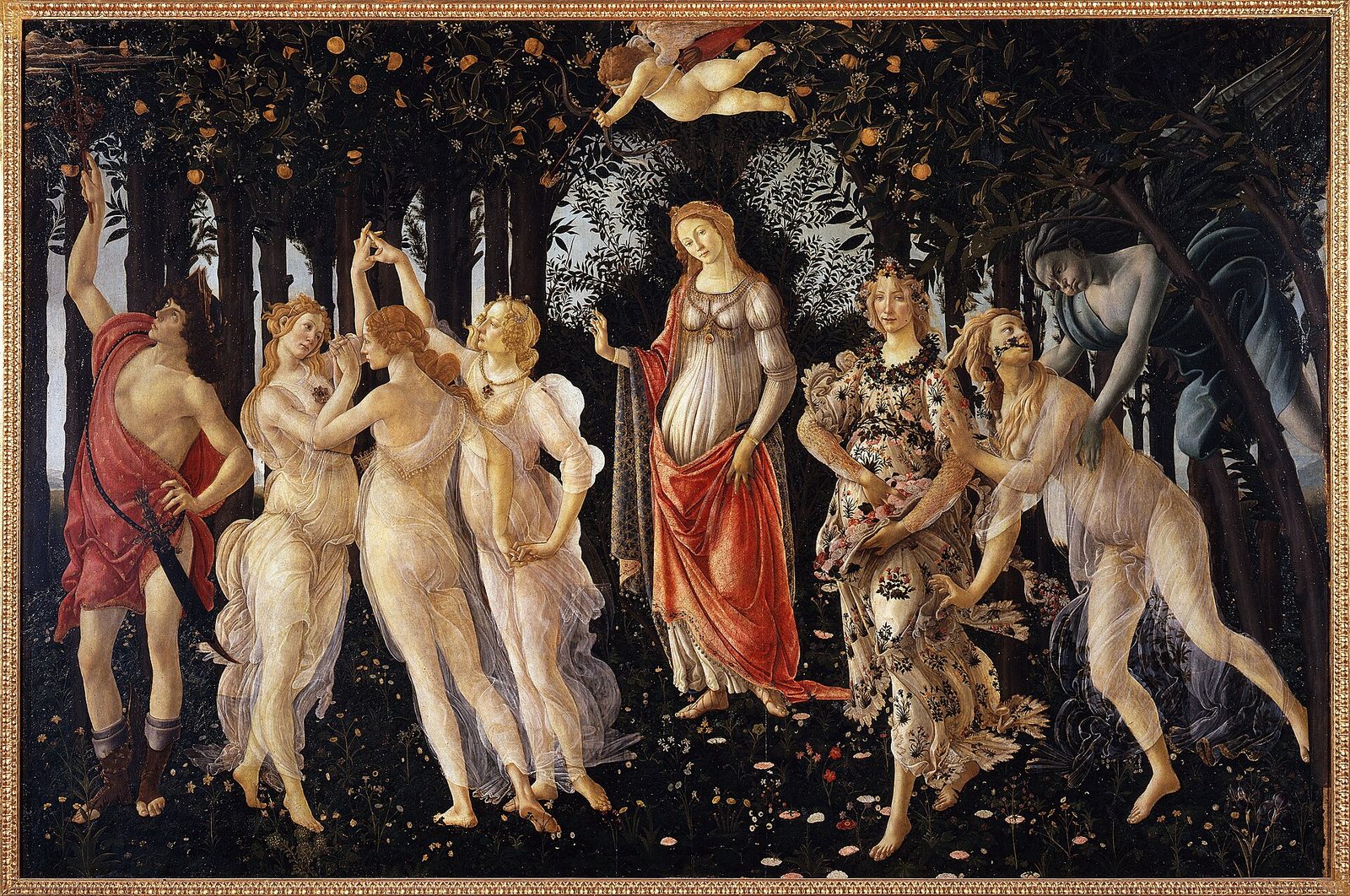
For most of the painting's modern history, that gap was papered over by a tidy story: the Birth of Venus was assumed to have been commissioned together with Botticelli's other large mythological painting, Primavera, by the same member of the Medici family, to hang together in the same house. Wikipedia's own account of the dispute states plainly that this pairing "is now uncertain," and the reason is a single archival discovery.
In 1975, an apparently complete 1499 inventory of the property belonging to Lorenzo di Pierfrancesco de' Medici's branch of the family was published for the first time. Primavera appears in that inventory. The Birth of Venus does not. On the strength of that absence, the art historian Ronald Lightbown, in his 1989 study Sandro Botticelli: Life and Work, concludes that the Birth of Venus only came into Medici ownership sometime after 1499, rather than being commissioned alongside Primavera as earlier scholarship had assumed. A single list of household goods, compiled more than a decade after the painting was likely made and unread by art historians for nearly five centuries after that, was enough to unravel an assumption that had stood as settled fact.
This is not a minor correction. It means the two paintings' entire shared origin story, the version repeated in most popular accounts of Botticelli, rests on an inference that a document meant to test it does not support. Ownership records overturning a settled attribution decades after the fact is not unique to this painting either; it is the same kind of documentary reversal that reshaped who legally owned Gustav Klimt's most famous portraits, just resolved through an inventory rather than a courtroom. Bruegel's Icarus is another doubted attribution.
What conservation science found under the paint
The canvas itself is unusual for Botticelli, who normally painted on wood panel, as he did for Primavera. The Uffizi's own account explains the choice as practical rather than artistic: canvas was "widely used throughout the 15th century for decorative works destined to noble houses," a cheaper support suited to a country villa rather than the more formal decoration expected in a city palazzo. Technical study cited on Wikipedia adds detail the Uffizi's own label does not: the picture is painted on two separate pieces of canvas sewn together before work began, over a gesso ground tinted blue, and it lacks the green underlayer beneath the flesh tones that appears in Botticelli's panel paintings, meaning he adjusted his usual method for the new surface rather than simply transferring it.
Modern scientific testing has also turned up pentimenti, changes the artist made as he worked. The Hora of spring originally wore what is described as low classical sandals, later painted out. The collar on the cloak she holds out was added as an afterthought. The hair of both Venus and the flying wind-pair on the left was reworked from an earlier version. Gold pigment was applied heavily to hair, wings, textiles, the shell, and parts of the landscape, and, unusually, added after the painting had already been placed in its frame. The whole surface was then finished with what conservators describe as a cool grey varnish, likely made from egg yolk.
Five and a half centuries of light exposure have changed what the picture looks like today. The green pigment used for Zephyr's wings, his companion's wings, and the leaves of the orange trees has darkened considerably, throwing off the balance of colour Botticelli originally intended. A small patch of leaf in the top right corner, protected from light for centuries by the edge of the frame, has darkened far less than the rest and gives conservators something close to a control sample of the original tone. The blues of the sea and sky have faded in the same way. What hangs in Room A9 today is not, strictly, the colour scheme Botticelli mixed.
A pose borrowed from antiquity, then bent out of it
Venus's hand positions, one covering her chest, the other reaching toward her hip, come directly from the Venus Pudica type found in Greco-Roman sculpture, a modesty pose Botticelli would have known from ancient marbles circulating in Florence. Wikipedia's own entry notes a complication worth naming directly: in classical art this particular hand-covering gesture was not normally paired with the newborn Venus Anadyomene subject at all, meaning Botticelli combined two separate classical conventions that ancient artists generally kept apart. The best-known marble example of the type, the Venus de' Medici, was documented in a Medici collection in Rome only by 1559, decades after Botticelli's painting, so whether he had access to that specific statue or a different model of the same pose remains an open question rather than a settled fact. A different ancient marble goddess makes the opposite kind of documentary point: the Venus de Milo arrived at the Louvre with an inscribed base naming its sculptor, and that base went missing within a few years of its arrival, the rarer case of proof being lost rather than never written down in the first place. But the rest of the figure departs from that classical source. The art historian Kenneth Clark, in his 1956 study The Nude: A Study in Ideal Form, put the distinction precisely: "Her differences from antique form are not physiological, but rhythmic and structural. Her whole body follows the curve of a Gothic ivory... She is not standing but floating." A classical nude distributes its weight evenly on either side of a plumb line; Clark's point is that Botticelli's Venus does not, and reads instead as an unbroken, flowing curve borrowed from centuries of Gothic art rather than the antiquity she is meant to depict. The most reproduced later paintings of Aphrodite share a single reclining pose, copied for 350 years.
The figure is not anatomically plausible on close inspection. Her neck and torso are elongated well past life proportion, and although she stands in a version of the classical contrapposto stance, her weight is shifted too far over her left leg for the pose to actually hold if she were standing rather than floating. None of the figures in the painting cast a shadow. The two wind figures on the left, Zephyr and his companion, are themselves adapted from an older source: an ancient Hellenistic gem, once owned by Lorenzo the Magnificent, that depicted a similar embracing pair. Even the parts of the painting that read as pure invention turn out, on inspection, to be built from older material Botticelli had close at hand. Checking what a famous image is actually doing, rather than what it is assumed to be doing, is what separates the Louvre's own documented provenance for the Mona Lisa from the version most visitors already believe before they arrive.
A composition built on a poem, and on a painting nobody has ever seen
The composition has a documented literary source, though not the one it is usually given credit for. Wikipedia's account traces the closest match to a Homeric Hymn to Aphrodite, first published in Florence in 1488 by the Greek scholar Demetrios Chalkokondyles, three years or so after the painting is now dated: "Of august gold-wreathed and beautiful Aphrodite I shall sing to whose domain belong the battlements of all sea-loved Cyprus where, blown by the moist breath of Zephyros, she was carried over the waves of the resounding sea on soft foam. The gold-filleted Horae happily welcomed her and clothed her with heavenly raiment." Every element in that translated passage, Cyprus, Zephyr, the sea foam, the Horae welcoming her with clothing, corresponds directly to the painting, but the printed hymn postdates the picture. Botticelli's most likely route to the same material is Angelo Poliziano, Lorenzo de' Medici's court poet, whose 1475 poem the Stanze per la giostra describes a relief of the same event and would have circulated in Florence's Medici-connected literary circles well before Chalkokondyles's translation reached print. Older scholarship, following Horne, went further and claimed Botticelli's patron directly instructed him to illustrate specific lines of Poliziano's poem, a claim Wikipedia's own entry now flags as "a possibility, though one difficult to maintain so confidently today," the same pattern of an old, tidy attribution losing its footing once it is checked against what the sources actually support.
The painting also gestures at a second source that cannot be checked at all, because nothing of it survives. Pliny the Elder, writing in the first century, described a celebrated Venus Anadyomene painted by the ancient Greek painter Apelles, a work Botticelli and the humanist scholars around him would almost certainly have known secondhand through Pliny's own text. Pliny's account carries its own strange coda: the lower portion of Apelles's painting was already damaged in antiquity and no one could be found to restore it, so the emperor Nero eventually had the ruined original replaced with a full copy by a different painter, Dorotheus. The painting that gave Botticelli's subject its classical pedigree was already gone, replaced by a copy, by the time Rome itself had fallen. What Botticelli painted is a Renaissance reconstruction of a Roman literary description of a Greek painting that no living person, in 1485 or now, has ever actually seen.