What people are actually asking
Search threads titled art director vs production designer usually want a hiring or credit answer: who is the boss of the art department, who talks to the director first, and why some IMDb pages list only one name for both jobs. The split is clearest on medium and large narrative productions. On commercials, music videos, and tiny indies, one designer may carry both titles because the crew cannot afford two keys.
This page keeps the comparison on responsibilities, reporting lines, and decision rights, using published union and guild language rather than freelance folklore. For a neighboring title that confuses agency creatives more than film crews, see the live comparison of art director vs creative director (advertising/creative-team sense of art director).
Side-by-side comparison
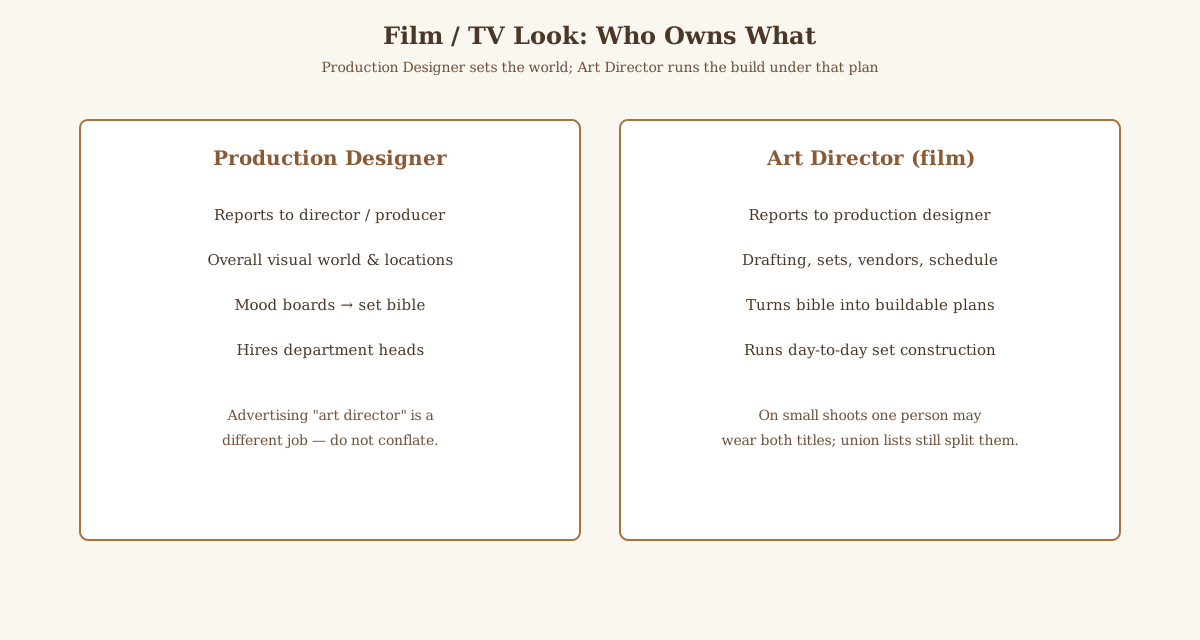
IATSE Local 856's Art Job Description 2024 states that the production designer works with producers, the director, the director of photography, costume, hair, and makeup to establish overall visual style; develops art-department budget and schedules; selects locations; defines scenic scope; designs sets; chooses materials, finishes, and colour palettes; and guides construction, paint, set decoration, props, graphics, special effects, and greens. The art director, in the same document, coordinates preparation, scheduling, and execution as delegated by the production designer; heads the art department day to day; liaises with construction, paint, set decoration, props, and locations; may assume full responsibility for carrying out the design concepts when the designer is absent; and helps administer the art-department budget with producers, the production manager, and accounting.
| Dimension | Production designer | Art director |
|---|---|---|
| Primary job | Invent and hold the show's visual world | Turn that world into builds, drawings, and schedules |
| Key partners | Director, DP, costume, producers | Construction, paint, set deco, props, locations, ADs |
| Budget posture | Sets priorities and scope with producers | Administers day-to-day spend against those priorities |
| On-set presence | Often bouncing among units, locations, and meetings | Often the art department's operational key on the ground |
| Credit logic | Heads the design | Reports to the designer; may supervise other art directors on large shows |
The Australian Production Design Guild's screen job descriptions rhyme with that split: the production designer is often first into the design department, shapes staffing, research, and location choices, and monitors aesthetics through manufacture; the art director (or supervising art director on large shows) controls workflows, documentation, construction supervision, and call-sheet liaison with assistant directors.
Where the job descriptions disagree about "head of department"
Published definitions do not use the phrase "head of the art department" the same way, and that is the source of most arguments online. The Art Directors Guild (IATSE Local 800) says production designers "create and develop the overall look, atmosphere and emotion that move the story" and, "as the head of the Art Department," make sure every set photographs well and serves the whole film, show, award show, or commercial (Art Directors Guild, Who Are Art Directors). The AFI Conservatory says the same thing in plainer words: the production designer is "the head of the Art Department on a film or television show," develops the visual concept from the script, does breakdowns and budgeting, presents designs to directors, and finds locations (AFI, What is Production Design?, May 31, 2023).
IATSE Local 856 words it differently. Its 2024 job sheet calls the art director "the head of the Art Department" and the department's liaison to every other department, working "as delegated by the Production Designer" (IATSE 856 Art Job Description, dated 02.28.2024). The two versions fit together once you notice that Local 856 is describing the department as a working unit, the drawings, schedules, and crews, while the production designer sits above it as the person who sets the design. In every one of these sources the art director answers to the production designer.
ADG's own definition of the art director leans on support and follow-through. The art director's "primary function is to support and follow through on the visual concepts for the production as specified by the Production Designer and Director," which takes both creative and management skills, and the art director is responsible "either completely or in part" for the Art Department, Construction, Set Dressing, Props, Locations, and Special Effects (ADG Local 800). The guild also states that the art director's responsibilities are the same whether the show is captured on film, digital data, tape, or live transmission.
How the titles got their current meaning
For Hollywood's first decades, art director was the top design credit. The Art Directors Guild traces its organization back to the Society of Motion Picture Art Directors, formed in 1937, with "Television" added to the name 30 years later. The guild points to producer David O. Selznick giving William Cameron Menzies the new credit of "production designer" on Gone With the Wind (1939) as the turning point, and the society took the Art Directors Guild name in 2000 (Variety, Art directors society makes Guild official, 2000).
Television had its own naming habit. The Australian Production Design Guild's job descriptions, drawn from its Manual for Screen Design Practices, say that "in the past, art director was the name given to the designer on television productions, particularly long running productions where the set up production designer had moved on." The guild adds that the title did not match the responsibilities, is no longer used that way, and that all subsequent designers are now recognized as production designers (APDG, Screen Job Descriptions).
The Academy caught up much later. In June 2012 its Board of Governors approved renaming the Art Directors Branch as the Designers Branch, a branch that covered production designers, art directors, set decorators, and costume designers (Deadline, June 29, 2012). In its August 30, 2012 rules announcement for the 85th Academy Awards, the Academy said that on the Designers Branch's recommendation "the Art Direction award will be known as the Production Design award" (Academy press release, Aug. 30, 2012, archived copy). The February 2012 ceremony still used the old category name, even though the nominees were already credited that way, for example "Art Direction: Hugo, Production Design: Dante Ferretti; Set Decoration: Francesca Lo Schiavo" (oscars.org, 84th Academy Awards).
Award rules still show the ranking. The 96th Academy Awards rules limit Production Design eligibility to the production designer and set decorator primarily responsible for the design and its execution, and they state that "an art director may be considered eligible for the Production Design award only when a production designer is absent from the credits" (96th Academy Awards rules, Rule Twenty). So when you look at older credits or award lists, check which year's naming you are reading before deciding who led the design.
The rest of the art department ladder
The two titles sit on top of a longer chain. IATSE 856's 2024 sheet lists, below the art director: an assistant art director, who takes on whatever the art director delegates, steps in when the art director is away, and helps supervise building, painting, and decorating; a set designer, who handles drafting plus 3D modeling, renderings, and previs, and may prepare files for CNC, laser cutting, or 3D printing; a draftsperson, who surveys and measures locations and draws working plans; graphic designers for on-camera graphics; a concept illustrator; and an art department coordinator who tracks budgets, schedules, and paperwork for the art director (IATSE 856, 2024).
The same APDG page explains how the art director job scales. On a large production there may be several art directors, each covering one area such as a foreign build, the drawing office, or studio sets, with a supervising art director above them managing the department, reporting progress and spend to production, and liaising with the designer. On small and medium productions a single art director is "the practical department head, directly beneath the production designer," controlling the art department budget, workflows, documentation, and construction supervision. Some shoots add an on-set art director who stays on set representing the designer's wishes and can make calls or refer changes back (APDG, Screen Job Descriptions).
ADG describes the assistant art director as the person who deals with construction crews (coordinator, foreman, painters, plasterers, greens, sign painters, metal and staff shops, mechanical effects, grips), sources materials both common and unusual, and does period and contemporary research (ADG Local 800). If you are trying to work out which role a job posting really means, the reporting line is the clue. A post that reports to the director and producers and mentions palette, period rules, and location choice is a production designer job. One that reports to the designer and mentions drawings, shop schedules, and department budgets is an art director job, whatever title the posting uses.
Guild membership follows the same ladder. ADG says assistant art directors become eligible after 400 days in an art department craft within the last four years, while art directors need 175 days as an art director or production designer and "an established reputation and status in production design" (ADG eligibility rules).
When one person wears both titles
Backstage's crew-position guide describes the production designer as the art department's head and the art director as the person who "manages the art department on set, essentially making the production designer's vision come to life," then adds: "Occasionally, the production designer and art director are one and the same" (Backstage, Film Crew Positions, updated November 25, 2024). That collapse is normal when the art department is three people and a truck. It gets risky when the script needs several builds running at once, because the one person holding both titles ends up stuck between concept meetings and paint calls.
A useful test before you merge the jobs: count how many sets will be in construction or dressing on the same day as shooting. If the answer is more than one, somebody has to be at the shop while somebody else is in the director's prep meeting. That is the practical reason large productions split the credit.
How to choose which role you need
Hire or credit a production designer when the project still needs a visual thesis: period rules, colour logic, location vocabulary, and a person empowered to say no to props that break the world. Hire an art director when the thesis exists and the bottleneck is drawings, vendors, shop hours, and department handoffs.
Agency "art directors" who layout campaigns are a different profession that shares an English title. If your search is really about creative-team hierarchy in advertising, stop here and open art director vs creative director instead of applying film union definitions to a brand pitch.