The difference in one paragraph
Chiaroscuro is the broad term. The National Gallery in London defines it as an Italian word that literally means "light-dark", used in painting for clear tonal contrasts that suggest the volume and modelling of what is depicted (National Gallery: Chiaroscuro). Tenebrism is a narrower label. The same museum says it describes a type of painting in which significant details such as faces and hands are lit by highlights set against a predominantly dark setting (National Gallery: Tenebrism).
Put simply, chiaroscuro is about how light and shade shape a form, and it can be gentle or dramatic. Tenebrism is about how much of the picture is plunged into darkness. When the background swallows most of the canvas and only a few lit passages remain, you are looking at tenebrism. When light and shadow are balanced across the picture to make bodies look round and solid, you are looking at chiaroscuro without the tenebrist label.
By those two definitions, every tenebrist painting uses chiaroscuro, because it depends on light and dark contrast. Most chiaroscuro, though, is not tenebrist. That one-way relationship is the simplest way to keep the terms straight.
What chiaroscuro means
Tate gives a slightly different emphasis. It translates chiaroscuro as light-dark and says the term refers to the balance and pattern of light and shade in a painting or drawing (Tate: Chiaroscuro). That wording matters because it makes chiaroscuro a property almost every representational picture has to some degree. Any painter who shades the side of a face turned away from the light is working with it.
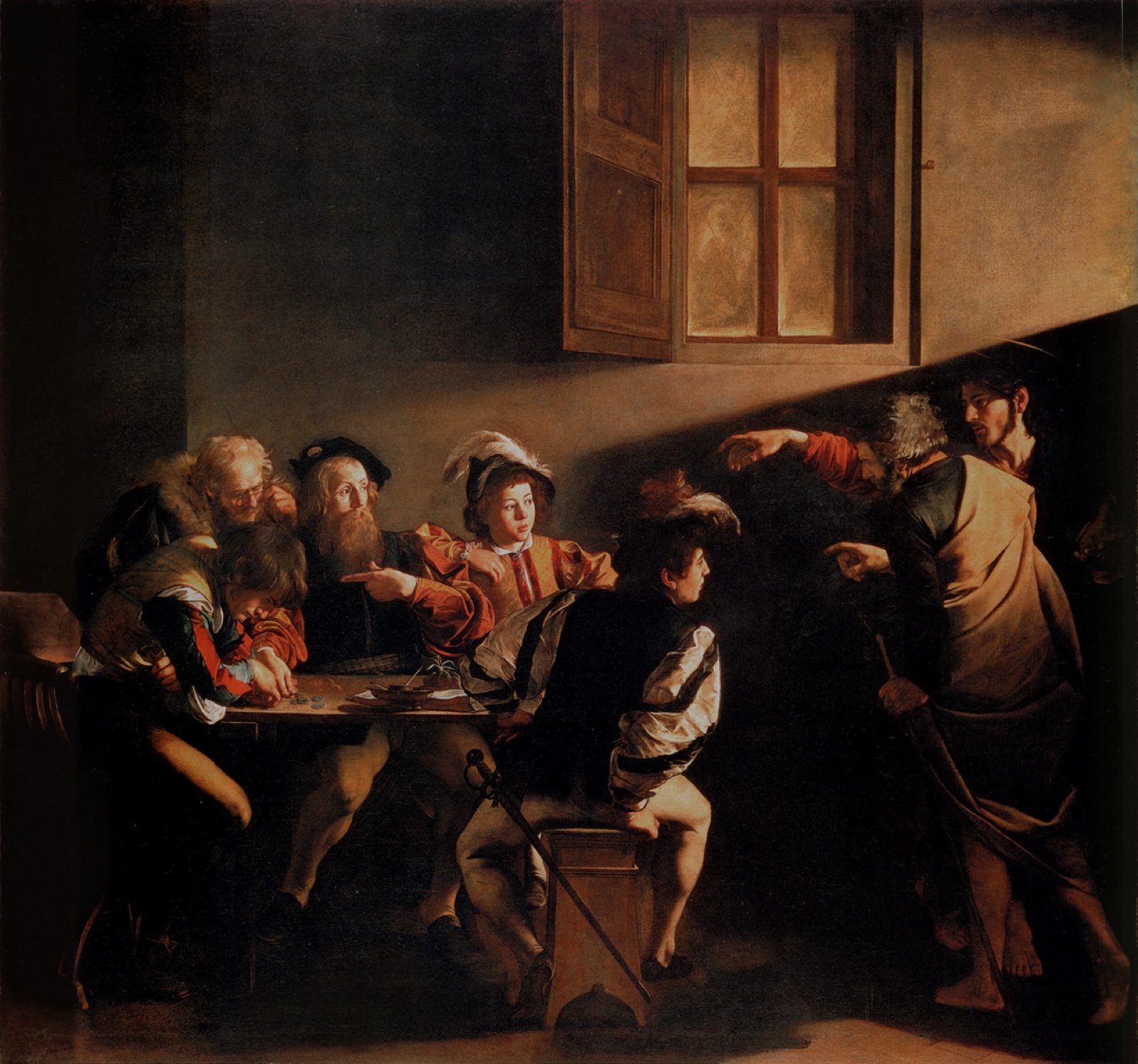
Tate adds an important practical note: chiaroscuro is generally only remarked upon when it is a particularly prominent feature of the work, usually when the artist uses extreme contrasts of light and shade. In other words, critics reach for the word when the contrast is doing obvious work, which is also why it so often appears in discussions of Caravaggio.
The National Gallery names two artists famed for it, and the pair shows how wide the term is. Leonardo da Vinci used chiaroscuro to give a vivid impression of the three-dimensionality of his figures, while Caravaggio used such contrasts for the sake of drama, and the museum notes that both were aware of the emotional impact of these effects. One painter used it to make bodies convincing; the other used it to stage a moment. Both count as chiaroscuro.
What tenebrism means
Tenebrism comes from the Italian tenebroso, which the National Gallery glosses as "darkened and obscuring" (National Gallery: Tenebrism). The emphasis is in the name. Tenebrism is defined less by how the light falls than by how much darkness surrounds it.
The museum's definition has two parts. First, significant details such as faces and hands are illuminated by highlights. Second, those highlights are contrasted with a predominantly dark setting. A painting with strong shadows but a lit room, a visible landscape or a bright sky behind the figures does not fit that second part, however dramatic it looks.
The National Gallery ties the term to a particular group: it says the late paintings of Caravaggio and those of many of his followers are often described as tenebrist. Note the word "late". The label is applied most readily to the darker pictures of his final years, not to everything he painted.
Leonardo: chiaroscuro without tenebrism
Leonardo's Virgin of the Rocks in the National Gallery is a good test case because it is dark but not tenebrist. The gallery describes it as an oil painting on poplar, nearly 190 cm high and 120 cm wide, painted between 1491 and 1508 (National Gallery: The Virgin of the Rocks).
The figures sit in a shaded grotto, and the museum says Leonardo used innovative techniques to make them appear to emerge from its darkness, blurring the edges of their forms to indicate the shadows that envelop them. He did it by painting very subtle, rather than stark, transitions between light and dark. The gallery notes that he built up his figures in layers of black and white underpainting, showing his knowledge of how we perceive shapes through the effect of light and shadow on their surfaces.
Yet the picture does not drown in black. A shaft of light from the top left moulds the figures, and the cave opens onto a distant lake and blue hills. The gallery describes the colours shifting from warm earthy browns in the rocks to cooler blues, aquamarines and hazy greys in the landscape beyond, an exploration of distance through colour, focus and light and dark that it calls chiaroscuro. That open, readable space is exactly what tenebrism removes.
The gallery also quotes Leonardo's own view of the matter: "The artist who avoids shadows, avoids the glory of art." For Leonardo, shadow served modelling and atmosphere. The blur at the edges of his forms has its own name, sfumato, covered below.
Caravaggio: where chiaroscuro turns dramatic
Caravaggio's Supper at Emmaus (1601) in the National Gallery shows the dramatic side of chiaroscuro. The museum says it was commissioned in 1601, following the sensation caused by the public unveiling of his first major religious works, the paintings of Saint Matthew in the Contarelli Chapel in Rome (National Gallery: The Supper at Emmaus).
The gallery's description reads like a lighting plan. Caravaggio uses contrasts of light and shade, which the museum calls chiaroscuro, to heighten the drama. A strong light from the left falls on the faces of Christ and the disciple on the right, casts a shadow on the blank wall behind Christ "almost like a reverse halo", and lights the hand the disciple thrusts toward the viewer. The innkeeper stands with his face in shadow, which the museum reads as implying that he has not yet "seen the light".
This is a useful reminder that even Caravaggio's pictures are routinely described as chiaroscuro rather than tenebrism. The background here is a plain grey wall, not a void, and the table, bread and fruit are fully legible. The light is selective and theatrical, but the setting is not predominantly dark in the way the tenebrism definition requires.
The gallery stresses how much this lighting mattered to other painters. It says Caravaggio made a deep impression on contemporary artists, both for his evocative use of chiaroscuro and for his practice of painting from life. Its artist page describes his paintings as characterised by dramatic, almost theatrical lighting, and as controversial, popular and hugely influential on succeeding generations of painters all over Europe (National Gallery: Caravaggio). Those succeeding painters are the "followers" the tenebrism definition refers to.
Joseph Wright of Derby: one candle and a dark room
For a later example that shows the tenebrist look outside Italy, compare Joseph Wright of Derby's An Experiment on a Bird in the Air Pump, exhibited in 1768. The National Gallery describes a room at night lit by a single candle that burns behind a large glass vessel, with the candlelight illuminating the faces of the observers and casting deep, dramatic shadows (National Gallery: An Experiment on a Bird in the Air Pump).
The museum says Wright painted a series of candlelight pictures of increasing complexity during the 1760s, and that his use of strong directional light and deep shadow to create drama was new in British art. It describes how colours change as they recede from the light, and adds that where the light does not reach, beneath the table, colour and form disappear altogether into blackness.
The National Gallery frames the work as one of Wright's candlelight pictures rather than using the word tenebrism, so treat this as a comparison, not a label the museum applies. Set against its definition, though, the match is close: faces and hands lit by a single source, a predominantly dark setting, and parts of the room lost entirely.
Sfumato: the third term people mix in
Sfumato often appears in the same discussions, and it is a different idea again. The National Gallery defines it as the "smoky" quality that blurs contours so that figures emerge from a dark background through gradual tonal modulations without harsh outlines. It notes that Leonardo advised painting "without lines" in his unfinished treatise on painting, and that Giorgione introduced the quality in Venice (National Gallery: Sfumato).
So the three terms describe different things. Chiaroscuro is the overall pattern of light and shade. Sfumato is the softness of the transitions between them, the absence of hard edges. Tenebrism is the dominance of darkness over the whole picture, with light reserved for a few key passages. A painting can show all three, as the Leonardo shows the first two, but they are not synonyms.
A short timeline of the paintings above
Putting the examples in order shows how the vocabulary maps onto history. Dates come from the National Gallery pages cited in each section.
1491 to 1508. Leonardo works on the London Virgin of the Rocks in phases, starting in the early 1490s, leaving Milan in 1499 and returning in 1506 to finish it, when he added ultramarine to the sky. The picture is the gallery's example of chiaroscuro and sfumato together.
1592. Caravaggio, born Michelangelo Merisi, moves to Rome at the age of 21. The National Gallery says that in 1595 Cardinal Francesco del Monte took him into his household, and his first public commissions followed through the cardinal's circle.
1601. Ciriaco Mattei commissions The Supper at Emmaus, after the Contarelli Chapel paintings made Caravaggio famous. The gallery describes its lighting as chiaroscuro.
1606. After killing a man in a sword fight, Caravaggio leaves Rome for Naples and later Malta and Sicily. The National Gallery's tenebrism definition singles out his late paintings.
1760s. Joseph Wright of Derby paints his series of candlelight pictures in England, exhibiting An Experiment on a Bird in the Air Pump in 1768.
How to tell them apart in a gallery
Standing in front of a painting, three quick questions sort most cases.
1. How much of the canvas is dark? If darkness takes up most of the picture and you cannot make out walls, floor or landscape, tenebrism is a fair description. If you can read the setting, call it chiaroscuro.
2. What is lit? Tenebrism, in the National Gallery's definition, picks out significant details such as faces and hands. If the light falls evenly across bodies to make them round, the painter is modelling form, which is chiaroscuro in Leonardo's sense.
3. Are the edges hard or soft? Soft, smoky transitions point to sfumato. Sharp boundaries where light suddenly stops point to the theatrical, spotlit effect associated with Caravaggio and his followers.
A last tip on usage: if you are writing about a painting and unsure which word applies, chiaroscuro is the safer choice. It is never wrong for a picture that uses strong light and shade, while tenebrism makes the stronger claim that darkness dominates the picture.