What a farmer on Melos dug up in 1820
On April 8, 1820, a farmer named Yorgos Kentrotas was clearing a field on the Aegean island of Melos, then part of the Ottoman Empire, when he uncovered fragments of a marble statue. A French naval ensign anchored offshore, Olivier Voutier, was exploring the island that day, saw the discovery, and recognized its importance. The pieces found together included the two halves of the female figure, a fragment of an arm, a marble hand holding an apple, two herms (carved head-and-pillar sculptures), and an inscribed base.
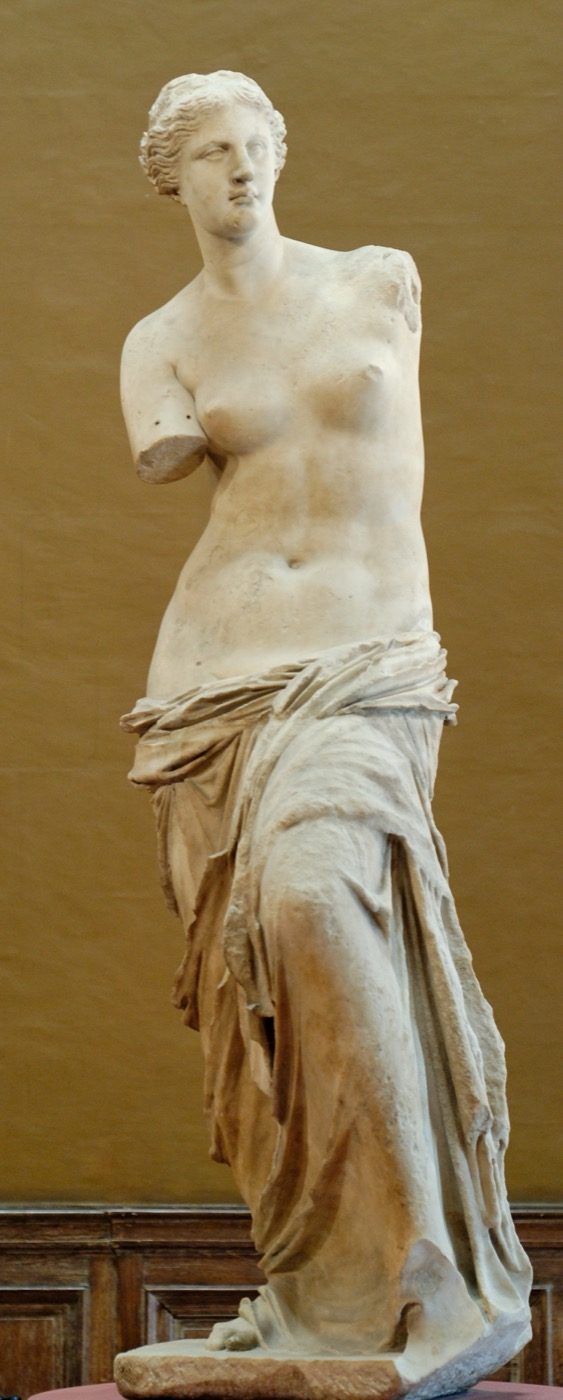
The statue itself had been carved in two blocks of Parian marble, joined at the hips where the line is largely hidden by the roll of drapery, which is why it could be assembled and recognized as a coherent figure once the pieces were laid out. Marble quarried on the island of Paros was prized across the ancient Greek world for its fine, translucent grain, and sculptors of the classical era, Praxiteles among them, favored it for their most important commissions. That reputation is part of why the material alone was not enough to settle which era, or which sculptor, had actually produced this particular figure.
Dumont d'Urville sailed on to Constantinople and reported the find to Charles-François de Riffardeau, Marquis de Rivière, the French ambassador to the Ottoman Empire, who sent an aide, the Comte de Marcellus, back to Melos to negotiate the purchase. By the time Marcellus arrived, the farmer had already accepted a rival offer and the statue was being loaded onto another buyer's ship; Marcellus intervened and secured it for France. The statue reached Paris and, by early 1821, had been presented to King Louis XVIII, who donated it to the Louvre. It has stayed in the museum's collection ever since, catalogued today under inventory number Ma 399, standing 2.02 metres tall. It is not the only Venus in a major museum whose early ownership history is thinner than the label suggests; the commission history of Botticelli's Birth of Venus in Florence has the same kind of gap, just for different reasons and in a different medium.
An inscription that pointed to the wrong era for what the Louvre wanted
The inscribed base found with the statue carried Greek lettering identifying the sculptor as Alexandros, son of Menides, from Antioch on the Maeander, a city not founded until around 280 BC. A signature naming that city put the work firmly in the Hellenistic period, a century or more after the classical age of Phidias and Praxiteles had ended.
That created a problem for the Louvre's director at the time, Auguste de Forbin. According to the World History Encyclopedia's account of the episode, Forbin instead had the statue attributed to the circle of Praxiteles, the fourth-century-BC Athenian sculptor credited with the first celebrated nude Aphrodite in Greek art, a far more prestigious pedigree for a museum piece than an obscure, later provincial sculptor. Smithsonian Magazine's account of the same dispute describes scholars sympathetic to the Praxiteles attribution securing a paper for the Académie des Beaux-Arts in April 1821 that formalized the classical-era claim, a position later writers say the museum maintained for well over a century. In painting, one reclining Aphrodite pose was copied for 350 years.
The inscribed base itself did not survive to settle the argument. It went missing from the Louvre's records not long after the statue's arrival, and it has never been recovered. What is known of its wording and appearance comes from a drawing made in 1821, at the request of the painter Jacques-Louis David, which the Comte de Clarac later used as the frontispiece for a paper making the case for the Alexandros attribution against the museum's official position. A missing fragment is a quieter way for an institution to shape how a work is read than physically chiseling an unwanted mural off a wall, but the effect on the historical record is the same kind of gap.
What the Louvre's record says today
Modern scholarship no longer accepts the Praxiteles attribution. The Louvre's published dating for the Venus de Milo is roughly 130 to 100 BC, squarely within the Hellenistic period the inscription had pointed to all along. That dating rests on stylistic analysis of the sculpture itself, independent of the missing inscribed base, so the case for a Hellenistic-era statue no longer depends on recovering the lost evidence. The display label the Louvre uses today makes no mention of a sculptor at all: it reads, in full, "Aphrodite, dite 'Vénus de Milo,' vers 100 AV. J.C., Ile de Mélos, Don du Marquis de Rivière au roi Louis XVIII," which translates as "Aphrodite, called 'Venus de Milo,' around 100 B.C., the island of Melos, gift of the Marquis de Rivière to King Louis XVIII."
The attribution to Alexandros of Antioch specifically is a separate, less settled question. Alain Pasquier, the Louvre's general conservator, has not disputed the Hellenistic dating, but has stopped short of confirming that the inscribed fragment described by nineteenth-century witnesses definitely belonged to this particular statue rather than to one of the other objects, including the two herms, found in the same scattered group on Melos. In an interview with Smithsonian magazine, Pasquier said he had spent many hours searching the museum's storerooms for the missing fragment without success, while maintaining it would be "inconceivable" for the base to have been destroyed. Scholars who think the fragment did belong to this statue have their own case to make: the curator and independent scholar Branko van Oppen has argued that "it is inconceivable that the curators at the Louvre would have added an inscribed part to the statue if they had not believed that the... fragment did belong to the plinth," since no one on the scene in 1820 could have forged a sculptor's name that later, unrelated inscriptions would go on to confirm as historical. The museum's position, as summarized in secondary accounts of the dispute, is to acknowledge the fragment existed and record what it said, without asserting as settled fact that it was the Venus's base.
That caution matters for how the story should be told. It is fair to say a signed, Hellenistic-era base was found with the statue and then went missing at a moment when its contents were inconvenient for the museum's preferred attribution. It is not settled that the fragment was definitely part of this statue's pedestal, and the Louvre's restraint on that point is worth taking as seriously as the more dramatic cover-up framing that popular accounts of the episode tend to favor, a caution about reading too much into a single artifact that also shapes what a museum's own catalogue record can and cannot establish for works far better documented than this one.
The arms nobody has reattached
The Venus de Milo has been missing both arms since it entered the historical record, and the Louvre made an early decision not to guess at a restoration. Conservators considered adding replacement arms shortly after the statue arrived in Paris, then abandoned the idea on the grounds that any reconstruction, however well researched, would permanently alter an object nobody could be certain how to complete.
The clearest clue is the marble hand holding an apple that Kentrotas found in the same group of fragments on Melos. In 1876 the German scholar Wilhelm Fröhner proposed that the statue's raised left hand originally held that apple, referencing the mythological judgment of Paris, while the lowered right hand gathered the drapery slipping from her hips. Other researchers have floated alternative reconstructions over the years, including a hand resting on a shield or spinning thread, based on the angle of the shoulders and the position of the legs, but none has displaced the apple theory as the most widely cited.
None of these theories has been tested by attaching new arms to the statue itself, and the Louvre has kept it as it was found. The statue that visitors see today is missing precisely the parts of the story, the arms and the inscribed base alike, that would resolve who made it, what it depicted, and why.