Shared street, different problem
Both movements walked away from academic history painting's hierarchy. Tate's Realism entry says that until the nineteenth century Western art favored idealised subjects, and Realism insisted on ordinary modern life painted naturalistically (Tate: Realism).
Tate's Impressionism entry dates the outdoor, on-the-spot practice to Claude Monet and other Paris-based artists from the early 1860s, chasing transient sunlight with broken brushwork (Tate: Impressionism).
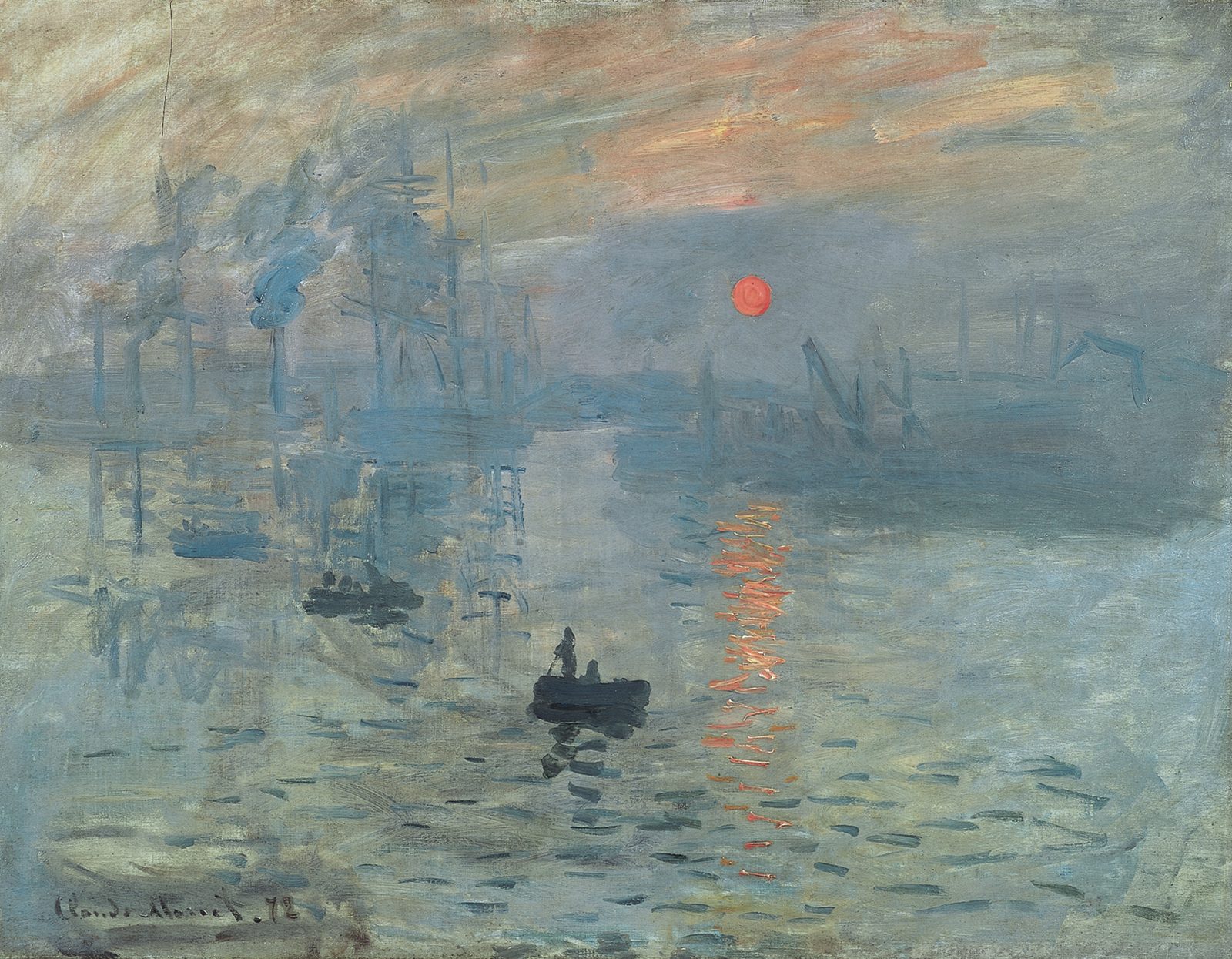
The National Gallery's Impressionism glossary adds that the name began as an insult from Monet's 1874 title Impression, Sunrise, and that the painters shared modern urban life and landscape subjects while exploiting new artists' materials (National Gallery: Impressionism).
What Realism meant
Tate warns that "realism" is also used loosely for any almost photographic look. The movement sense is narrower: mid-century artists choosing ordinary life over elevated myth, and painting it without academic idealisation.
That subject choice is the political and social edge people remember: labourers, burials, café interiors, not gods. Technique can be tight or broad; the refuse-to-idealise stance is the constant.
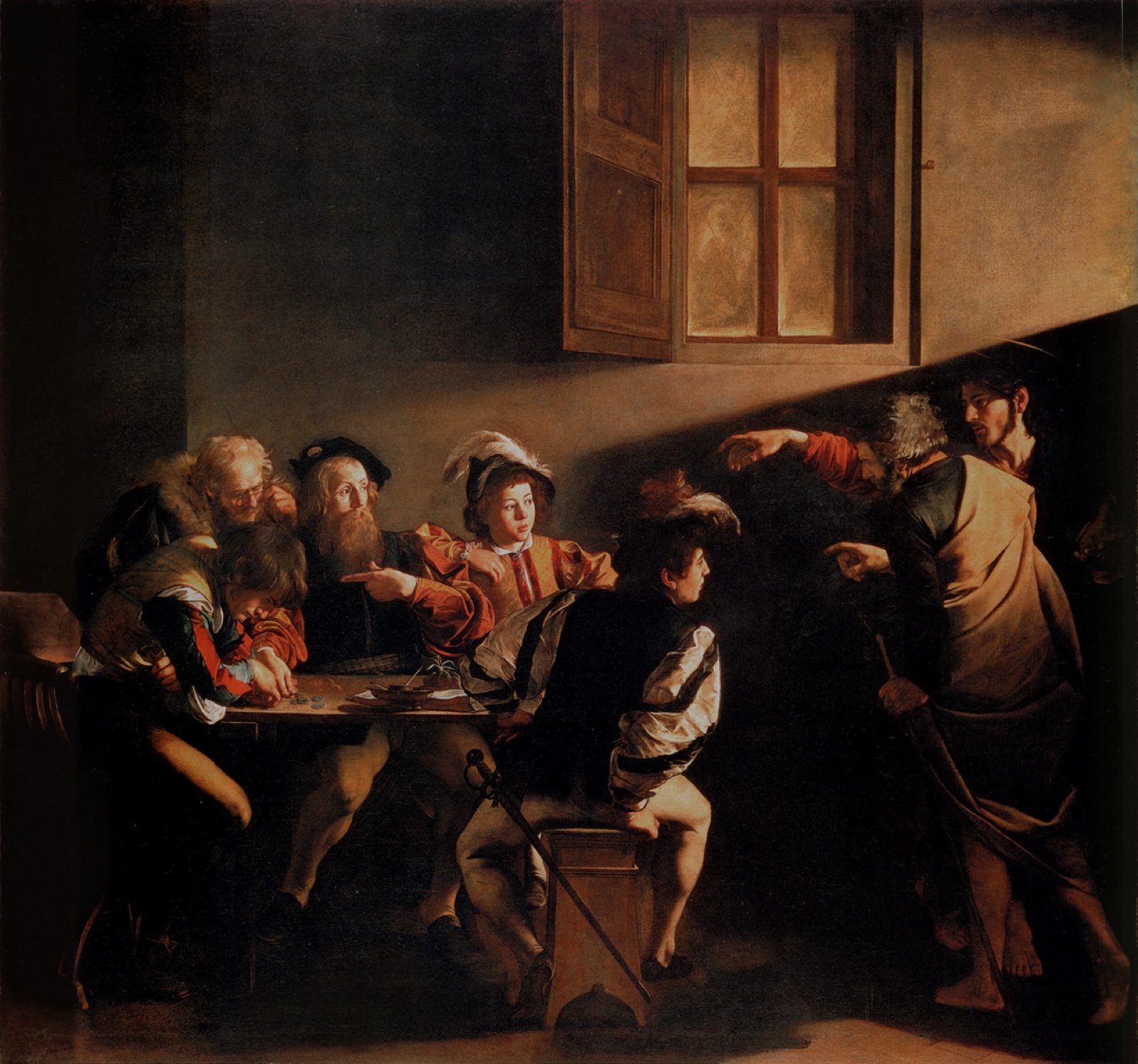
Impressionists inherited the modern-life permission Realism fought for, then spent it on optical effects Realism did not prioritize.
What Impressionism added
Tate stresses painting outdoors spontaneously rather than finishing from studio sketches, which forced faster decisions about color as light changed. Broken brushwork is a tool for that speed, not a decoration pasted on afterward.
Group identity matters too. Impressionists exhibited together in Paris in the 1870s and 1880s; Realism was a broader mid-century tendency with Courbet as a flagship name rather than a single salon club.
For the next turn after Impressionism, see Impressionism vs Post-Impressionism. For light modeling technique that both centuries used, see chiaroscuro vs tenebrism.
A museum test
If the picture's main claim is "this unidealised modern scene deserves paint," you are in Realist territory. If the main claim is "this hour's light on this river or boulevard," you are in Impressionist territory.
Some canvases do both. Date, artist circle and whether the brushwork dissolves form into light patches are better guides than the presence of a worker or a café alone.
Courbet, Manet, and the handoff
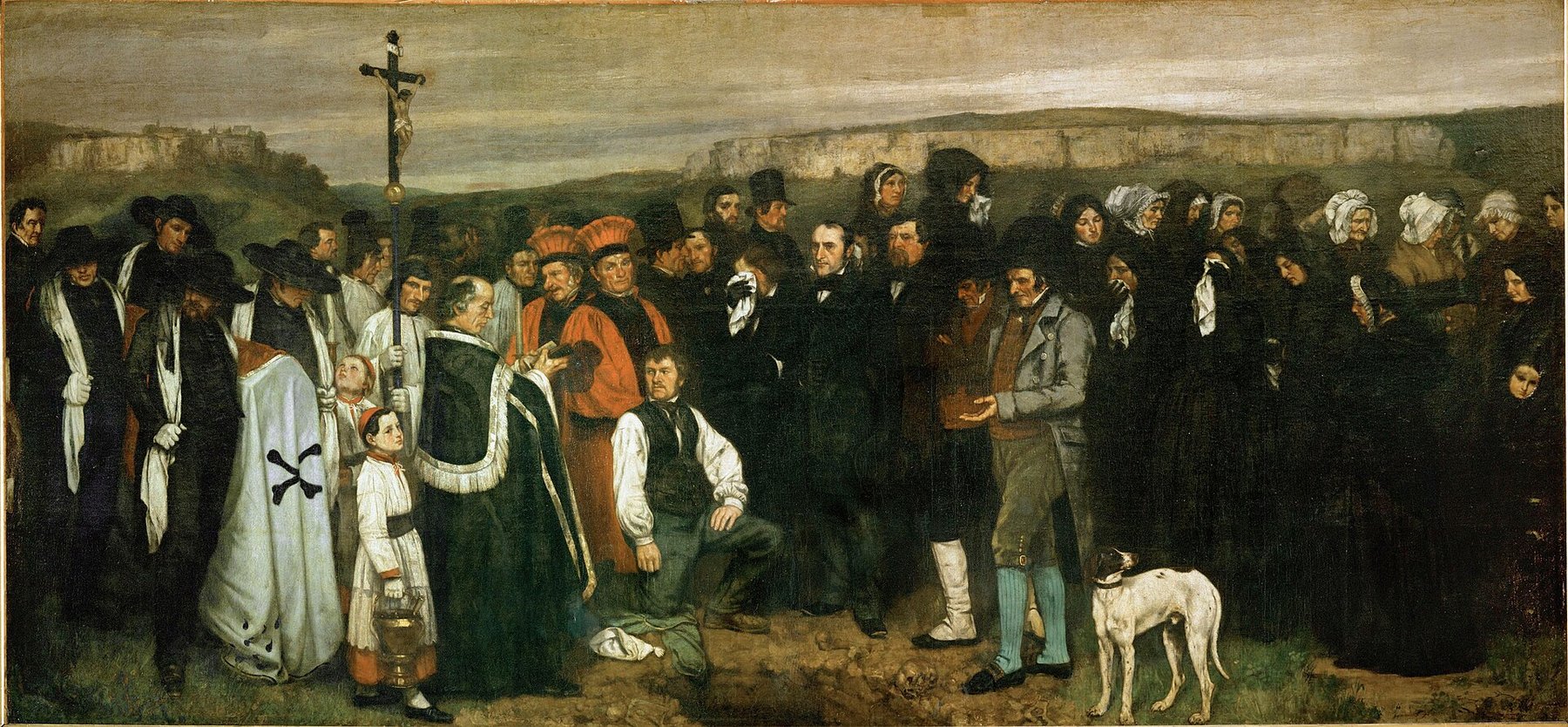
Gustave Courbet's mid-nineteenth-century Realism insisted that stone breakers, funerals, and studio politics deserved large-canvas gravity once reserved for history painting. Tate's Realism entry stresses that everyday subject matter and a blunt look at contemporary life were the program, not a soft style synonym for "looks real."
Edouard Manet sits on the hinge. He keeps modern subjects and shocking contemporary dress while loosening paint and flattening some space in ways younger painters around the 1860s-70s read as permission. He exhibited through the Salon system more than through the later Impressionist group shows, so textbooks argue about whether to file him as Realist, modernist precursor, or both.
Claude Monet, Camille Pissarro, Pierre-Auguste Renoir, Edgar Degas, Berthe Morisot, and peers push further into momentary light, optical mixture, and informal cropping. The handoff is social as well as stylistic: cafes, critics, dealers, and group exhibitions create a parallel path beside the official Salon.
Two canvases to keep in mind
A teaching pair often used in surveys is Courbet's rural or burial scenes against Monet's series paintings of haystacks or the Rouen Cathedral facade. One argues for the dignity and friction of present-day social fact; the other argues that the same motif changes with hour and weather, so painting must chase conditions.
Another useful pair is a Manet figure in contemporary dress beside a Renoir or Monet leisure landscape. Ask what each picture thinks is worth noticing: class and looking relations, or light on surfaces and the sensation of being outdoors.
You do not need those exact titles on the wall to run the exercise. Any museum with a mid-century Realist figure composition and a later Impressionist landscape will do. Write what the paint is doing before you write the ism.
Materials and working method
Impressionist practice is tightly linked to portable paint in tubes, brighter commercial pigments, and the habit of working outdoors (plein air) for studies or finished canvases. Broken strokes and complementary contrasts try to keep light sensation lively rather than polished enamel smoothness.
Realist canvases can be as technically polished or as roughly brushed as the artist needs; the binding claim is about subject and truth-telling toward modern life, not a single brush recipe. Studio finish remains common even when the theme is a stone road or a burial.
Neither camp abandoned drawing or composition. Degas alone is enough to kill the myth that Impressionism meant "no structure." The difference is what counts as a finished public statement and which institutions bless it.
1874 and the exhibition story
In April 1874, the Societe Anonyme of painters, sculptors, and printmakers opened an exhibition in Paris that later histories treat as the first Impressionist group show. A critic's jab at Monet's Impression, Sunrise helped stick the name "Impressionists" to the circle.
That show matters because it marks an organizational break: artists pooling resources to face the public outside the Salon's jury gate. Later group exhibitions through the 1870s and 1880s keep arguing about who belongs, how finished a canvas must look, and whether dealers or independents should lead.
Realism as a Courbet-centered fighting word peaks earlier, in the 1850s, with Pavilion-scale provocations and critical wars over what art owes to ordinary life. Impressionism inherits the modern-life theme but redirects attention toward perception and momentary appearance.
How to use the labels without flattening them
Say Realism when the argument is about unvarnished contemporary subjects and social frankness in the mid-nineteenth-century sense Tate outlines. Say Impressionism when the argument is about light, momentary effects, and the 1870s group identity around outdoor color practice.
Avoid using "realistic" as a casual adjective for any tight drawing; that drifts from the historical Realism program. Avoid using "impressionistic" for any loose brushwork in any century; save it for the movement or a clear analogy.
On UmberLore, follow this page with artist or technique guides when you need denser case studies. Keep citation-forward gallery links in your own notes when you quote wall texts.
Revision notes for readers
Re-read the definitions section first, then the practical or historical sections that match your assignment. Skimming only the comparison table leaves out the process details reviewers expect at UmberLore length.
When you cite Tate or National Gallery glossary pages, add the access date in your notes because wall texts and glossary wording can be edited without notice.
If two sources disagree on a dating band, prefer the museum label for the object in front of you and treat encyclopedia ranges as approximate.
Keep studio safety and conservation claims modest unless you are quoting a manufacturer tech sheet or a conservator publication. Style history and material safety are related but not identical topics.
Finally, write one sentence in your own words that a classmate could falsify. If you cannot state a falsifiable contrast, you are still in adjective fog rather than in art-historical comparison.
Critics, dealers, and the market path
Realism's fights often ran through Salon walls, pamphlets, and Courbet's self-staged provocations. The audience was still largely the official exhibition public even when the artist spat at its jury.
Impressionism scales a different infrastructure: independent group shows, supportive dealers, and collectors willing to buy landscapes that looked unfinished to Salon eyes. Durand-Ruel and peers matter in that story as much as any single manifesto.
Price histories later reverse some contemporary insults, but do not use auction records as proof that 1874 critics were "wrong" in some cosmic sense. They were arguing about finish, subject, and institutions in their moment.
For students, one dealer letter or one exhibition checklist is worth more than a vague claim that Impressionists were "rebels." Rebels still needed rooms, frames, and buyers.
Women artists and who gets centered
Berthe Morisot and Mary Cassatt (among others) make clear that Impressionist networks included women who showed, sold, and shaped the look of modern domestic and leisure subjects. Survey courses that only name Monet and Renoir distort the social map.
Realism conversations likewise widen when you include printers, photographers nearby in time, and painters outside Paris who documented labor without Courbet's celebrity. The ism is a center of gravity, not a membership card with complete minutes.
When you write a comparison essay, notice whose names your sources repeat. If every Realism example is male rural labor and every Impressionism example is male landscape, you are inheriting a syllabus bias you can flag in one clause.
What to write on an exam card
Realism (1850s core): modern ordinary subjects, anti-ideal, Courbet as emblem, Salon as main battlefield.
Impressionism (1870s group identity): light and momentary appearance, often outdoor color practice, 1874 exhibition as organizational landmark, Monet's title as naming accident that stuck.
Bridge figure: Manet, modern life plus paint handling that younger artists amplify, Salon career still central.
Do not equate Realism with meticulous detail. Do not equate Impressionism with carelessness. Both can be exacting about different goals.
Cite Tate Realism and Impressionism entries plus one object label. That trio usually satisfies a short undergraduate comparison without inventing biography.