The one-sentence difference
The National Gallery in London puts the contrast neatly: in the main, the Post-Impressionist artists were less concerned with recording optically accurate appearances, as the Impressionists had been, than with "the symbolic or expressive possibilities of representation" (National Gallery glossary: Post-Impressionism). Everything else in this guide is detail on that one shift, from the eye to the mind.
It helps to know that the two names are not equal kinds of label. Impressionism was a real group of artists who exhibited together eight times in the 1870s and 1880s. Post-Impressionism was never an exhibiting group in that sense. The name was applied afterward, in 1910, by a critic looking back at artists who had gone their own ways.
Impressionism: painting the moment
Tate dates Impressionism to Claude Monet and other Paris-based artists from the early 1860s (Tate: Impressionism). Its basis was painting outdoors, spontaneously and on the spot, rather than in a studio from sketches. Working quickly in front of the subject, in the open air (en plein air), let the painters catch the momentary, transient effects of sunlight. The result, according to Tate, was a greater awareness of light, color and the shifting pattern of the natural scene, with brushwork that became rapid and broken into separate dabs to render the fleeting quality of light.
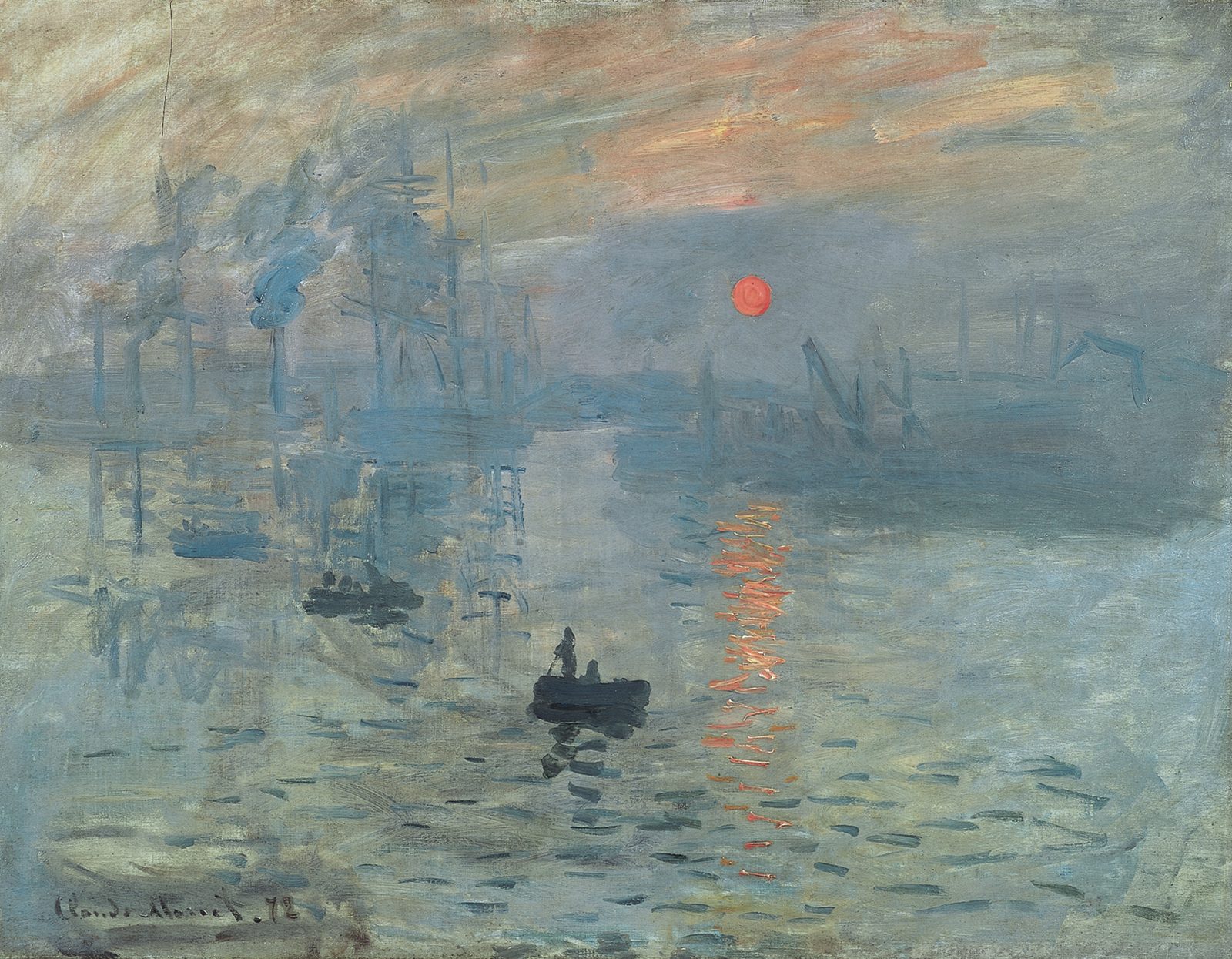
The name began as an insult. The National Gallery explains that the term, first used derisively, came from the title of a painting Monet showed in 1874, independently of the official Salon in Paris, alongside artists such as Renoir, Cézanne and Pissarro (National Gallery glossary: Impressionism). Tate names the painting, Impression, Sunrise, and says the 1874 show was greeted with derision, with Monet's picture singled out for ridicule.
The group went on to exhibit together eight times, up to 1886. Besides Monet and Renoir, Tate lists Camille Pissarro and Berthe Morisot as core figures, with Edgar Degas and Édouard Manet also often associated with the movement. The National Gallery adds two practical traits: the painters took full advantage of technical advances being made in the manufacture of artists' materials, and they tended to share subjects, namely aspects of modern urban life and landscapes.
A good example of the city side is Gustave Caillebotte's Paris Street; Rainy Day (1877) at the Art Institute of Chicago. The museum notes that Caillebotte showed his affinity with the Impressionists through his subject of modern urban life, though with a more Realist technique, and that he suggests the weather not by painting raindrops but through newly available retractable umbrellas and reflections on the wet cobblestones (Art Institute of Chicago: Paris Street; Rainy Day). It is a reminder that the movement was never a single uniform style.
Post-Impressionism: a label invented in 1910
Tate defines Post-Impressionism as a term describing the changes in Impressionism from about 1886, the date of the last Impressionist group show in Paris (Tate: Post-impressionism). The term was first used by the British artist and critic Roger Fry, who organized the 1910 exhibition Manet and the Post-Impressionists. A second Post-Impressionist exhibition followed at the Grafton Galleries in London.
The National Gallery describes the category broadly as artists working in France in the 1880s, immediately after the Impressionists, who were aware of Impressionism but sought to move beyond it. It adds that the term is sometimes applied to late work of the original Impressionists, which is one reason people find the boundary confusing.
Both institutions agree on the core. Tate says the term is usually confined to four major figures who developed and extended Impressionism in distinctly different directions: Paul Cézanne, Paul Gauguin, Georges Seurat and Vincent van Gogh. Those are also the four names the National Gallery says Fry showed in 1910. The important phrase is distinctly different directions. Post-Impressionism is less a style than a family of reactions to the same starting point.
The four Post-Impressionists, one by one
Paul Cézanne kept the Impressionist rule of painting from nature but, in Tate's words, added rigor, famously saying "I want to re-do Poussin from nature." Tate glosses Poussin as a notoriously intellectual pioneer of French landscape, so the remark announces a wish to give Impressionist observation the solid order of classical painting. The Art Institute of Chicago calls Cézanne "the odd man out" among the artists branded as Impressionists and, in its entry on The Basket of Apples (c. 1893), points to the misaligned tabletop, tilted bottle and shifts in brushwork that create what has been called his "controlled chaos" (Art Institute of Chicago: The Basket of Apples).
Georges Seurat, according to Tate, put Impressionist painting of light and color on a scientific basis, the approach known as Neo-Impressionism or divisionism. His A Sunday on La Grande Jatte (1884–86) at the Art Institute of Chicago dissolves, up close, into "dots and dashes of complementary colors laid side by side," and the museum says Seurat aimed to make a painting of modern life equivalent to a classical Greek frieze (Art Institute of Chicago: A Sunday on La Grande Jatte).
Paul Gauguin kept intense light and color but, Tate says, rejected painting from nature and reintroduced imaginative subject matter. The Art Institute's Mahana no atua (Day of the God) (1894) shows the result: a "tropical paradise of the artist's invention," painted in Paris after his first trip to Tahiti and drawn from fantasy and memory, with figures that read more as symbolic forms than portraits (Art Institute of Chicago: Mahana no atua (Day of the God)).
Vincent van Gogh painted from nature but, per Tate, developed a highly personal use of color and brushwork that directly expressed his emotional response to the subject and his inner world. The Bedroom (1889) in Chicago is the familiar case: the museum describes its bold colors, thick and broken brushwork and sharply receding lines, and quotes his letter to his brother Theo listing the colors, from pale lilac walls to a blood-red bedspread (Art Institute of Chicago: The Bedroom). For more of his work, see our guide to Van Gogh paintings.
Side by side
The table below compresses the differences. Treat it as a guide to tendencies rather than rules, since the National Gallery itself notes the label can stretch to late work by Impressionists.
| Question | Impressionism | Post-Impressionism |
|---|---|---|
| When | From the early 1860s; group shows 1874 to 1886 | From about 1886; name coined by Roger Fry in 1910 |
| Was it a group? | Yes, artists who exhibited together eight times | No, a later label for artists working separately |
| Main aim | Record the passing effects of light as the eye sees them | Structure, system, symbol or emotion beyond optical accuracy |
| Where painted | Outdoors, quickly, in front of the subject | Varies: Cézanne and Van Gogh from nature; Gauguin from imagination |
| Brushwork | Rapid, broken dabs | Varies: Seurat's dots, Van Gogh's thick strokes, Cézanne's shifting marks |
| Typical subjects | Modern urban life and landscapes | Still lifes, landscapes, imagined scenes, interiors |
| Key names | Monet, Renoir, Pissarro, Morisot; Degas and Manet often associated | Cézanne, Gauguin, Seurat, Van Gogh |
Where the two overlap
The cleanest proof that the movements blur is that the same people and exhibitions appear on both sides. Cézanne showed at the first Impressionist exhibition in 1874, Tate notes, and yet he is one of the four core Post-Impressionists. Seurat's La Grande Jatte, whose dots and dashes of complementary colors the Art Institute calls characteristic of Seurat's pointillist technique, was first shown at the VIIIe Exposition de peinture in Paris, May 15 to June 15, 1886, according to the Art Institute's exhibition history. That was the eighth show of the series, and both Tate and the National Gallery date the group's last exhibition to 1886.
Even the vocabulary is unsettled. The National Gallery calls pointillism "an Impressionist painting technique developed by Georges Seurat," in which countless tiny dots of pure color are meant to fuse in the viewer's eye at a distance (National Gallery glossary: Pointillism). Tate files the same work under Neo-Impressionism, which it calls the post-impressionist work of Seurat, Paul Signac and their followers, and adds that pointillism is a popular but incorrect name for the divisionist technique, one that Signac himself repudiated (Tate: Neo-impressionism). Two major museums, two classifications for the same paintings.
Monet, meanwhile, kept developing long after 1886. The Art Institute's Stacks of Wheat (End of Summer) (1890–91) belongs to a series he painted both in the field, at several easels at once, and in the studio, refining pictorial harmonies; fifteen of the canvases hung together in Paris in May 1891 (Art Institute of Chicago: Stacks of Wheat (End of Summer)). That studio refinement and serial planning are a long way from the quick 1870s sketch, and they show why the line is hard to draw: the National Gallery notes the Post-Impressionist label is sometimes applied to late work of the original Impressionists. Our pieces on the Water Lilies series and where Monet's paintings are follow that late career.
Seeing both movements in one museum
If you want to compare the two in person, the Art Institute of Chicago is a convenient place to start, because every Chicago painting cited above belongs to its collection. The museum says it holds the largest group of Monet's Stacks of Wheat in the world, which makes it possible to watch one Impressionist subject change with season and light across many canvases.
The Post-Impressionist side is just as concentrated. La Grande Jatte is nearly ten feet wide, and the museum notes that Seurat built it from many smaller painted and drawn sketches and several larger canvases, then returned to it two years after he began, amplifying some silhouettes and adding figures such as the monkey on the leash. That slow, planned construction is the opposite of painting on the spot.
The Bedroom adds another contrast. The Art Institute explains that the composition exists in three versions; Chicago's is the second, made in September 1889, nearly a year after the first, and Van Gogh painted a third, smaller version at the same time as a gift for his mother and sister. Returning to the same composition nearly a year later, and repeating it again as a gift, is a long way from painting quickly in front of the subject.
Gauguin's Day of the God was, according to the museum, produced in Paris rather than in Tahiti, and it ranks among the most abstract and avant-garde works of his career. Seeing it near Caillebotte's carefully observed Paris street makes the gap between the two movements obvious.
A quick test in the gallery
Stand in front of the painting and ask what the artist seems to be after. If the picture is mostly about a moment of light, a time of day, weather on a street or a river, and the brushwork is quick and broken, you are almost certainly looking at Impressionism.
If the painting seems to be about something the eye alone could not see, a solid underlying structure, a system of color, an invented world, or the painter's feelings, you are in Post-Impressionist territory. Then check the date and the name on the label. A work from after 1886 by Cézanne, Seurat, Gauguin or Van Gogh is the textbook case. A late Monet is the hard case, since the National Gallery notes that the Post-Impressionist term is sometimes applied to late work of the original Impressionists.