What Tate counts as modern art
Start with Tate's art-terms entries. Tate uses modernism and modern art for the same succession of movements: the ones critics and historians have identified from the realism of Gustave Courbet onward, ending in abstract art and its developments in the 1960s. That gives modern art a start at Courbet's realism and an end in the 1960s, with no single year fixed at either side.
The entry also says what the movements shared. Tate lists a rejection of history and conservative values, experiment with form that tended toward abstraction, and a new emphasis on materials, techniques and processes. It adds that modernism was generally tied to utopian visions of human life and a belief in progress.
The works Tate picks as key moments show how long the span is. They include Alphonse Legros's Le Repas des Pauvres (1877), Georges Braque's Bottle and Fishes (c. 1910-12), Kazimir Malevich's Black Square (1913), László Moholy-Nagy's K VII (1922), Salvador Dalí's Metamorphosis of Narcissus (1937) and Robert Morris's Untitled (1965, reconstructed 1971). That is nearly ninety years of work under one label.
The end date has a stated cause. By the 1960s, Tate says, modernism had become a dominant idea of art, and the American critic Clement Greenberg had formulated a particularly narrow theory of modernist painting. A reaction followed, and it was quickly identified as postmodernism. So Tate's modern art ends where an argument against it begins. Even the endpoint, abstraction, gets re-dated by a museum, as the guide to the painting long called the first abstract one shows: a Kandinsky watercolor signed 1910 that its own museum now dates to 1913.
Postmodernism sits between the two
Two-column answers leave out the middle term, and the middle term is where the dates blur. Tate describes postmodernism as a reaction against modernism and as the period that followed modernism's dominance. It says the term was first used around 1970, and that as an art movement it defies definition, because no one postmodern style or theory holds it together.
Tate suggests that postmodernism may be said to begin with pop art in the 1960s and to take in much of what followed, naming conceptual art, neo-expressionism, feminist art and the Young British Artists of the 1990s. The Pop Art guide covers a 1947 collage that carried the word before the movement had a name, which is one more reason the starting line stays soft.
The attitudes changed along with the dates. Tate says modernism rested on idealism and reason, and that modernists championed clarity and simplicity. Postmodernism, in Tate's account, was born of scepticism, embraced complex and often contradictory layers of meaning, collapsed the distinction between high culture and popular culture, and introduced a sense that 'anything goes'. Jeff Koons's Three Ball Total Equilibrium Tank (1985) is one of the works Tate uses to illustrate the term.
Postmodernism is also the label that overlaps both neighbors. Its early years fall inside Tate's modern span, which runs to the 1960s, and its later years fall inside the 1947 and 1977 definitions of contemporary below.
Contemporary art has no fixed start
Tate's entry on contemporary art is short. It opens by saying the term is 'loosely used' for art of the present day and of the relatively recent past, of an innovatory or avant-garde nature.
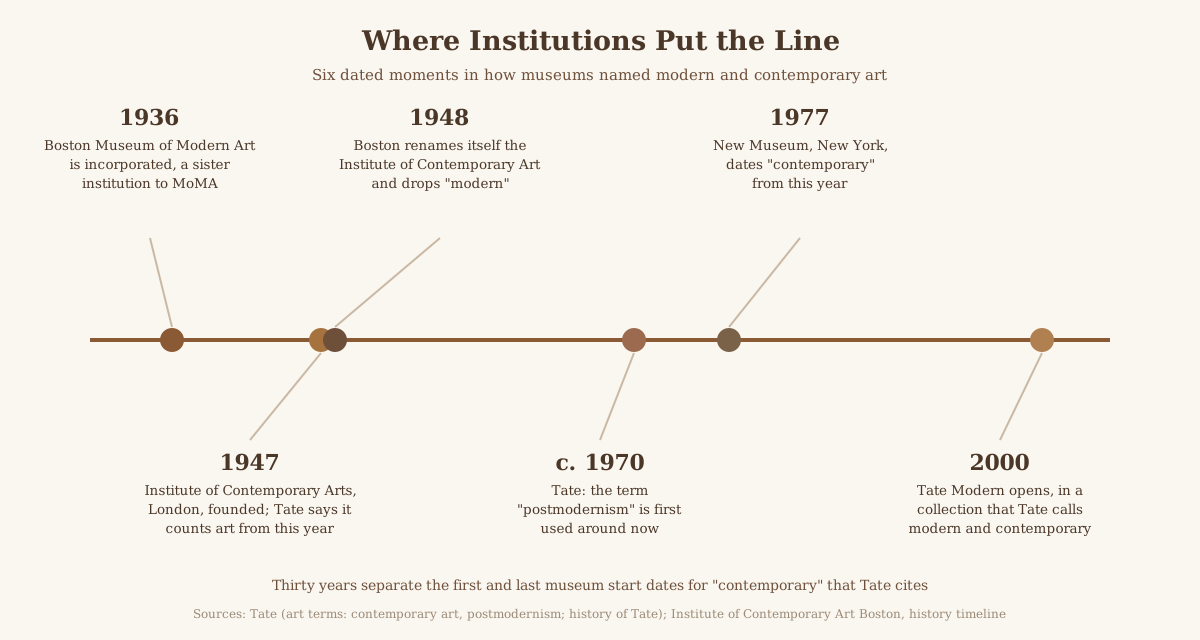
It then concedes that the date of origin varies. The Institute of Contemporary Arts in London, founded in 1947, champions art from that year onwards. The New Museum of Contemporary Art in New York chooses 1977. In the 1980s Tate planned a Museum of Contemporary Art in which contemporary meant 'art of the past ten years on a rolling basis'.
Those three definitions give different answers for the same painting. A work from 1960 sits inside the London institute's remit and outside the New Museum's, and it would have dropped out of a rolling ten-year window by 1971.
Outside museums the dates drift further. The table sets out what a few sources say, with the commercial pages marked as such.
| Source | What it says about modern art | What it says about contemporary art |
|---|---|---|
| Tate, art-terms entries | Succession of movements from the realism of Gustave Courbet to abstract art and its developments in the 1960s | Art of the present day and the relatively recent past; the start date varies by museum |
| Institute of Contemporary Arts, London (as reported by Tate) | Not addressed | Counts art from 1947, the year the institute was founded |
| New Museum, New York (as reported by Tate) | Not addressed | Counts art from 1977 |
| Tate's 1980s plan for a museum of contemporary art | Not addressed | The past ten years, on a rolling basis |
| Caroline Ashwood, artist's shop blog | Roughly 1870 to 1960 | Anything after 2000 for most people; some still include the 1960s and 1970s; nothing before 1945 |
| The Marshall Gallery, gallery blog | Not addressed in the post | Defines "contemporary modern art" as a period from the late 1940s to the present |
| Google AI Overview for this query, retrieved 15 October 2026 (it changes over time) | 1860s to the 1970s | The 1960s or 1970s to the present |
The museum entries alone disagree by thirty years on where contemporary art begins, 1947 against 1977, before the retailers' pages come in. One shop blog gives most people's rule as anything after 2000, while noting that some still call 1960s and 1970s paintings contemporary and that nothing before 1945 qualifies. That leaves a fifty-five-year stretch, 1945 to 2000, between its two firm points, and the page calls the question hard to answer because the term can be a bit vague. The same blog also raises a second test, whether the artist is living, which none of the museum entries uses. The 1947 and 1977 dates here come from Tate's entry alone.
The Boston museum that dropped 'modern'
The Institute of Contemporary Art in Boston shows the word being chosen rather than discovered. Its history page says the museum was incorporated in 1936 as the Boston Museum of Modern Art, a 'renegade offspring of the Museum of Modern Art' in New York, and describes it as a sister institution to MoMA.
In 1948 it changed its name to the Institute of Contemporary Art. The museum's timeline says the change set off heated debate in the art world, and it quotes the 1948 statement behind it: the new name distanced the museum from the 'widespread and injurious misunderstandings' that the term modern art had accrued during the war era, and aligned it instead with the art of the time. That statement records the reason the museum gave for the switch.
The same timeline lists the Contemporary Art Museum, Houston, as founded in 1948, and the ICA says it went on to pave the way for other institutes and museums of contemporary art.
Other art terms have documented origins of their own. The guide to art style names covers movement labels that began as critics' insults. The mixed media guide shows a practice dated to about 1912 whose label is first recorded in English in 1962. Non-objective art is a third case, a term that a Guggenheim museum put in its own name in 1939.
Three eras compared
Set side by side, Tate's three descriptions look like this. Every cell is drawn from the Tate entries listed in the sources.
| Modern art | Postmodern art | Contemporary art | |
|---|---|---|---|
| Dates in Tate's entries | From the realism of Gustave Courbet to abstract art and its developments in the 1960s | Term first used around 1970; may be said to begin with pop art in the 1960s | No fixed start: 1947 at the ICA in London, 1977 at the New Museum, a rolling ten years in Tate's 1980s plan |
| Core idea of the work | Experiment with form, a tendency to abstraction, new emphasis on materials, techniques and processes | No single style or theory; individual experience and interpretation count for more than abstract principles | The entry names no unifying principle, only a time frame and an innovatory or avant-garde character |
| Belief about progress and truth | Idealism, a utopian vision and a belief in progress; trust that universal principles could explain reality | Scepticism and suspicion of reason; doubt that universal truths exist | The entry takes no position |
| Relation to popular culture and daily life | Sought a new alignment with the experience and values of modern industrial life | Collapsed the distinction between high culture and mass or popular culture, and between art and everyday life | The entry takes no position |
| Works Tate shows | Braque, Bottle and Fishes (c. 1910-12); Malevich, Black Square (1913) | Jeff Koons, Three Ball Total Equilibrium Tank (1985) | Tracey Emin, Hate and Power Can be a Terrible Thing (2004); Ai Weiwei, Sunflower Seeds (2010) |
Read down the contemporary column and the entries thin out. Tate's modern and postmodern entries mostly describe attitudes. Its contemporary entry mostly describes timing, with a nod to an innovatory or avant-garde character. Read that way, modern and postmodern are positions artists took, while contemporary is closer to a timing label.
Why the dates never settle
Each museum draws its own line, and the two cases above show how. The Boston rename in 1948 tied the word to a statement about the war era, and the New Museum's 1977 choice tied it to a year.
Tate's own history page shows how the two words travel together. It says Tate Modern opened in 2000 and describes the national collection as including international modern and contemporary art, without stating a boundary between the two in that sentence.
No source in the table claims the question is closed. Tate calls the term loosely used, and the shop blog says it can be a bit vague. The only firm points are at the ends: work from the 1910s is modern under every source in the table that gives dates, and work made after 2000 is contemporary under every fixed start date in it.
How to place a work in front of you
Start with the label. If the wall text or collection page says modern, postmodern or contemporary, that is the institution's call, and it follows that institution's start date.
Without a label, date the work. A canvas from 1913 is modern under every source in the table that gives dates. A work from 2010 is contemporary under every fixed start date in the table. Everything between 1947 and 2000 depends on whose line you use, so the same canvas can fall inside one museum's contemporary remit and outside another's.
When the date lands in that stretch, the safest description names the evidence: made in the 1960s, counted as modern by Tate's entry and as contemporary by the London institute's. That is longer than a label, and it holds up whichever line the reader prefers.