What Pausanias saw at Olympia
The statue was the work of Phidias, the Athenian sculptor whom the officials of Elis brought to the sanctuary to furnish a temple they had just finished. The workshop built for him stood west of the sacred precinct, facing the temple, and its hall was laid out on the same plan as the temple’s nave so that the figure could be put together at full size before being taken apart and carried indoors. Pausanias, writing in the second century CE, found it in position at the back of the cella, and his account in Description of Greece 5.11 is the fullest description of it that survives.
What he saw was a seated Zeus of gold and ivory, a garland of olive shoots on his head, a small Victory in his right hand and a sceptre in his left with an eagle perched on the sceptre. The sandals were gold, and so was the robe, which carried embroidered figures of animals and lily flowers. The throne mixed gold, ebony, ivory and precious stones, and its frame was crowded with carvings and paintings: four dancing Victories, one at each foot; Theban children carried off by sphinxes; and below the sphinxes, Apollo and Artemis shooting down the children of Niobe.
Above the image, Pausanias records three Graces on one side of the throne and three Seasons on the other. The footstool, which he says the Athenians called the thranion, carried golden lions and a relief of Theseus fighting the Amazons.
Screens built like walls held visitors back from the throne, and Panaenus, whom Pausanias calls a brother of Phidias, painted them with scenes that included Atlas holding up heaven and earth, Heracles waiting to take the load from him, and Penthesileia dying with Achilles supporting her. On the pedestal under the throne Pausanias lists a further series of reliefs in gold: the Sun in his chariot, Zeus and Hera, Hephaestus, Hermes, Hestia, Eros receiving Aphrodite as she rises from the sea, Apollo with Artemis, Athena, Heracles, and near the end of the pedestal Amphitrite and Poseidon. Read Pausanias’s description.
Pausanias adds that the statue’s height and breadth had been measured and published, and says he will not praise the men who did the measuring, because their records fall far short of the impression the image itself made. He closes his account of the making with a story: when the work was finished, Phidias asked the god for a sign that it pleased him, and a thunderbolt fell on the floor, where a bronze jar was kept afterwards to cover the spot.
A second literary passage is usually read alongside Pausanias. In Timon 4 the second-century satirist Lucian has a character complain that the gods pay no attention to crime, and cite the Zeus at Olympia as the proof: robbers have laid hands on the god himself, he says, and the figure simply sat there with a thunderbolt in its hand while they did it. The detail is worth pausing on, because it disagrees with Pausanias. Lucian arms the statue with a thunderbolt in the right hand; Pausanias puts the Victory in that hand and the sceptre in the left. Graham Anderson treated the discrepancy as a textual question in a note in the Journal of Hellenic Studies. Either way, the passage is evidence of a story about temple robbery, not a description of a removal. Read Lucian’s Timon 4.
Oil, ivory and the upkeep of the image
Gold and ivory plate on a wooden frame is not a combination that looks after itself, and the statue needed constant attention. Pausanias notes that the floor in front of it was paved in black stone instead of white, with a raised rim of Parian marble running around the black paving, and that the rim was there to hold in the olive oil poured out over the image. The oil, he explains, kept the ivory from being damaged by the damp of the Altis.
The same passage sets out two contrasting arrangements. The ivory of the image on the Acropolis, the one the Athenians call the Maiden, was helped not by oil but by water, because the Acropolis stands high and is very dry. At Epidaurus, when Pausanias asked why the image of Asclepius received neither water nor oil, the attendants told him that the statue and its throne stood over a cistern. Upkeep of this kind was worked out site by site, against local conditions.
The Archaeological Museum of Olympia describes the same routine and records a rectangular tank of oil kept in front of the figure, both to supply moisture and to give off reflections. Its account of the workshop reports what excavation recovered there: clay molds for the god’s himation, fragments of ivory, goldsmiths’ tools, and a small cup inscribed “Belonging to Phidias.” The museum gives the statue a height of almost twelve meters, and cites the geographer Strabo’s remark that if Zeus stood up he would break the roof of the temple.
Two fires, two different claims
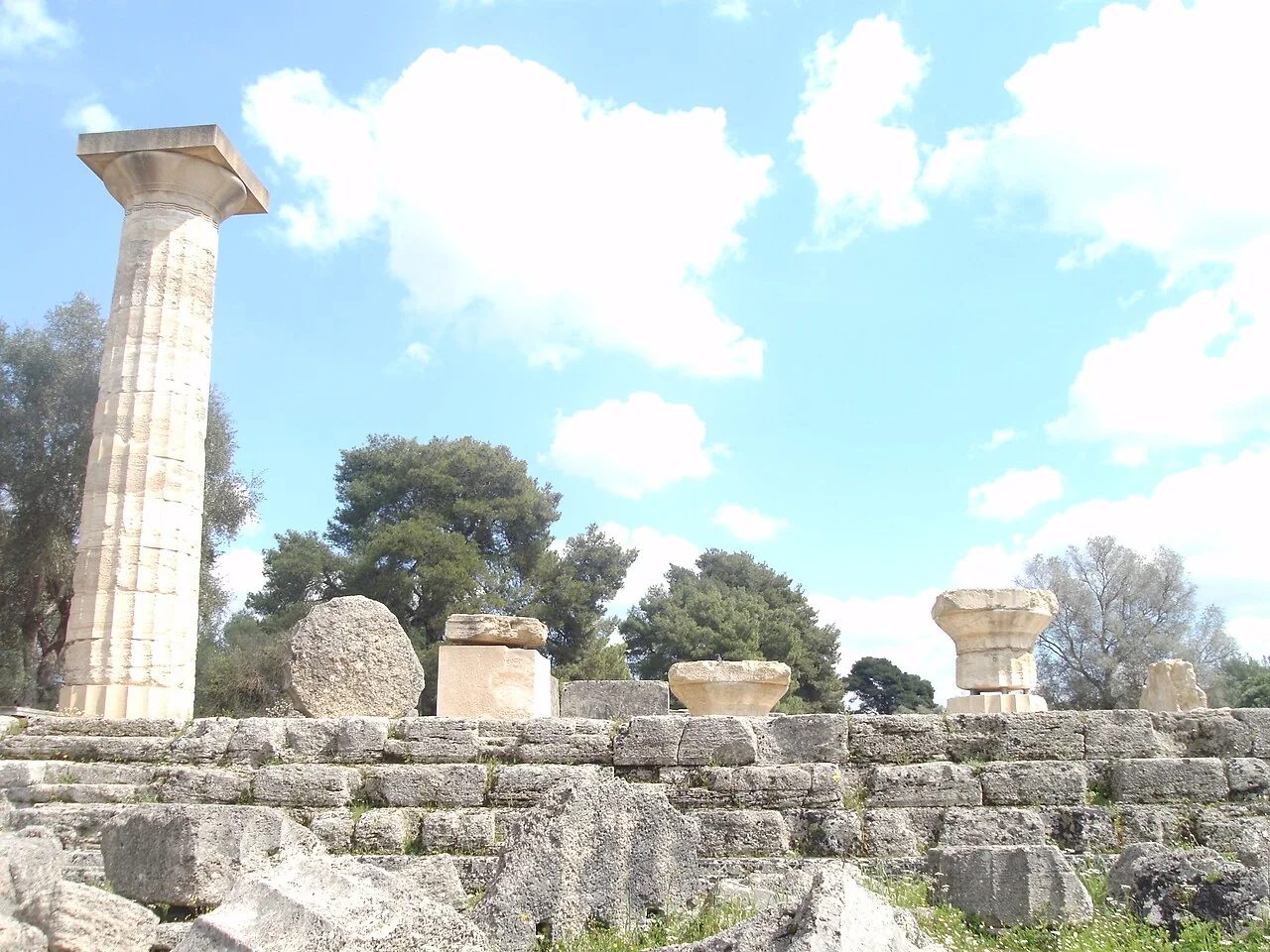
The first fire belongs to Olympia. In 426 CE the Altis, the sanctuary precinct around the temples, burned. John Younger and Paul Rehak describe that fire in their 2009 Hesperia study of the temple’s sculpture, and they note what followed: earthquakes in 522 and 551 completed the destruction of the temple, and the Alpheios river soon flooded the site, covering it with several meters of silt. Those events account for the ruins visible at Olympia today. They do not establish that the cult statue was still inside when the fire reached the sanctuary.
The second fire belongs to Constantinople. A tradition recorded by the Byzantine writer Cedrenus holds that the statue had been taken from Olympia and installed in the Palace of Lausus, an aristocratic collection of ancient art in the new capital, and that the palace burned in 475. Gisela Richter set that tradition against the alternative in her 1966 Hesperia article, where the other hypothesis had the Zeus destroyed at Olympia in the fire of 426. Younger and Rehak treat the transfer as probable, and point to evidence for the statue’s presence in the Palace of Lausus after 395.
The museum at Olympia opens its own account of all this by saying that the fate of the statue remains uncertain, then runs the story through to the fire without weighing the rival explanation. In its telling the figure was moved in the late fourth or early fifth century and installed in the palace of Lausus, an official serving under Theodosius II, before the building burned in 475 during the reign of Zeno. The archaeological literature is more guarded, and no record written at the time of the transport survives.
The two explanations side by side
Set out next to each other, the two candidates turn out to rest on different kinds of evidence and to be answered by different kinds of discovery.
| Question | Olympia fire | Constantinople transfer |
|---|---|---|
| Event | The Altis, the sanctuary precinct, burned in 426 CE | The Palace of Lausus, Constantinople, burned in 475 CE |
| Earliest support | Richter, Hesperia 35 (1966), recording a hypothesis she neither originates nor endorses | Cedrenus, discussed by Richter, Hesperia 35 (1966) |
| Evidence the statue was there | None that it was still there in 426 | A record of the statue in the palace after 395 |
| How the statue gets there | No move is required; it is already at Olympia | A transfer from Olympia, described only in later tradition |
| Modern standing | Richter sets it out as the alternative explanation | Younger and Rehak call it probable; the museum calls 475 its final fate |
| What would settle it | Excavated remains of the statue at Olympia | A contemporary record of the transfer, which no source supplies |
The table makes one asymmetry plain. Both accounts end in a fire in the fifth century CE, and neither rests on a record written while the events were happening. The difference is that one explains a fire in the sanctuary where the statue certainly stood, while the other explains a fire in a palace where the statue may have stood. Destruction at Olympia needs the statue to have stayed put; destruction in Constantinople needs it to have traveled, and the travel is the part recorded only by later writers.
What the evidence can and cannot settle
Excavation at Olympia has recovered the temple, its architectural sculpture and the workshop where the statue was made, but none of that identifies where the cult image itself ended up. The finds from the workshop date it and show how it was built; they say nothing about its last century.
That is why the question stays open. The Palace of Lausus burning in 475 is not proof that the Olympia statue was there, and the Altis burning in 426 is not proof that it was still there either. Both events can be placed on a timeline. The statue cannot be placed at either fire with certainty.
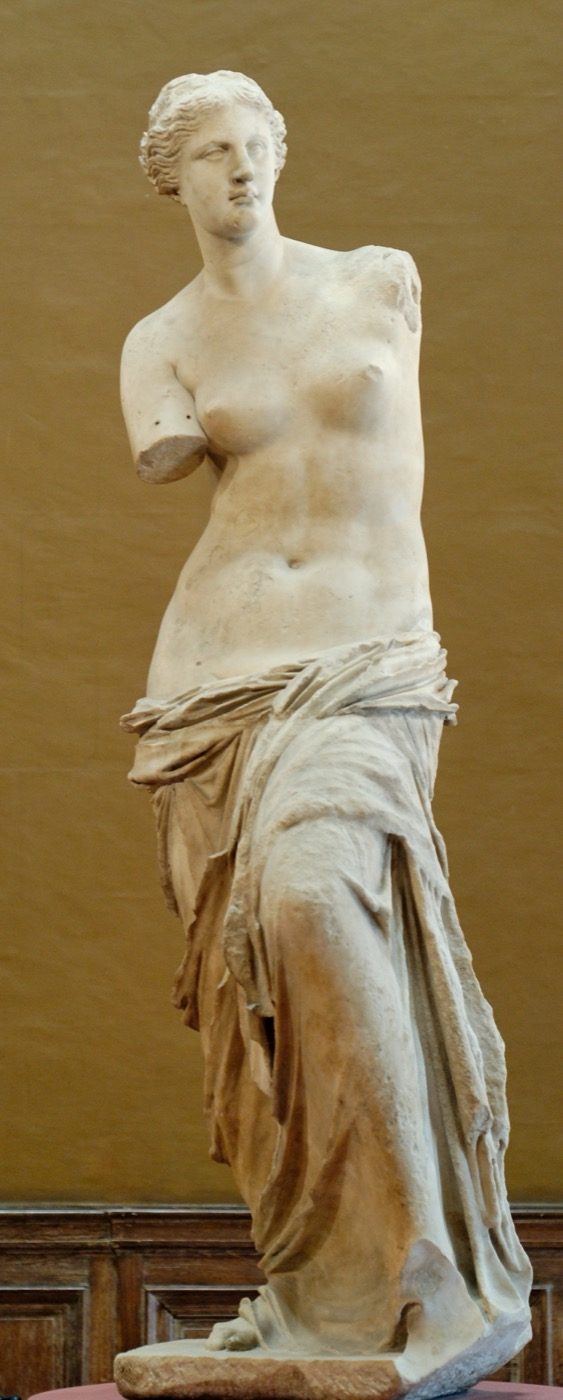
The shape of the problem is familiar from another famous Greek sculpture whose surviving physical evidence does not settle every question about its history: the Venus de Milo’s missing inscribed base. The two cases differ in their details, but each turns on what a missing object can and cannot prove. How this site sources a page, and what it does about dates and corrections, is set out on our method page. More on the site’s Sculpture topic page.
What the record preserves is a set of descriptions and a set of claims about what became of the object, not the object. The museum notes that the statue now survives in descriptions and in small reproductions on coins, and the passage in Pausanias is the fullest of those descriptions. Everything past that point, including where the figure ended up, has to be argued from texts written at some distance from the events they describe, which is why the two candidates are weighed rather than settled.
The careful answer is that the statue was still described at Olympia in the second century. Lucian, writing in the same century, joked about temple-robbers interfering with it, which shows a story in circulation but not a removal. Younger and Rehak consider a transfer to Constantinople probable, and the museum at Olympia treats the 475 fire as the end of it. Destruction at Olympia in 426 remains the alternative.
Coins that still show the pose
The cult statue is gone. What a museum can put in a tray is a coin. Berlin's Münzkabinett holds a bronze of Elis struck under Hadrian, accession 1876/324, catalogued as RPC III 321.2 and dated 135-136 CE. The cabinet's own label reads the reverse as enthroned Zeus Nikephoros to the left, "after the statue of Phidias." Oxford's Roman Provincial Coinage lists several Hadrianic issues of Elis, RPC III 299 to 302, with Zeus seated left, Nike in the extended right hand and the left hand on a sceptre. That arrangement matches Pausanias, who puts the Victory in the right hand and the sceptre in the left, and it does not match Lucian, who arms the statue with a thunderbolt in the right hand.
A coin is not a measurement of the lost statue, and the museum at Olympia already says the figure survives in descriptions and in small reproductions on coins. The Berlin piece is one of those reproductions with a collection number, a weight (10.75 g) and a diameter (24 mm), which is more than a sentence that says "coins exist." It still cannot say whether the statue burned at Olympia in 426 or in the Palace of Lausus in 475.