The one-word answer, then the name that matters
Who stole the Mona Lisa painting? Vincenzo Peruggia. UmberLore already counts incidents on how many times the Mona Lisa was stolen (once as a theft) and tests fame myths on the Mona Lisa page. This article is the identity brief: who he was, how he walked out, who the police wrongly chased, and what the 1913 recovery actually proved. Spellings vary in older English newspapers (Perugia vs Peruggia); modern references follow the Italian form Peruggia used in police and trial records.
Full civil name in Italian records is Pietro Vincenzo Antonio Peruggia. He was born on 8 October 1881 in Dumenza, a village in the Varese Alps near the Swiss border, to Celeste Rossi and Giacomo Peruggia. After moving to Paris around 1908 he worked as a decorator and glazier. For a short period that work included Louvre contracting: cleaning and reframing paintings, and building protective cases. Curators later listed him among workers who had handled the Mona Lisa's glass box, which meant he already knew how the frame assembly came apart. That prior access is the practical bridge between "handyman" and "thief," not a mastermind resume.
Peruggia was a former Louvre contractor who had helped with glass and cases for paintings, including work tied to the Mona Lisa's protective box. On the closed Monday of 21 August 1911 he entered in a worker's white smock, lifted the panel from the Salon Carre, stripped frame and case on a service stair, and left with help from a plumber who unlocked a door. The theft was not noticed until the next day.
How the Monday theft worked
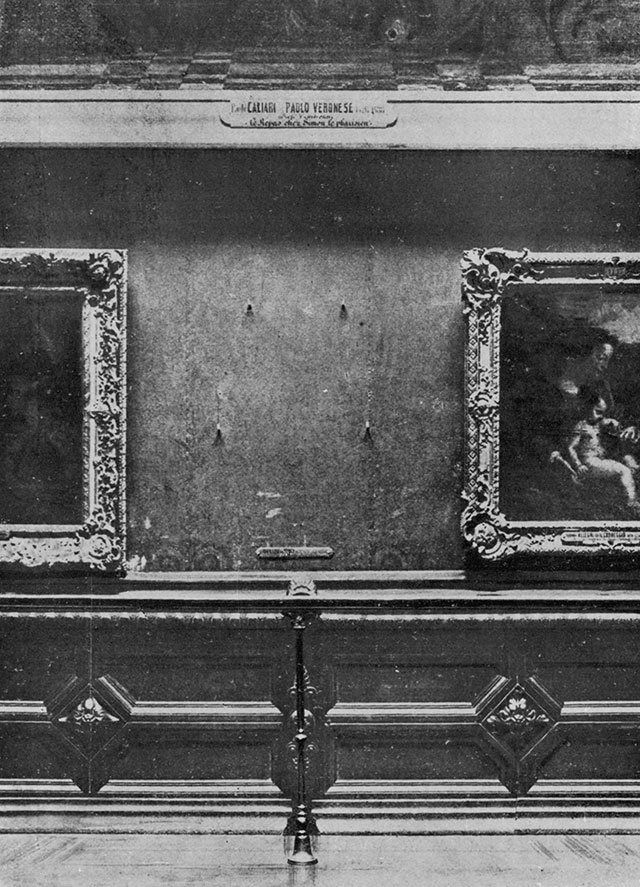
Louvre Mondays in that summer schedule were closed for maintenance, so the galleries were thin of visitors and thick of workers in white smocks. According to Peruggia's later Florence interrogation, he entered around 7 a.m. through the same door other workers used, dressed like staff, and waited until the Salon Carre was empty. The Mona Lisa hung between Correggio's Mystical Marriage and Titian's Allegory of Alfonso d'Avalos on four iron pegs. He lifted the panel off those pegs and carried it to a nearby service stair of the Sept Metres.
On the stair landing he stripped the protective case and frame, leaving the discarded pieces behind student works stored there. Popular retellings sometimes say he hid the wood panel under his smock. Panel size undercuts that cartoon: the painting is about 53 by 77 cm, and Peruggia stood about 160 cm tall. A short man cannot swallow a 77 cm panel under a smock. The workable exit path in the police and trial narrative is a service door unlocked by a plumber who mistook him for an employee. He then hid the panel in his Paris apartment.
Discovery lagged by a day. A painter arriving to copy the Mona Lisa found an empty wall; the museum director was on holiday and had joked that stealing the Mona Lisa would be like stealing the towers of Notre Dame. The arts minister had told staff not to call him unless the Louvre burned or La Joconde vanished. Both lines later became ironic newspaper copy. At least sixty policemen searched the museum. Early official confidence that the case would close in two or three days did not match the two-year hideout that followed.
What Peruggia said he wanted
In Florence he framed the crime as patriotic restitution: an Italian returning a masterpiece "stolen" from Italy. The court gave weight to that story and sentenced him lightly (about a year and fifteen days, reduced on appeal to roughly seven months). Letters home talking about fortune complicate a pure-patriot reading; he also tried and failed to interest London dealer Joseph Duveen.
He misunderstood the painting's path. Leonardo brought the work to France in the sixteenth century for Francis I, centuries before Napoleon. Napoleon did loot Italian collections in other cases, and Peruggia absorbed that broader grievance while working among Louvre staff stories. The Mona Lisa itself was not a Napoleonic prize. Patriotism may have been sincere, opportunistic, or both; it does not change the identity of the thief.
Money talk sits in the same file as the patriotism speech. A letter dated 22 December 1911 told his father that Paris was where he would make his fortune "in one shot." Another letter vowed that the family would enjoy a prize he was about to realize. Experts note that a pure patriot would more likely have handed the panel to an Italian museum than shopped it to dealers. The Duveen approach in London, where the dealer reportedly laughed him off, further undercuts a donation-only story. The Italian court still accepted patriotic motives as mitigating circumstances, and popular pressure plus a psychiatric assessment that painted him as simple helped compress the sentence on appeal.
Popular culture later cast him as everything from tragic patriot to comic bungler. After the arrest, Italian hero-worship cooled once the public saw a small-time decorator instead of a phantom genius. The Louvre ledger still only needs one name in the theft column.
How the Louvre lost him, then found the painting
Police fingerprinted staff and chased celebrities. Peruggia had a prior record and a thumbprint on the glass, yet investigators interviewed him without treating him as the prime suspect and missed the panel hidden in his Paris lodging. For more than two years the empty wall was a news machine. Rewards, false sightings, and passenger-ship searches filled columns while the panel sat in a Paris trunk. The missing label on the wall became its own tourist stop.
The investigative misses stack in plain sight. He had helped make the protective glass and was not on payroll at the robbery hour. Permanent staff fingerprints were taken; his were not cross-checked against police files even though Alphonse Bertillon's anthropometry system already held a 1909 mugshot of him. Officers visited his apartment twice. One detective even finished a report leaning on the table under which the panel sat in a cavity. Examining-judge orders to follow glazier leads were not pursued with the urgency the empty wall deserved.
Apollinaire and Picasso entered the story through a separate Louvre pilfering panic, not through any chain that put the Mona Lisa in their hands. Apollinaire was arrested and released; Picasso was questioned and released. Ocean-liner passengers were searched. New York police boarded another ship on a false trail. None of that theater produced the panel, because the panel was still in a Paris trunk under a decorator's table.
In December 1913 Peruggia contacted Florence dealer Alfredo Geri under a Leonardo-flavored alias (Leonardo V.). Geri's later account and Peruggia's account conflict on negotiation details, but both agree that Peruggia expected a reward for returning what he called Italy's painting. Geri called Uffizi director Giovanni Poggi, who authenticated the panel. They secured it and informed the police, who arrested Peruggia at his hotel on 12 December 1913. Crowds treated the recovery as a national event; The New York Times headlined Florentines sweeping police aside in a rush of tens of thousands to see the painting. After Italian exhibitions with banner headlines, the panel returned to the Louvre, with a well-photographed rehang around early January 1914.
Newspaper scale matters for cultural history, but it should not blur the roster. The thief was a small-time decorator with museum access, not a phantom genius and not the modernist painters caught in the dragnet. Fame of the painting rose with the missing-wall spectacle; that fame effect is a separate claim from the identity claim this page answers.
The Valfierno story and why it stays unproven
A later theory claims Argentine con man Eduardo de Valfierno (sometimes styled Marques de Valfierno) hired French forger Yves Chaudron to paint multiple Mona Lisa copies, then used Peruggia to steal the original so American collectors would buy the forgeries as the missing masterpiece. The entire chain rests on Karl Decker's 25 June 1932 Saturday Evening Post article, retold in the Post's 2013 centennial note. Decker said Valfierno confessed in a Casablanca bar in 1914 under a promise not to publish until after Valfierno's death.
The Saturday Evening Post itself now flags the tale as a famous maybe. Critics note that Valfierno claimed three men were needed because the framed assembly weighed nearly 220 pounds, while Louvre figures put the panel nearer 20 pounds, light enough for one man. The story invents a stolen key that fails an exit door until a helpful guard unlocks it; that beat does not appear in the investigation record. A 1911 New York paper had already floated a similar "steal original, sell copies" pitch attributed to thief Eddie Geurin, which undercuts originality. Outside Decker's prose there is little independent biography of Valfierno tied to this crime.
Until better evidence appears, this page treats Valfierno and Chaudron as an unproven narrative layer, not as co-thieves on the Louvre ledger. Peruggia's Florence arrest, Geri-Poggi authentication, and Italian trial remain the documented recovery chain. Wanting a mastermind does not create one in the archives.
What this page is not claiming
It is not claiming the Mona Lisa was obscure before 1911; the dedicated Mona Lisa article argues the fame timeline with guidebooks and copyists. It is not counting acid attacks, thrown rocks, or soup protests as additional thefts; those are attacks or protests against a work still owned by the museum.
It is not authenticating Karl Decker's 1932 Valfierno tale as fact. That Saturday Evening Post narrative is a famous maybe. Until better evidence appears, the documented thief remains Peruggia acting for himself.
Panel size and smock legends vary in popular retellings. Some reconstructions stress that a short thief could not hide a 77 cm panel under a smock and instead describe an exit through a service door after a plumber unlocked it. For legal identity, those stage details matter less than the arrest record and the Florence recovery chain. If you came here from a quiz show card that asks only for a name, write Vincenzo Peruggia and stop. If you came here from a conspiracy thread, demand primary police and trial evidence before adding masterminds.
Quick timeline
8 October 1881: Peruggia born in Dumenza, Italy. Around 1908: move to Paris and Louvre contracting as decorator and glazier, including work on protective cases. 1909: Bertillon mugshot enters police files after an earlier arrest. 21 August 1911: theft on a closed Monday from the Salon Carre; discovery the next day when a copyist finds the wall empty. Autumn 1911: Apollinaire and Picasso side drama; Peruggia interviewed but not charged; false ship searches and reward tips fill the press while the panel stays in a Paris trunk. Late 1913: Peruggia travels to Florence with the panel and contacts Alfredo Geri. 12 December 1913: Uffizi director Giovanni Poggi authenticates; police arrest Peruggia. Late December 1913 through early 1914: Italian exhibition crowds and headlines; panel returned to the Louvre (rehang celebrated around 4 January 1914). 1914 trial: about one year and fifteen days, reduced on appeal to roughly seven months. World War I: Italian army service, then Austrian captivity as a prisoner of war. Postwar: marriage to Annunciata Rossi, daughter Celestina, return to France as painter-decorator under the name Pietro Peruggia. 8 October 1925: dies of a heart attack in Saint-Maur-des-Fosses, France, on his 44th birthday; later cemetery relocation of remains is a local footnote, not part of the theft story.
The biographical spine is longer than a quiz card and shorter than a thriller novel on purpose. Public memory ballooned; the documented thief did not become a mastermind in the archives simply because headlines needed a larger villain.